(Relevant for Sociology Paper I: Social Change in Modern Society and Sociology Paper II: Rural and Agrarian Social Structure; Rural and Agrarian Transformation in India; Social Movements in Modern India)
The rural and agrarian transformation in India has been one of the most significant dimensions of social change in the post-independence era. From land reforms and the Green Revolution to rural-urban migration and the emergence of footloose labor, India’s countryside has undergone complex shifts driven by economic policies, technological interventions, and state-led development programs. These transformations have not only altered the agrarian economy but also reconfigured social relations, power structures, and patterns of inequality, particularly around caste, class, and land ownership.
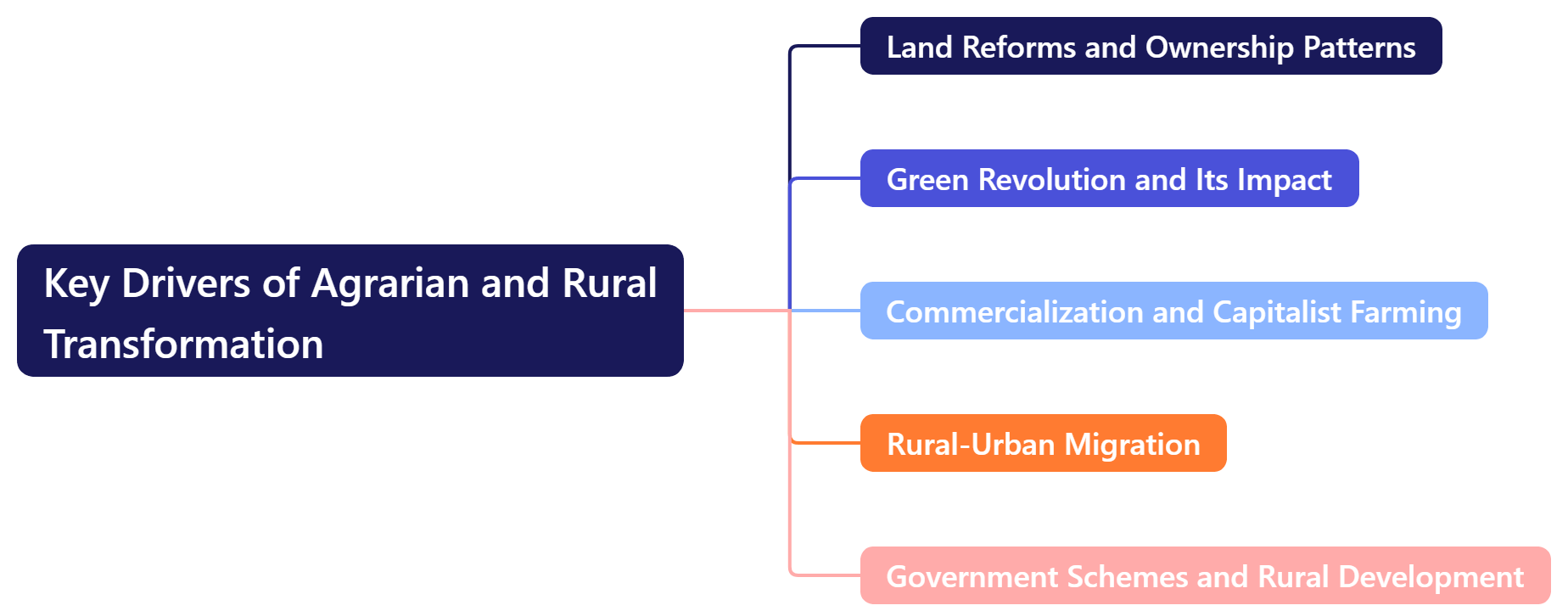
Key Drivers of Agrarian and Rural Transformation:
Land Reforms and Ownership Patterns: Post-independence India undertook land reforms to redistribute land through the abolition of zamindari, tenancy regulation, and land ceiling laws. However, these reforms were unevenly implemented, allowing large landowners to retain control through legal loopholes. As a result, land inequality persists, with caste and class hierarchies continuing to shape rural ownership structures.
Green Revolution and Its Impact: The Green Revolution brought high-yielding variety seeds, chemical fertilizers, and mechanization to Indian agriculture, primarily benefiting regions like Punjab and Haryana. While it boosted food production, it also led to regional inequalities, soil degradation, and rising input costs, contributing to a new phase of agrarian distress, particularly for small farmers.
Commercialization and Capitalist Farming: Agriculture in India has increasingly shifted from subsistence to commercial modes. With the rise of contract farming and corporate influence, farming has become profit-driven. However, marginal farmers, lacking bargaining power and capital, are pushed into debt traps and economic vulnerability, creating a dualistic rural economy.
Rural-Urban Migration: Due to unemployment and agrarian stress, many rural residents migrate to cities in search of work. This distress migration leads to the depopulation of villages, leaving behind the elderly and children, while creating overcrowded urban slums. Such migration is reshaping the demographic and social structure of rural India.
Government Schemes and Rural Development: Initiatives like MGNREGA, PM-KISAN, Digital India, and the Rurban Mission aim to improve rural livelihoods and infrastructure. These schemes have created employment opportunities, financial inclusion, and digital connectivity. However, implementation challenges, such as corruption and administrative delays, hinder their full impact on rural transformation.
Sociological Analysis:
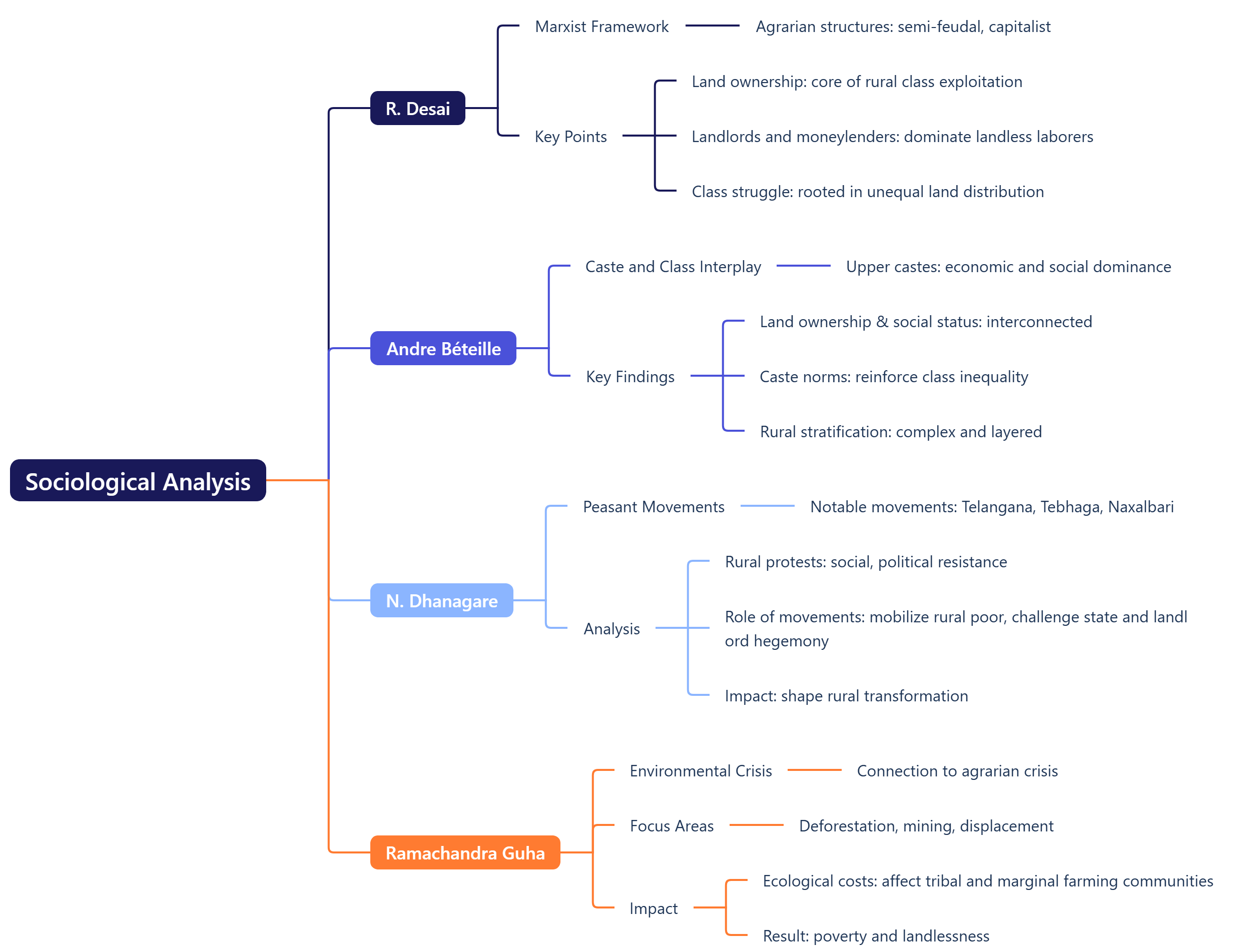
R. Desai used a Marxist framework to examine Indian agrarian structures, identifying them as semi-feudal and capitalist in nature. He argued that land ownership is the core of rural class exploitation, where landlords and moneylenders dominate landless laborers. Desai emphasized that class struggle, rooted in unequal land distribution, is central to understanding rural India’s socio-economic conflicts.
Andre Béteille explored the interplay between caste and class in rural Indian society. He demonstrated that land ownership and social status often go hand-in-hand, with upper castes dominating both the economic and social hierarchy. His village studies revealed how caste-based norms reinforce class inequality, making rural stratification a complex and layered phenomenon.
N. Dhanagare analyzed various peasant movements such as Telangana, Tebhaga, and Naxalbari to show that rural protests were not just economic reactions but social and political resistance against systemic exploitation. He argued that these movements played a crucial role in mobilizing the rural poor, challenging both state and landlord hegemony, and shaping the course of rural transformation.
Ramachandra Guha connected environmental degradation to the agrarian crisis by focusing on how deforestation, mining, and development-induced displacement disrupt rural livelihoods. He argued that the ecological costs of unchecked development disproportionately affect tribal and marginal farming communities, pushing them into poverty and landlessness.
Current Affairs
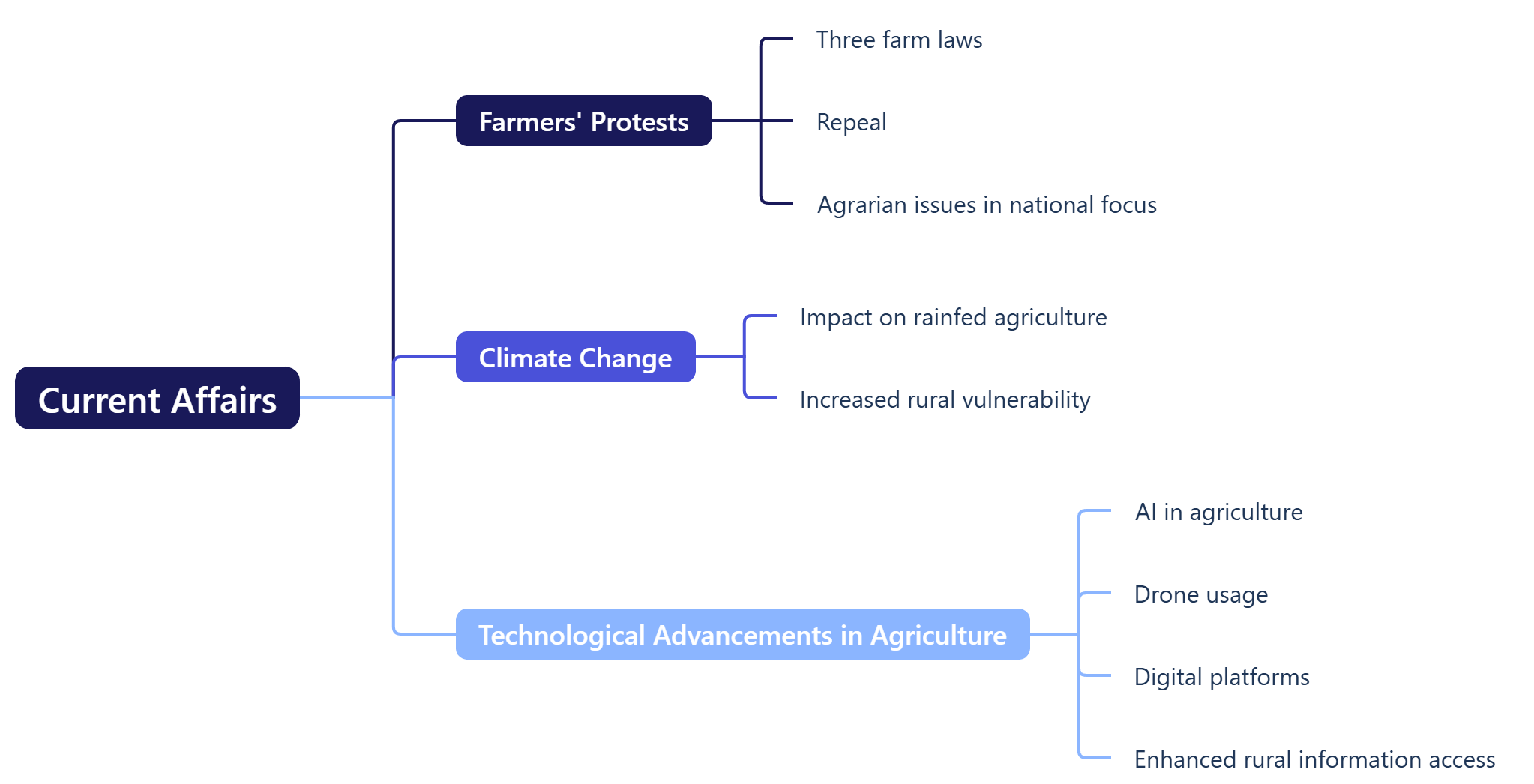
Farmers’ protests against the three farm laws and subsequent repeal brought agrarian issues into national focus.
Climate change is severely impacting rainfed agriculture and increasing rural vulnerability.
AI in agriculture, drone usage, and digital platforms are transforming rural information access.
Conclusion:
Rural and agrarian transformation in India is multi-dimensional, reflecting shifts in economy, technology, social relations, and politics. It is essential to critically analyze these changes through a sociological lens that combines historical depth, empirical data, and theoretical understanding.
PYQs
Paper 1 –
Discuss the relationship between land reforms and social stratification in India. (2014)
Discuss the nature and characteristics of peasant movements in India. (2015)
Discuss how environmental concerns are reshaping rural social structures. (2016)
Explain the impact of Green Revolution on agrarian class structure. (2016)
Examine the Marxist perspective on agrarian class structure in India with reference to A.R. Desai. (2017)
Explain how caste and class intersect in the context of rural India. (2018)
What are the key differences between peasant and worker movements? Illustrate with examples. (2019)
How do sociologists conceptualize rural transformation? Illustrate with examples. (2019)
Critically examine the concept of ‘footloose labour’ in the context of informal labor markets. (2020)
Explain the sociological significance of rural-urban migration in India. (2021)
Paper 2 –
Examine the role of caste in shaping agrarian relations in rural India. (2014)
What is the significance of land reforms in transforming rural society in India? (2015)
Examine the agrarian structure in India and its implications on social mobility. (2015)
Critically assess the impact of commercialization of agriculture on rural social structure. (2016)
Discuss the role of peasant movements in shaping rural society in post-independence India. (2017)
Discuss the impact of rural development programs like MGNREGA on labor dynamics in villages. (2018)
Explain the socio-environmental consequences of developmental projects in tribal and agrarian regions. (2019)
Analyze the contemporary relevance of A.R. Desai’s views on rural transformation. (2020)
Discuss the emergence of informal and precarious labor markets from rural India. (2020)
How does migration affect the socio-economic conditions of rural households in India? (2021)
To Read more topics like Rural and Agrarian Transformation in Indiain Public Posts, visit: www.triumphias.com/blogs









One comment