Maintaining the Balance of Power between Judiciary and Executive in India

Maintaining the Balance of Power between Judiciary and Executive in India

Maintaining the Balance of Power between Judiciary and Executive in India

(Relevant fort GS paper-2, Executive)

Introduction: Balance of Power between Judiciary and Executive in India

In a constitutional democracy like India, the separation of powers among the Legislature, Executive, and Judiciary is the cornerstone of governance. The Constitution of India enshrines this doctrine to ensure that no organ exceeds its jurisdiction. However, the line between judicial activism and executive overreach has increasingly blurred in recent years. Maintaining the delicate balance between the judiciary and the executive is essential to uphold democratic principles and safeguard citizens’ rights.

Constitutional Framework

India follows a parliamentary system where the executive (Council of Ministers headed by the Prime Minister) is drawn from and accountable to the legislature. The judiciary, headed by the Supreme Court, is independent and entrusted with interpreting the Constitution, safeguarding fundamental rights, and ensuring the rule of law.

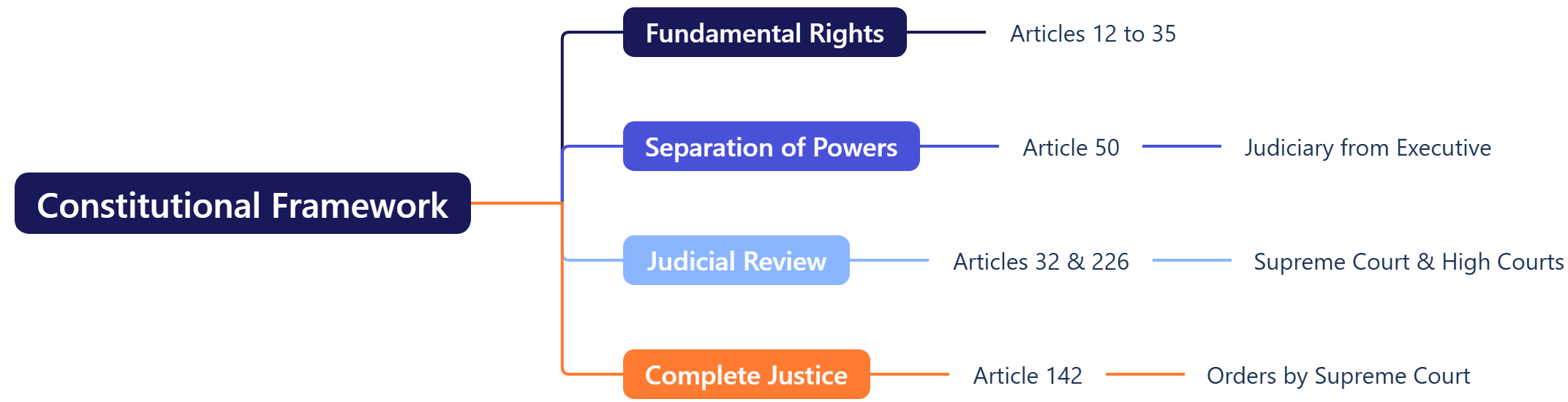
  • Articles 12 to 35: Fundamental Rights
  • Article 50: Separation of judiciary from executive
  • Articles 32 & 226: Judicial review powers of the Supreme Court and High Courts
  • Article 142: Allows Supreme Court to pass any order necessary to do “complete justice”

Evolution of the Balance

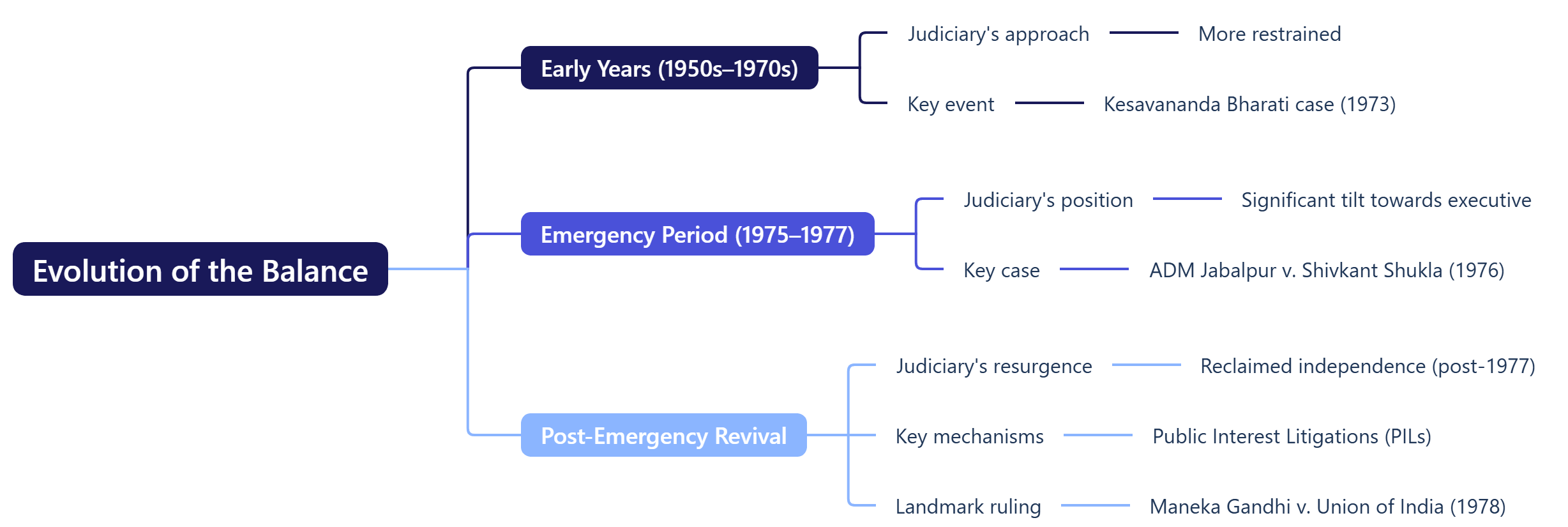
  1. Early Years (1950s–1970s)

Initially, the judiciary followed a more restrained approach. However, tensions rose post the Kesavananda Bharati case (1973), where the Basic Structure Doctrine was laid down, limiting the powers of Parliament to amend the Constitution.

  1. Emergency Period (1975–1977)

This period marked a significant tilt in favor of the executive. In ADM Jabalpur v. Shivkant Shukla (1976), the Supreme Court held that right to life could be suspended during Emergency — a widely criticized verdict that reflected executive dominance.

  1. Post-Emergency Revival

The judiciary reclaimed its independence post-1977 through Public Interest Litigations (PILs) and landmark rulings like Maneka Gandhi v. Union of India (1978), expanding the interpretation of Article 21 (Right to Life).

Contemporary Tensions and Examples

  1. Judicial Activism vs Judicial Overreach

While the judiciary is empowered to check executive excesses, frequent interventions in administrative and policy matters often lead to accusations of overreach.

  • Example: The Supreme Court banning firecrackers to curb air pollution was seen by some as encroaching on executive policy.
  • Farm Laws (2021): The Supreme Court stayed implementation of central laws — a move some experts argued was judicial overstep, as law-making falls under Parliament.
  1. Executive Overreach

There have been instances where the executive has tried to limit judicial independence:

  • NJAC Case (2015): The 99th Constitutional Amendment sought to replace the collegium system for judicial appointments with the National Judicial Appointments Commission (NJAC).
    • Supreme Court struck it down citing that judicial independence is part of the basic structure.
    • This intensified the debate over who should have the final say in judges’ appointments.
  • Delays in Collegium Recommendations: The executive often delays or selectively approves judicial appointments recommended by the Collegium — causing vacancies and court backlogs.

Recent Developments (2023–2024)

  • Row over judicial appointments: As of early 2024, over 30% of High Court posts remain vacant, largely due to delayed action by the executive on Collegium recommendations.
  • Supreme Court’s Stand: The court has reprimanded the Centre several times for sitting on appointments, calling it “disturbing” and “against judicial independence.”
  • High-Profile PILs: Judiciary continues to intervene in governance issues — from COVID-19 management to environmental regulations and demonetisation-related cases.

Importance of Balance

A functional democracy demands that neither the judiciary becomes the super-executive, nor the executive becomes autocratic. Some key reasons why balance is essential:

  • Checks and Balances: Prevents concentration of power
  • Protects Rights: Judiciary acts as the guardian of fundamental rights
  • Promotes Good Governance: Executive ensures implementation while judiciary provides oversight
  • Ensures Rule of Law: Prevents arbitrary use of state power

Way Forward

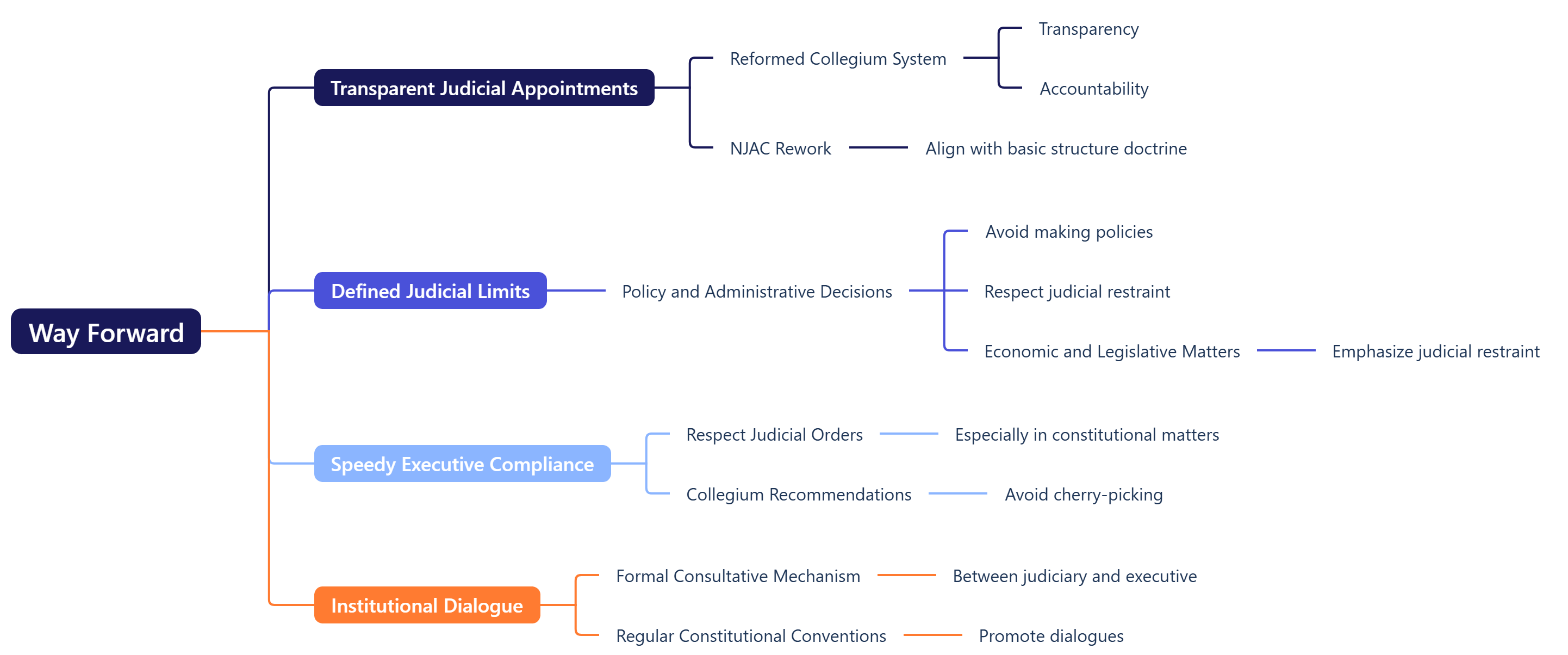
  1. Transparent Judicial Appointments
  • Implement a reformed collegium system with transparency and accountability
  • Consider reworking NJAC to align with basic structure doctrine
  1. Defined Judicial Limits
  • Judiciary must avoid making policies or administrative decisions
  • Respect the principle of judicial restraint, especially in economic and legislative matters
  1. Speedy Executive Compliance
  • The executive must respect judicial orders, especially in constitutional matters
  • Avoid cherry-picking Collegium recommendations
  1. Institutional Dialogue
  • Create a formal consultative mechanism between the judiciary and executive to resolve issues
  • Promote regular constitutional conventions and dialogues

Global Comparison

  • In the USA, judicial appointments are made by the executive but approved by the Senate — balancing powers.
  • In the UK, the Judicial Appointments Commission is independent, ensuring transparency and minimal political interference.

India must evolve its model to ensure efficiency and independence while maintaining accountability.

Conclusion

The judiciary and the executive are co-equal branches of the state, not rivals. While the judiciary must act as the constitutional conscience, the executive is responsible for governance and policy implementation. Strengthening their mutual respect and cooperation is essential for preserving the democratic fabric of India. A well-maintained balance not only upholds the spirit of the Constitution but also reinforces public trust in the Indian democracy.

To Read more topicsvisit: www.triumphias.com/blogs

Read more Blogs:

OBC Data and Reservation Policy in India

Rural and Agrarian Transformation in India

2 comments

Leave a Reply

Your email address will not be published. Required fields are marked *