(Relevant for Sociology Paper I – Social stratification and mobility (caste, class, status);Politics and Societyand SociologyPaper II: Politics and Society;Social Movements in Modern India)
In India, reservation policy is a tool for affirmative action, aiming to rectify historical injustices and socio-economic exclusion based on caste. The Other Backward Classes (OBCs) constitute a significant portion of India’s population, yet the absence of updated, reliable OBC population data has weakened the scientific implementation of caste-based reservations. With rising demands for a nationwide caste census, debates have intensified around data-driven policy, equity, and social justice.
Background:
Mandal Commission (1979): Recommended 27% reservation for OBCs in government jobs and educational institutions, identifying social and educational backwardness through surveys and indicators.
Supreme Court Verdict (Indra Sawhney, 1992): Upheld Mandal recommendations but capped total reservation at 50%, and introduced the concept of the creamy layer, excluding the economically advanced among OBCs from benefits.
Recent Developments: In 2021, the Supreme Court upheld the 27% OBC reservation in All India Quota (AIQ) for medical admissions. The need for updated OBC data has been echoed in debates around reservation efficacy and fairness.
Sociological Analysis
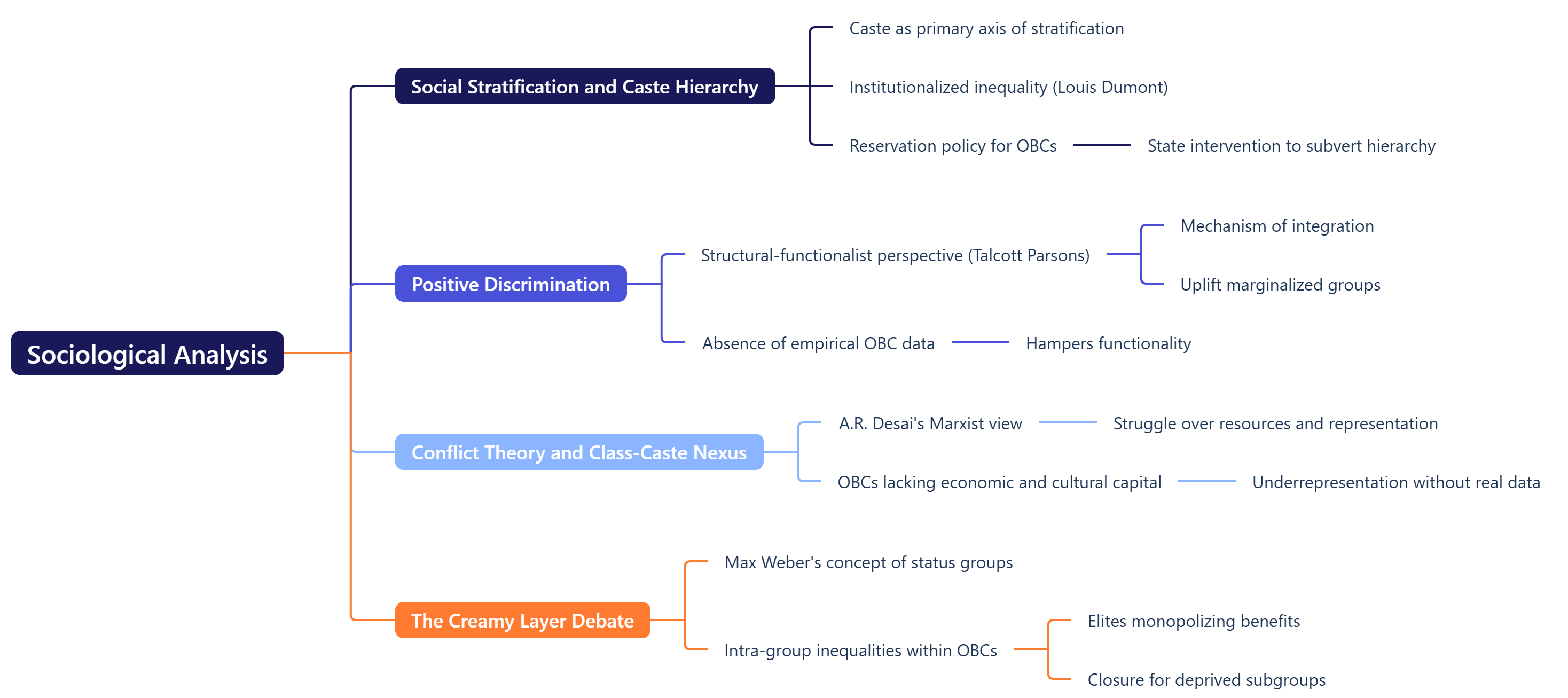
Social Stratification and Caste Hierarchy: Caste continues to function as a primary axis of social stratification in India. Louis Dumont argued in Homo Hierarchicus that caste is a system of institutionalized inequality. The reservation policy for OBCs attempts to subvert this hierarchy through state intervention.
Positive Discrimination: From a structural-functionalist perspective (e.g., Talcott Parsons), reservation is a mechanism of integration, aiming to uplift marginalized groups into mainstream institutions. However, the absence of empirical OBC data hampers its functionality.
Conflict Theory and Class-Caste Nexus: A.R. Desai, using a Marxist lens, viewed reservations as a struggle between dominant castes and oppressed classes over resources and representation. OBCs, lacking economic and cultural capital, remain underrepresented unless state policies are informed by real data.
The Creamy Layer Debate: Max Weber introduced the idea of status groups and social closure. The debate around the “creamy layer” reflects intra-group inequalities within OBCs, where elites monopolize benefits, causing closure for more deprived subgroups.
Why Caste Census is Critical for OBC Reservation
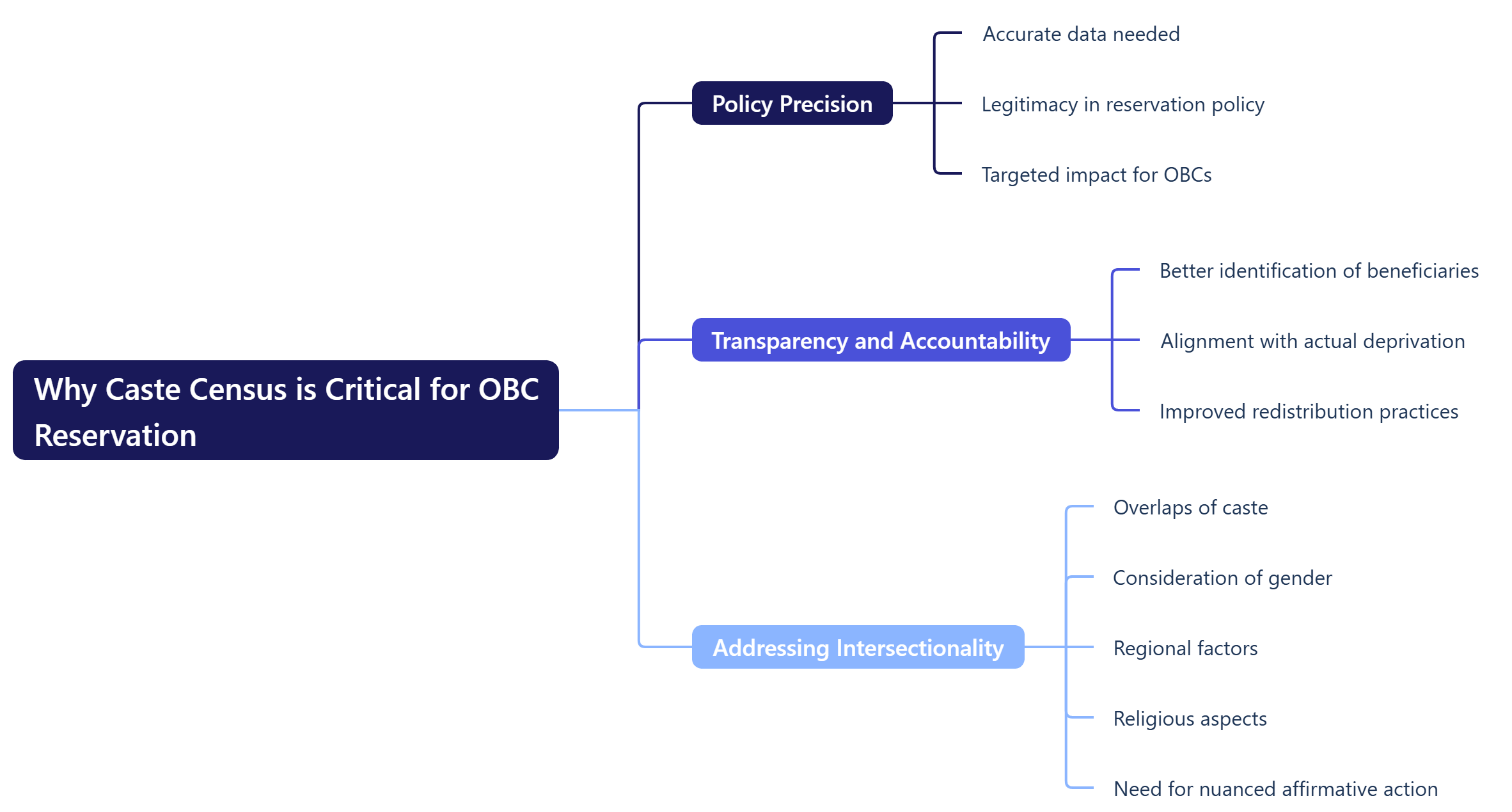
Policy Precision: Without accurate data, the reservation policy for OBCs lacks legitimacy and targeted impact.
Transparency and Accountability: It enables better identification of beneficiaries and ensures redistribution aligns with actual deprivation.
Addressing Intersectionality: Understanding overlaps of caste, gender, region, and religion is essential for nuanced affirmative action.
Recent Demands
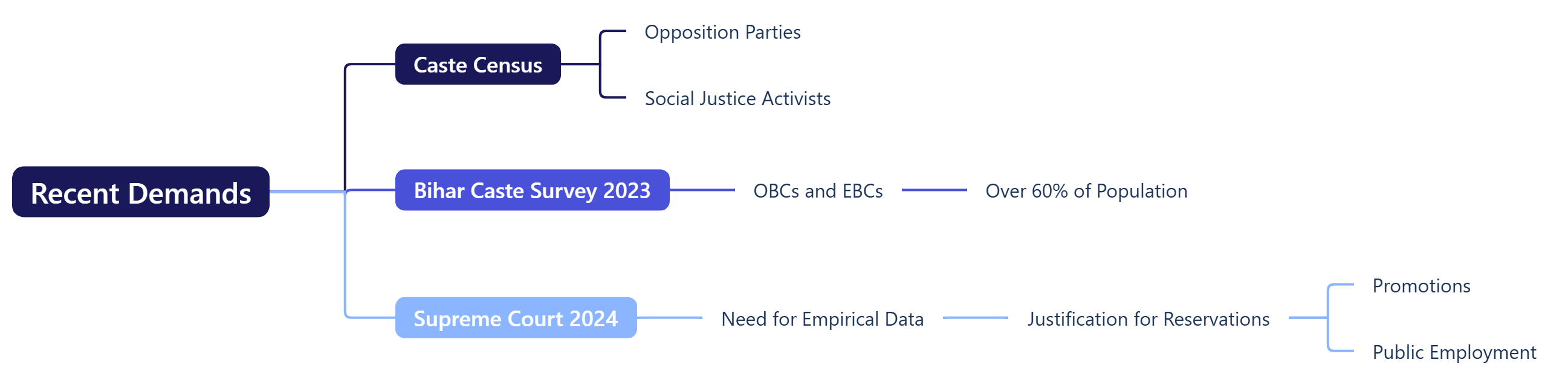
Opposition Parties and social justice activists have demanded a caste census to inform welfare schemes and reservations.
The Bihar Caste Survey 2023 reignited national discussions by revealing that OBCs and EBCs form over 60% of the state’s population.
The Supreme Court in 2024 emphasized the need for empirical data to justify reservations in promotions and public employment.
Challenges
Absence of disaggregated data in the 2011 Socio-Economic and Caste Census (SECC)
Creamy layer misapplication and inconsistencies across states
Political resistance to full transparency over caste numbers
Conclusion:
The future of India’s reservation policy hinges on empirical, caste-wise data, particularly for OBCs. Accurate and updated OBC population data would bridge the gap between constitutional ideals of equality and ground realities of caste-based exclusion. As India aspires for inclusive development, the demand for a caste census is not just political — it is sociological, demanding evidence-based justice.
PYQs
Paper 1
What is the sociological significance of caste in modern society? Has the caste system weakened or transformed? (2014)
What is social mobility? Discuss the relationship between caste and social mobility in Indian society. (2015)
Analyze the relevance of Weber’s concept of ‘status group’ in understanding caste dynamics in modern India. (2016)
How do functionalist and conflict perspectives explain the role of reservation policies in India? (2017)
Critically examine the concept of social stratification. How does caste-based stratification differ from class-based stratification? (2018)
Examine the emergence of backward class movements and their impact on social structure in India. (2019)
Distinguish between the ideas of ‘positive discrimination’ and ‘preferential treatment’ in the context of social justice. (2020)
Explain the concept of equality of opportunity. To what extent is it achieved through reservation policies in India? (2021)
Discuss the role of affirmative action in addressing social inequality. How far has it succeeded in the Indian context? (2022)
Discuss the nature of caste as a form of social inequality. What are the sociological explanations for its persistence? (2023)
Paper 2
What are the sociological implications of state-driven classification of castes as ‘backward’ or ‘forward’? (2014)
Evaluate the challenges in implementing reservation policies in higher education institutions. (2015)
To what extent have reservations helped in the empowerment of OBCs and SC/STs in Indian society? Give examples. (2016)
Assess the impact of social movements by backward classes on Indian social structure. (2017)
Critically discuss the role of the state in addressing caste-based inequalities through affirmative action. (2018)
Critically examine the impact of the Mandal Commission Report on Indian politics and society. (2019)
Explain the changing patterns of caste-based political mobilization and their implications for democracy. (2020)
Analyze the socio-political consequences of the creamy layer concept within OBC reservations. (2021)
Discuss how caste has influenced public policies related to employment and education in post-independence India. (2022)
Discuss the implications of the absence of nationwide caste census data for the implementation of social justice policies in India. (2023)
To Read more topics like OBC Data and Reservation Policy in India in Indiain Public Posts, visit: www.triumphias.com/blogs







One comment