


Middle-Class Women
(Relevant for Sociology Paper II: Social Classes in India)
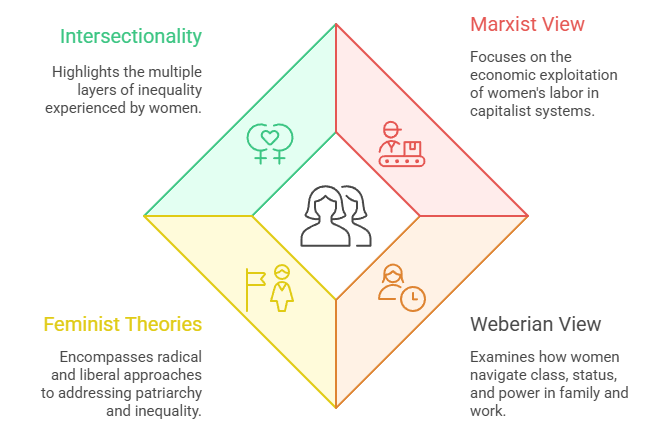
IntroductionThe story of middle-class women is the story of India’s transition itself. They stand between two worlds—one rooted in patriarchy and tradition, and the other aspiring toward equality, modernity, and freedom. Their lives reflect both the continuity of social structures and the contradictions of social change. From education and employment to family roles and cultural expectations, middle-class women navigate challenges and opportunities that reveal how gender, class, caste, and modernity intersect in Indian society. Understanding their experiences helps us see how social stratification works and why women’s agency is both constrained and evolving. Who Are Middle-Class Women?The term middle class itself is contested. Economically, it includes salaried professionals, small entrepreneurs, and families with stable income and educational access. But sociologically, the middle class is also defined by status aspirations, lifestyle choices, cultural values, and networks of social capital. For women in this group, education and exposure often provide opportunities unavailable to rural or working-class women. Yet, patriarchal family structures still shape their choices—whether in career, marriage, or motherhood. Karl Marx would see middle-class women as caught in the contradictions of capitalism—drawn into paid labor but still responsible for unpaid domestic work. Max Weber would highlight their “status anxiety”—balancing prestige, respectability, and modern aspirations. Sociological Analysis
The experiences of middle-class women illustrate how gender intersects with class, caste, and modernity.
Key Dimensions of Middle-Class Women’s Lives
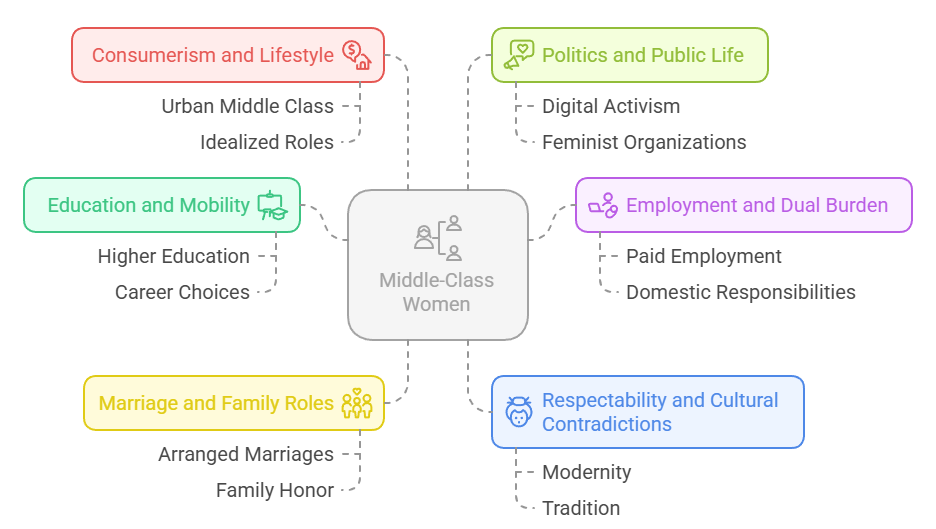
Education has been the greatest driver of mobility for middle-class women. Higher education, especially in fields like medicine, teaching, IT, and banking, has enabled many to join the formal workforce. But education does not always translate into freedom. Families may still expect women to prioritize marriage over career, or restrict their job choices to “respectable” professions.
Middle-class women increasingly participate in paid employment. Yet they face the dual burden—balancing professional roles with domestic responsibilities. Even when they earn, housework and childcare often remain their “duty.” This demonstrates the resilience of patriarchy in middle-class households. While women contribute financially, men rarely share domestic labor equally. The result is “time poverty” for women, where professional ambitions clash with cultural expectations.
Marriage remains a central institution in the lives of middle-class women. Despite rising education, arranged marriages continue, often mediated by caste and class networks. Intercaste and interreligious marriages are still rare in the middle class compared to love marriages among elites. Women are also expected to uphold the family’s honor, values, and traditions. Here, Louis Dumont’s theory of hierarchy and purity can explain how gender roles are tied to cultural norms.
Middle-class women live within the politics of “respectability.” They are encouraged to be modern—educated, fashionable, tech-savvy—but also traditional, modest, and family-oriented. This contradiction reflects the tension between modernity and tradition. M.N. Srinivas’s concept of Sanskritization is relevant here. Families may adopt modern lifestyles while still clinging to caste norms and patriarchal structures.
The rise of the urban middle class has reshaped consumption. Middle-class women are central consumers of fashion, beauty, digital technology, and household goods. This reflects Bauman’s idea of liquid consumerism—where identity is increasingly shaped by lifestyle and consumption choices. At the same time, consumerism pressures women into idealized roles—perfect professionals, perfect mothers, perfect homemakers—fueling stress and insecurity.
The middle class often drives social movements, and women are not absent from this sphere. From digital activism on women’s rights to participation in student protests, environmental campaigns, and feminist organizations, middle-class women are increasingly visible in the public sphere. Yet, representation in formal politics remains limited, reflecting ongoing structural barriers. Current Relevance
ConclusionMiddle-class women embody the contradictions of modern India. They are educated, ambitious, and aspirational, yet often restrained by patriarchal expectations. Their struggles with the dual burden, their negotiation of respectability, and their embrace of consumerism and digital life reflect the paradoxes of Indian society in transition. Studying their role connects sociology theory with real-world dynamics. It highlights how class, gender, and culture intersect, making middle-class women a vital lens to understand both social continuity and social change in India. PYQsPaper I –
Paper II –
|



To Read more topics, visit: www.triumphias.com/blogs
Read more Blogs:
One comment