The Fourth Industrial Revolution (4IR), often called Industry 4.0, is transforming how societies produce, consume, and interact. Unlike earlier industrial revolutions driven by steam, electricity, or digital electronics, this phase is marked by a fusion of technologies like Artificial Intelligence (AI), Big Data, Internet of Things (IoT), Robotics, 3D Printing, and Biotechnology. The 4IR is not just about machines—it is about social change, inequality, urbanisation, and governance.
Fourth Industrial Revolution
The hallmark of 4IR is the blurring of physical, digital, and biological systems. Examples include:
Second Industrial Revolution (19th century) – Electricity, steel, mass production.
Third Industrial Revolution (20th century) – Digital revolution: computers, internet.
Fourth Industrial Revolution (21st century) – Integration of AI + data + biotechnology + automation.
Each stage of industrialisation restructured work organisation, class relations, and urban landscapes. 4IR continues this historical trajectory but at a much faster pace.
Sociological Analysis
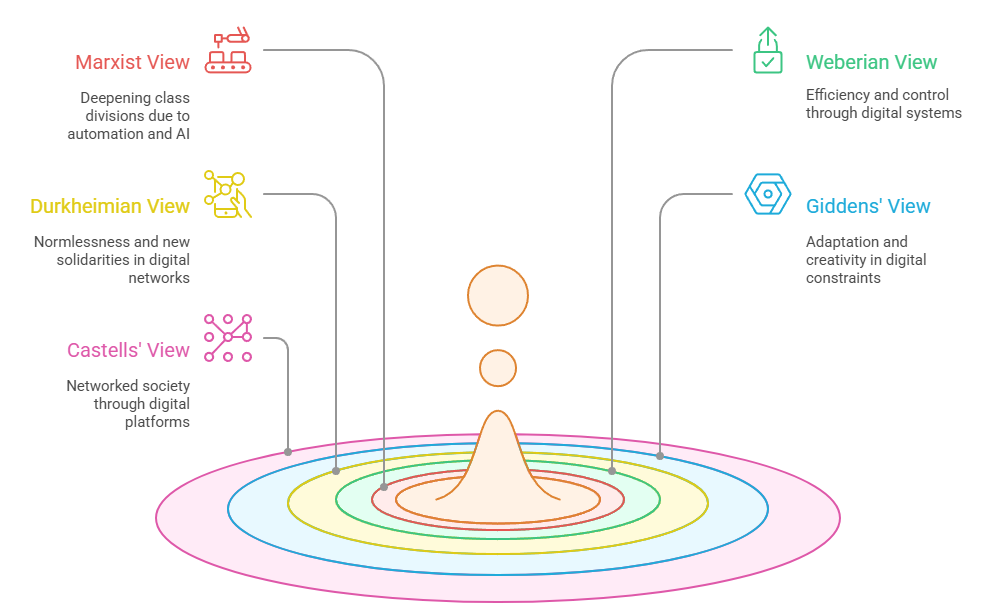
Marxist Perspective – Marx would view 4IR as deepening class divisions. Automation and AI displace workers, concentrating wealth in the hands of tech elites. Gig workers face insecurity and alienation as they are reduced to algorithm-driven labour without control over production.
Weberian Perspective: Weber’s idea of rationalisation is visible in the spread of algorithmic authority and automated decision-making. Bureaucracy is replaced by digital systems, creating efficiency but also a “digital cage” where individuals are constantly monitored.
Durkheim’s Perspective – Solidarity and Anomie: Durkheim would highlight how old occupational roles collapse, leading to normlessness (anomie). At the same time, new solidarities emerge through digital networks, online activism, and global professional communities, reshaping collective life.
Giddens’ Structuration and Reflexivity: Giddens reminds us that individuals both shape and are shaped by structures. In 4IR, people adapt to digital constraints but also use technology creatively. Reflexivity increases as societies constantly adjust to risks like AI ethics and data misuse.
Castells’ Network Society: Castells explains 4IR through the concept of a network society. Social, economic, and political life is now organised through digital networks—whether in gig platforms, online education, or political mobilisation via social media.
Impacts of 4IR on Indian Society
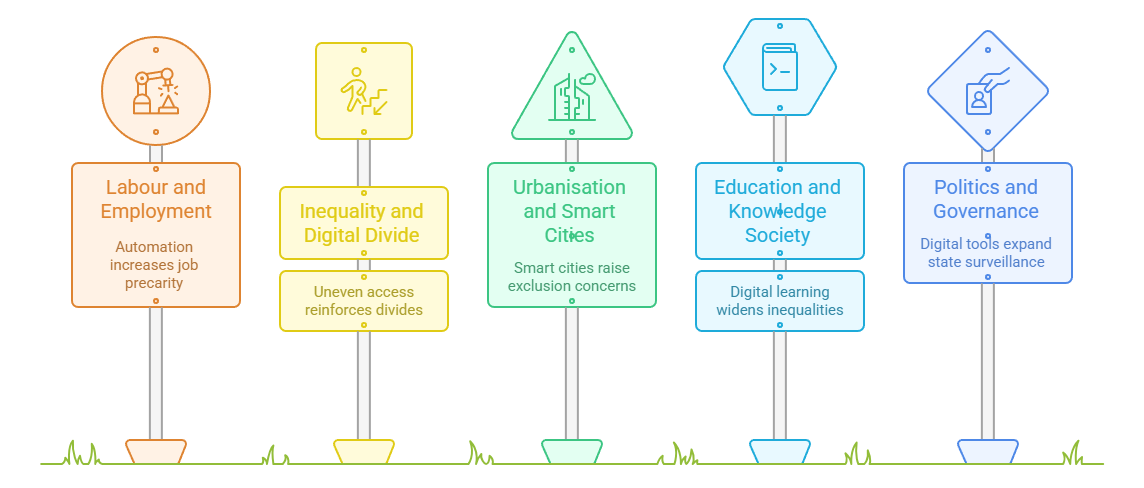
Labour and Employment: Automation and digital platforms are restructuring work. While high-skilled IT jobs grow, routine jobs decline. Gig work in India (Ola, Zomato, Swiggy) expands, but workers face precarity and lack of social security.
Inequality and Digital Divide: The benefits of 4IR are unevenly distributed. Rural areas and marginalised groups lack digital access, reinforcing caste, class, and gender divides. Women especially face barriers in digital literacy and online participation.
Urbanisation and Smart Cities: The Smart Cities Mission applies IoT and AI for governance, transport, and surveillance. While promising efficiency, it rises concerns about exclusion of slum dwellers, displacement, and privacy violations in urban spaces.
Education and Knowledge Society: Digital learning and NEP 2020 reforms push India towards a knowledge society. But unequal access to devices and internet widens educational inequalities between urban and rural students, creating a new digital class divide.
Politics and Governance: Digital India, Aadhaar, and e-governance enhance service delivery but also expand state surveillance. Political campaigns increasingly depend on data analytics and social media, reshaping the nature of democracy and citizenship in India.
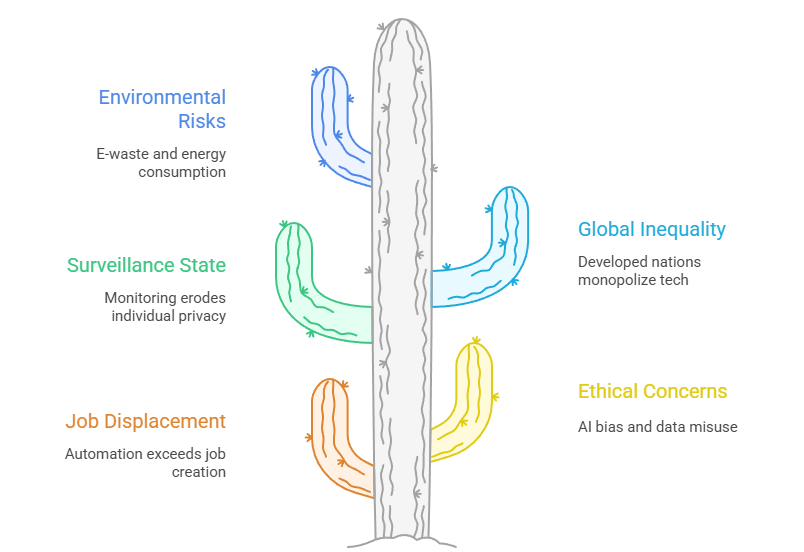
Challenges of the Fourth Industrial Revolution
Job Displacement: Routine jobs vanish faster than new ones emerge.
Ethical Concerns: Bias in AI, misuse of personal data, and algorithmic discrimination.
Surveillance State: Overdependence on monitoring erodes privacy rights.
Global Inequality: Developed countries dominate AI and biotech patents.
Environmental Risks: E-waste, energy consumption of data centers, and ecological strain.
Opportunities of the Fourth Industrial Revolution
Productivity Gains: Automation boosts efficiency in manufacturing and services.
Healthcare Transformation: AI diagnostics, personalised medicine, and biotech innovation.
Agriculture: Smart irrigation, precision farming, and drone-based monitoring.
Social Empowerment: Digital platforms give voice to marginalised groups.
Sustainable Development: Green technologies powered by 4IR tools support climate goals.
Conclusion
The Fourth Industrial Revolution is not just a technological wave—it is a sociological revolution. It affects how we work, live, interact, and imagine the future. For India, it presents both an opportunity to leapfrog in development and a risk of widening inequalities.
The question is not whether the Fourth Industrial Revolution will change society—it already has. The challenge is whether we can steer this transformation towards inclusivity, equity, and human dignity.
PYQs
Paper‑2:
“Discuss the changing nature of the problems of working class in the informal sector of the economy.” 2016
“Examine the impact of industrialisation and urbanisation on family structure.”2016
“Evaluate the impact of industrialization on family and kinship structures in capitalist societies.” 2019:
“Discuss the concept of alienation as developed by Karl Marx. How is alienation manifested in industrial capitalist societies?” 2020






2 comments