Media in Times of War: Propaganda, Misinformation, and Social Perception | Sociology Optional Coaching | Vikash Ranjan Classes | Triumph IAS | UPSC Sociology Optional
In the fog of war, truth becomes one of the first casualties. The media—often seen as the fourth pillar of democracy—can turn into a powerful weapon of psychological warfare. From World Wars to modern conflicts like Ukraine-Russia or Israel-Gaza, the mediahas been used to amplify propaganda, circulate misinformation, and influence public perception. With the rise of social media and 24×7 news cycles, this influence has multiplied, affecting not only national sentiment but global political narratives.
The Role of Media in Wartime:
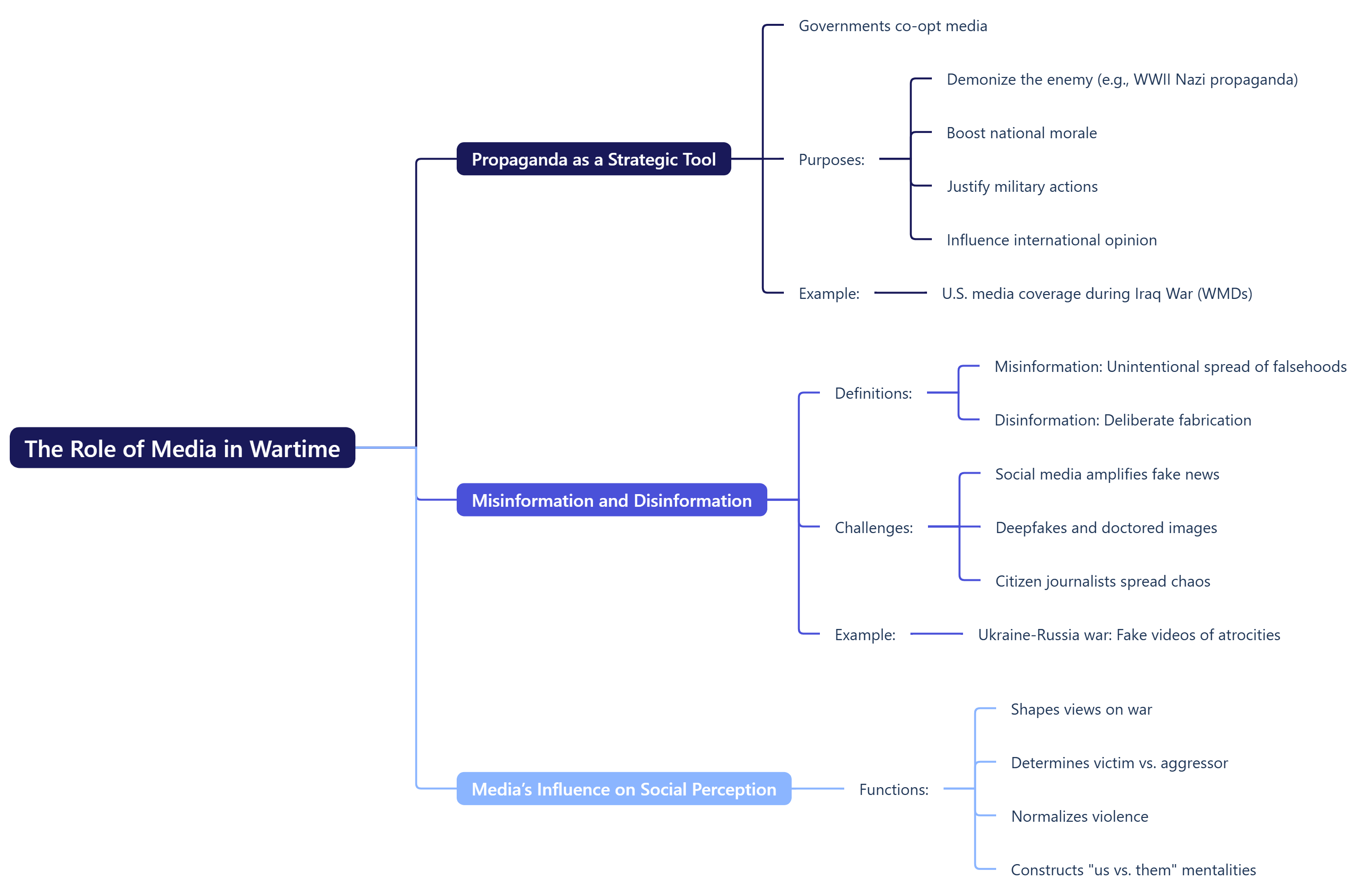
Propaganda as a Strategic Tool: Media is often co-opted by governments to craft pro-national narratives. During war, it helps:
Demonize the enemy (e.g., Nazi propaganda in WWII)
Boost national morale
Justify military actions
Influence international opinion
Example: The U.S. media coverage during the Iraq War portrayed weapons of mass destruction (WMDs) to gain public approval for military action—later proven false.
Misinformation and Disinformation: Misinformation is unintentional spread of falsehoods, while disinformation is deliberate fabrication. In times of war:
Social media algorithms amplify fake news
Deepfakes and doctored images circulate widely
Citizen journalists and unverified sources contribute to chaos
Example: During the Ukraine-Russia war, both sides circulated fake videos of enemy atrocities, confusing global audiences and fuelling polarized narratives.
Media’s Influence on Social Perception: Media doesn’t just report war—it shapes how society sees war:
Determines “who is the victim” and “who is the aggressor”
Normalizes violence and desensitizes the public
Constructs “us vs them” mentalities
Sociological Analysis:
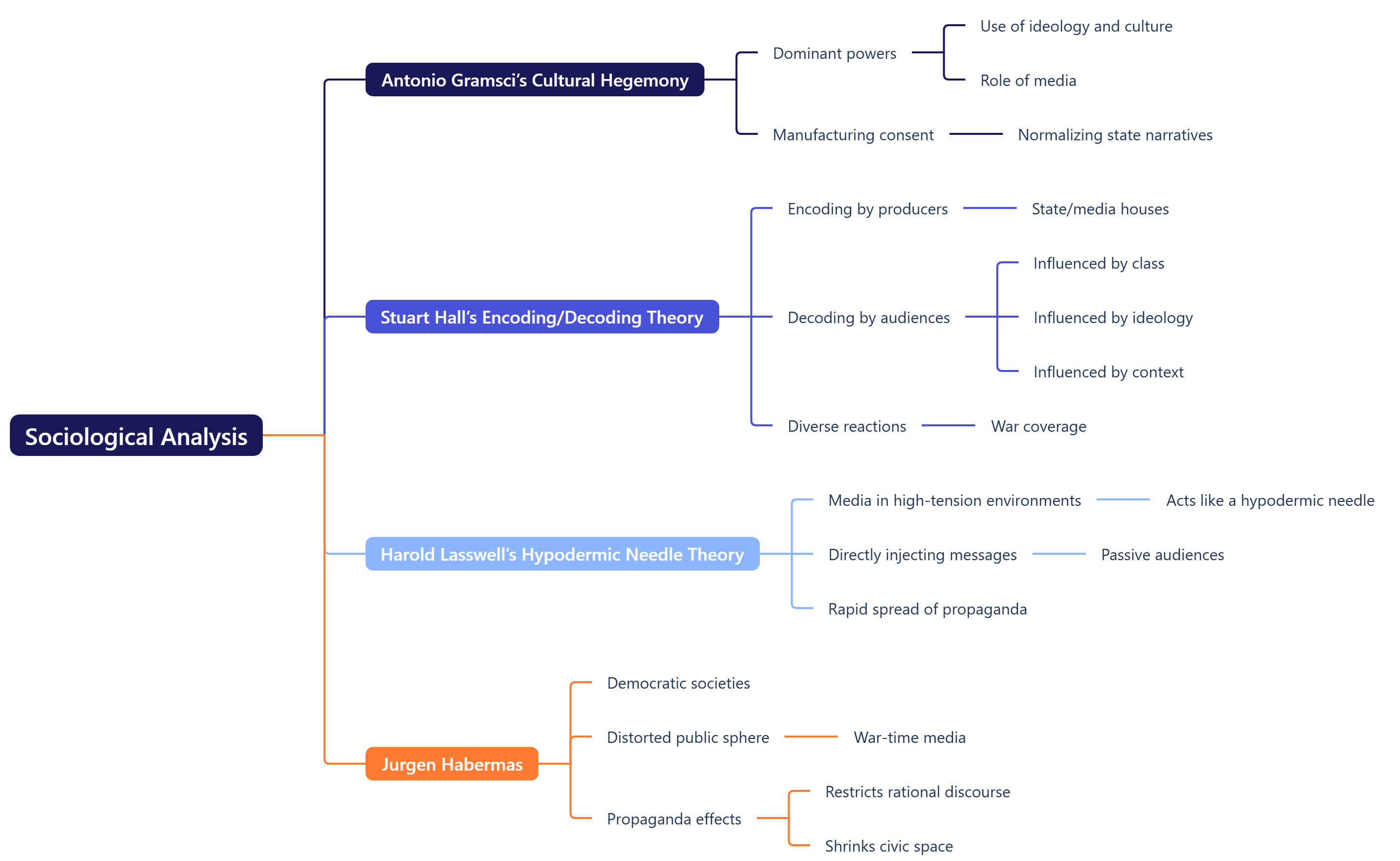
Antonio Gramsci’s Cultural Hegemony: Gramsci explains how dominant powers use ideology and culture—including media—to maintain consent. In war, state-controlled media can manufacture consent by normalizing state narratives.
Stuart Hall’s Encoding/Decoding Theory: Media messages are encoded with meaning by producers (state or media houses) and decoded differently by audiences based on class, ideology, and context—explaining diverse public reactions to war coverage.
Harold Lasswell’s Hypodermic Needle Theory: In high-tension environments like war, media acts like a hypodermic needle injecting messages directly into passive audiences, enabling rapid spread of propaganda.
Jurgen Habermas – In democratic societies, war-time media distorts the public sphere, where informed debate should occur. Propaganda restricts rational discourse and shrinks civic space.
Contemporary Indian Society
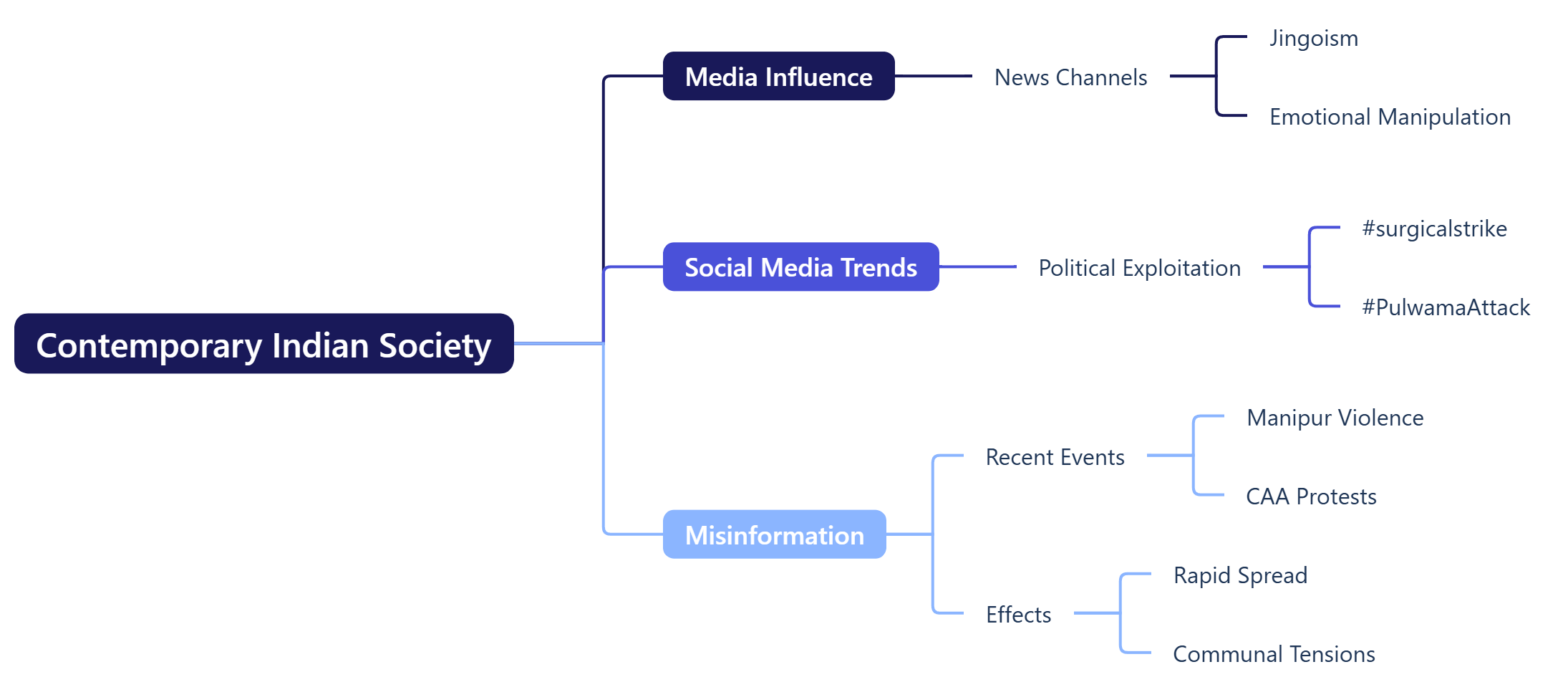
India-Pakistan conflicts show how news channels often indulge in jingoism and emotional manipulation.
Social media trends like #surgicalstrike or #PulwamaAttack get politicized for electoral gains.
Misinformation during Manipur violence or CAA protests spread rapidly through unverified channels, fuelling communal tensions.
Conclusion:
As war becomes increasingly hybrid—fought both on the battlefield and in the digital space—understanding media’s sociological impact is essential. Recognizing the dynamics of propaganda, misinformation, and perception management can empower citizens to critically engage with narratives rather than passively consume them. For civil service aspirants and future policymakers, this awareness is not just academic—it’s a democratic responsibility.
PYQs
Paper 1 –
Discuss the relationship between mass media and social change in modern society. (2014)
Explain how the concept of ‘hegemony’ as introduced by Gramsci helps in understanding the functions of mass media in contemporary society. (2017)
Evaluate the impact of globalization on the institution of mass media. (2018)
Discuss how cultural values are transmitted through media. (2019)
Examine the role of communication in social change with suitable examples. (2020)
Explain the relevance of Stuart Hall’s theory of encoding and decoding in understanding media messages. (2021)
Analyze the implications of digital media on the process of socialization. (2022)
How does mass media help in the creation of social reality? Discuss. (2023)
Paper 2 –
Discuss the impact of mass media on Indian culture. (2015)
Examine the role of media in shaping public opinion in democratic India. (2016)
How do media act as an agent of social control in contemporary Indian society? (2017)
Examine the increasing role of digital media in the political mobilization of Indian youth. (2019)
Critically analyze the role of media in communal violence in India with suitable examples. (2020)
Discuss the growing influence of social media in constructing political narratives in India. (2021)
Analyze how misinformation and fake news on digital platforms challenge democracy in India. (2022)
Evaluate the role of media in shaping national identity in contemporary India. (2023)
To Read more topics like Media in Times of War: Propaganda, Misinformation, and Social Perceptionin Public Posts, visit: www.triumphias.com/blogs







One comment