Despite decades of legal prohibition, manual scavenging—the practice of manually cleaning human excreta from sewers, septic tanks, and insanitary latrines—remains a grim reality in India. The Supreme Court’s recent Rs 5 lakh fine on Delhi’s PWD for sending workers to clean sewers without protective gear underscores the persistence of this inhuman practice. Manual scavenging is not only a public health hazard but also a manifestation of deep-seated caste-based discrimination. From a sociological lens, it illustrates structural inequality, occupational marginalization, and social exclusion, particularly for Dalit communities historically forced into this occupation.
Legal Framework and Supreme Court Directives
The eradication of manual scavenging in India is anchored in the PEMSR Act, 2013, which prohibits employment as manual scavengers and mandates rehabilitation, compensation, and mechanisation. The landmark Supreme Court case Dr. Balram Singh v/s Union of India, 2023 reinforced these principles:
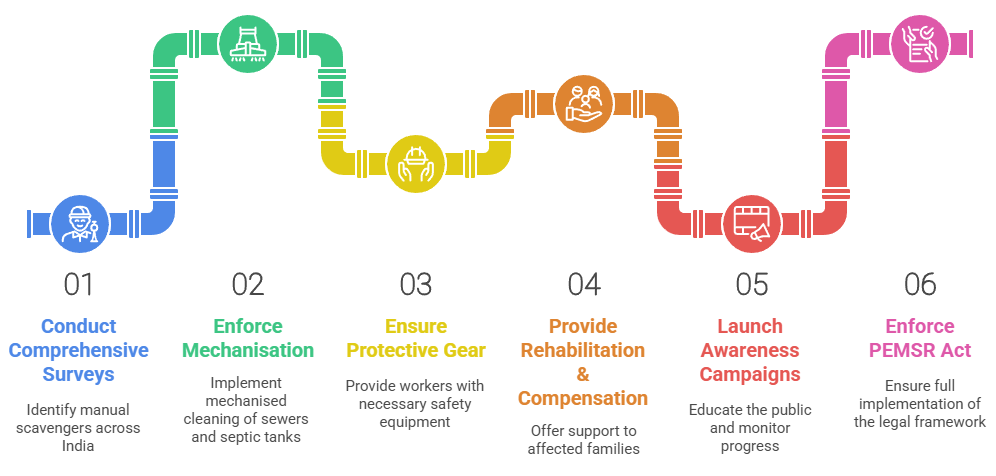
Fresh, Reliable Survey: Conduct comprehensive surveys to identify manual scavengers across India.
Eradication Measures: Enforce complete mechanisation of sewer and septic tank cleaning; human entry only in exceptional cases.
Protective Gear & Safety: No worker to enter drains, sewers, or septic tanks without proper protective equipment—violations implicate Articles 21 (Right to Life) and 23 (Prohibition of Forced Labour).
Rehabilitation & Compensation: Families of deceased or disabled workers have the right to prompt compensation and social security integration.
Awareness & Reporting: Launch public campaigns and maintain centralized portals to monitor deaths, rehabilitation status, and compensation disbursement.
Enforcement of Welfare Laws: Ensure full implementation of the PEMSR Act, 2013.
Sociologically, these directives recognize manual scavenging as a structural injustice, not merely an occupational hazard, and frame eradication as a constitutional and human rights issue.
Persistence of Manual Scavenging
Despite legal prohibitions, manual scavenging persists due to several interlinked factors:
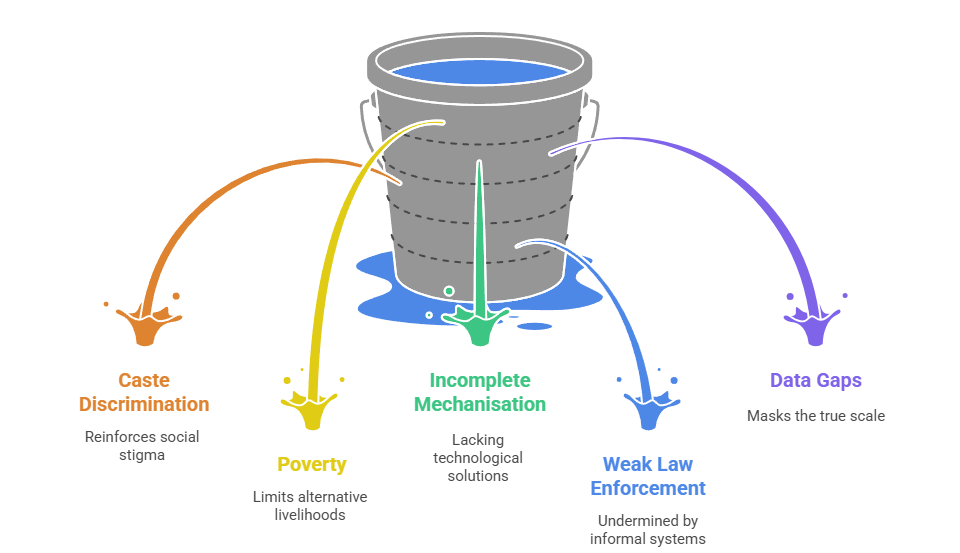
Caste-Based Discrimination: Historically linked to Dalit communities, this occupation is hereditary, with deep-rooted social stigma and untouchability reinforcing marginalization.
Poverty and Lack of Alternatives: Many scavengers have limited access to education, skills, or alternate livelihoods.
Incomplete Mechanisation: Technological solutions for sewer cleaning are not universally available, particularly in smaller towns.
Weak Law Enforcement: The 1993 and 2013 Acts are inadequately enforced, often undermined by informal contractor systems.
Data Gaps: Inconsistent surveys mask the true scale, limiting effective policy interventions.
Current estimates suggest that while 732 of 766 districts claim to be manual scavenger-free, around 58,000 individuals remain engaged in this hazardous work as of 2024.
Health and Social Challenges
Manual scavengers face multidimensional oppression:
Health Risks: Exposure to toxic gases and pathogens leads to Hepatitis, Cholera, Tetanus, asphyxiation, and other occupational diseases.
Social Stigma: Labeled as “untouchables,” scavengers experience systemic exclusion and discrimination.
Economic Challenges: Paid below minimum wage, often on a contractual basis, with no job security or social protection.
Double Discrimination: Women face both caste- and gender-based exploitation, including harassment and economic marginalization.
Psychological Impacts: Social exclusion, hazardous work, and low self-worth contribute to depression, anxiety, and substance abuse.
This aligns with sociological theories of structural violence (Galtung) and intersectionality (Crenshaw), showing how caste, gender, and class combine to perpetuate disadvantage.
Technological and Policy Initiatives
India has launched multiple initiatives to mechanize sanitation work and rehabilitate manual scavengers:
Mechanisation and Robotics:
Bandicoot Robot, Endobot, Robo-Drain System, Swasth AI, and Vacuum Trucks reduce human entry into sewers.
NAMASTE (National Action for Mechanised Sanitation Ecosystem): Integrates mechanised cleaning, welfare, and skill development.
Rashtriya Garima Abhiyan & Swachhta Udyami Yojana: Support rehabilitation, skill training, and entrepreneurship.
Recognition of Prior Learning (RPL): Certifies skills of sanitation workers to improve employability.
Despite these efforts, implementation gaps, limited availability of machines, and inadequate outreach hinder progress, particularly in smaller municipalities.
Pathways to Complete Eradication
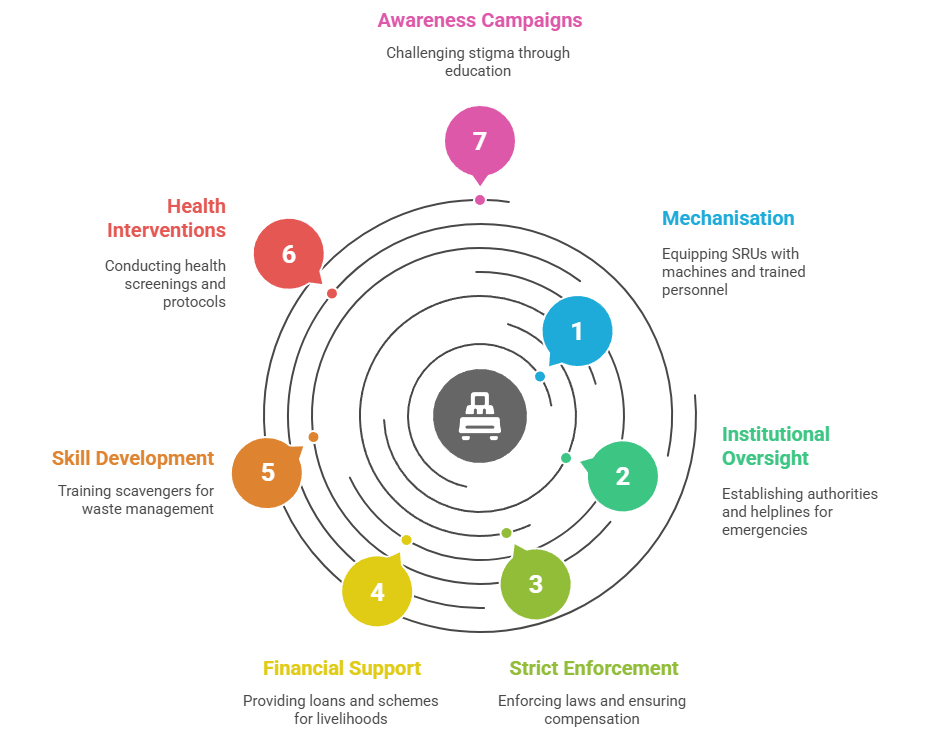
100% Mechanisation: Equip Sanitation Response Units (SRUs) with machines, vehicles, and trained manpower for mechanised operations.
Institutional Oversight: Appoint Responsible Sanitation Authorities in each district, establish SRUs in municipalities, and maintain 24×7 helplines for sewer and septic tank emergencies.
Strict Enforcement: Enforce PEMSR Act, 2013, treat sewer deaths as culpable homicide, and ensure compensation in line with Supreme Court directives.
Financial Support: Expand access to Swachhta Udyami Yojana loans for equipment procurement, and support SRMS schemes for sustainable livelihoods.
Skill Development & Livelihoods: Train scavengers under PM-DAKSH for waste management and machine operation, with preferential hiring in urban bodies and under MGNREGA projects.
Health Interventions: Conduct regular health screenings for sanitation workers, focusing on respiratory, skin, and gastrointestinal ailments, with defined treatment and preventive protocols.
Awareness Campaigns: Challenge caste-based stigma through education, public outreach, and community participation, emphasizing the human rights perspective of sanitation work.
Sociologically, these measures recognize manual scavenging as a structural and intersectional issue, requiring coordinated action across technology, governance, law, and social empowerment.
Sociological Perspective
Manual scavenging exemplifies structural inequality and caste-based oppression. It reflects the historical marginalization of Dalit communities and highlights how occupational hierarchies intersect with social identity to perpetuate disadvantage.
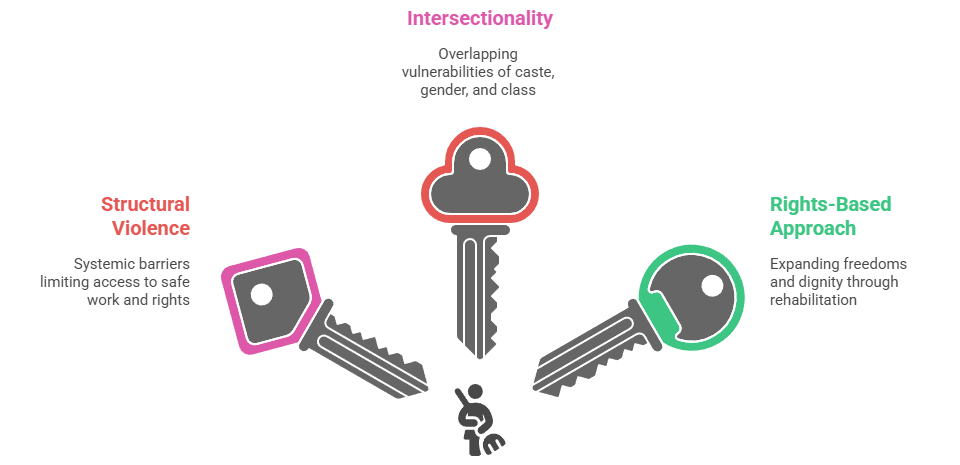
Structural Violence: Johan Galtung’s theory explains how systemic social structures inflict harm by limiting access to safe work and essential rights.
Intersectionality: Kimberlé Crenshaw’s framework illustrates how caste, gender, and class compound vulnerabilities, particularly for women manual scavengers.
Rights-Based Approach: Aligning with Amartya Sen’s capability approach, eradication and rehabilitation expand the real freedoms of marginalized communities, enabling dignity, health, and social participation.
Conclusion
Manual scavenging remains a stark indicator of social injustice, occupational inequality, and caste-based marginalization in India. While legal frameworks like the PEMSR Act, 2013, Supreme Court directives, and initiatives such as NAMASTE and Safaimitra Suraksha Challenge mark important steps, mechanisation, institutional oversight, and rehabilitation remain critical.
Addressing manual scavenging is not merely about eliminating hazardous labor; it is about dismantling structural inequities, ensuring social justice, and restoring dignity to historically oppressed communities. A holistic approach that integrates technology, policy, financial support, skill development, health care, and awareness is essential for India to finally eradicate this inhuman practice and create a just, safe, and inclusive sanitation ecosystem.