Gender inequality remains one of the most persistent and complex social issues of the 21st century. The UN Gender Snapshot 2025, released by UN Women and UN DESA, reveals that without urgent intervention, over 351 million women and girls could remain in extreme poverty by 2030. Despite progress in education and employment, women continue to face systemic disadvantages in political representation, unpaid care work, digital access, and exposure to climate risks and violence. Sociologically, these disparities can be analyzed through Amartya Sen’s capability approach, Bourdieu’s social reproduction theory, and Giddens’ structuration theory, which together illuminate the structural, cultural, and individual dimensions of gender inequality.
Global Dimensions of Gender Inequality
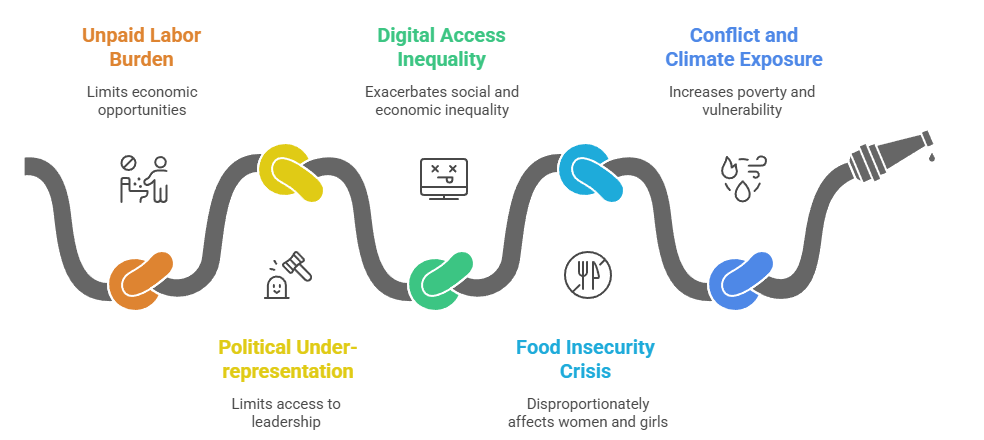
Persistent Poverty Female poverty has stagnated at around 10% since 2020. Climate change, conflict, and global economic shocks exacerbate women’s vulnerabilities. Beck’s risk society theory explains that modern environmental and economic risks disproportionately affect marginalized groups, particularly women, due to pre-existing social and economic hierarchies.
Work and Representation Women globally spend 2.5 times more hours on unpaid domestic and care work than men. Despite their contributions, women hold less than one-third of parliamentary seats worldwide. Notably, 102 countries have never had a woman head of state or government, highlighting persistent patriarchal structures that limit women’s access to leadership roles.
Digital Divide In 2024, 70% of men used the internet compared to 65% of women. Closing this gap could lift 30 million women from poverty, benefiting 343 million women and girls and potentially adding $1.5 trillion to global GDP by 2030. Digital exclusion thus functions both as a cause and consequence of social inequality.
Food Insecurity and Violence Women are disproportionately affected by food insecurity, with 64 million more women than men experiencing hunger in 2024. Violence remains widespread: 1 in 8 women aged 15–49 experienced intimate partner violence in the past year. Early marriage persists, with 18.6% of young women married before 18, though down from 22% in 2014.
Climate Change and Conflict Exposure By 2024, 676 million women and girls lived within 50 km of deadly conflict, the highest since the 1990s. Worst-case climate scenarios could push 158 million more women into poverty by 2050, reinforcing the gendered dimensions of vulnerability in both environmental and political contexts.
Gender Inequality in India
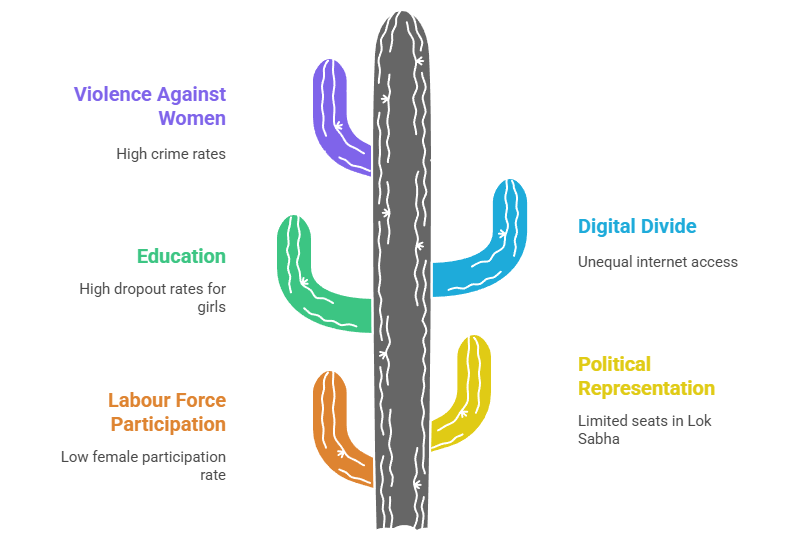
Labour Force Participation India’s Female Labour Force Participation Rate (FLFPR) stands at 37% (2023), among the lowest in South Asia. Bourdieu’s concept of social reproduction highlights how entrenched patriarchal norms, domestic responsibilities, and lack of mobility reinforce women’s economic marginalization across generations.
Political Representation Women hold around 15% of seats in Lok Sabha, though the Women’s Reservation Act 2023 promises to increase this to 33%. Giddens’ structuration theory emphasizes that while laws provide structural opportunities, cultural norms and political practices shape women’s agency in exercising political power.
Education India has achieved gender parity in school enrolment, but dropout rates rise at secondary levels due to early marriage, safety concerns, and social norms, restricting educational attainment and long-term economic empowerment.
Digital Divide Only 33% of Indian women use the internet, compared to 57% of men (NFHS-5). Lack of digital access limits participation in e-governance, financial inclusion, online learning, and employment opportunities, reinforcing structural inequality.
Violence Against Women NCRB 2022 data shows over 4 lakh cases of crimes against women, highlighting persistent safety challenges. Gender-based violence is both a cause and consequence of social marginalization, limiting mobility, economic participation, and public engagement.
Global Frameworks for Gender Equality
UN Sustainable Development Goal 5 – Achieve gender equality and empower all women and girls.
Beijing Declaration and Platform for Action (1995) – Provides a comprehensive blueprint for achieving gender equality, including measures on education, work, health, and political participation.
Convention on the Elimination of All Forms of Discrimination Against Women (CEDAW) – Encourages national policy reforms and legal protection against gender discrimination.
These frameworks illustrate how international norms and agreements provide structural guidance for addressing gender disparities, while leaving space for local adaptation.
India’s Initiatives Towards Gender Equality
Poshan Abhiyaan – Enhances nutrition outcomes for children, pregnant women, and lactating mothers.
Digital Literacy for Women (PMGDISHA) – Enables women to access e-governance services and financial platforms, promoting economic and social empowerment.
One Stop Centre Scheme (Sakhi Centres) – Provides integrated services for women affected by violence, including police facilitation, legal aid, and psycho-social counseling.
WISE-KIRAN – Supports women in science and engineering; from 2018–2023, nearly 1,962 women scientists received support.
Maternity Benefit (Amendment) Act, 2017 – Provides 26 weeks of paid maternity leave for working women.
Nari Shakti Vandan Adhiniyam, 2023 – Seeks to reserve one-third of seats for women in Lok Sabha, State Assemblies, and Delhi Assembly.
Sociologically, these programs reflect an attempt to enhance women’s capabilities (Sen), reduce structural barriers, and promote agency, while addressing intersectional vulnerabilities across class, caste, and region.
Sociological Analysis
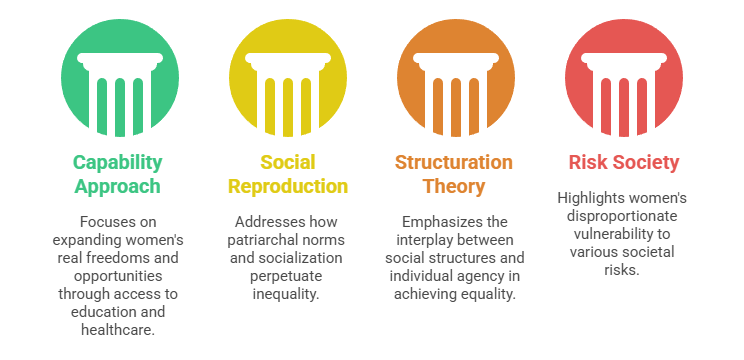
Amartya Sen – Capability Approach Gender equality requires expanding women’s real freedoms and opportunities, not just legal entitlements. Access to education, digital tools, healthcare, and political representation enhances capabilities, allowing women to participate fully in society.
Bourdieu – Social Reproduction and Patriarchy Patriarchal norms, domestic obligations, and gendered socialization perpetuate inequality. Policies must tackle these deep-rooted cultural structures alongside structural reforms.
Giddens – Structuration Theory Social structures (laws, institutions, and norms) and individual agency are interdependent. While legislative measures like the Women’s Reservation Act create opportunities, social practices and norms determine their effectiveness.
Beck – Risk Society Women disproportionately face risks from climate change, conflict, and economic instability. Gender-sensitive disaster planning, climate resilience programs, and social protection schemes are necessary to address these vulnerabilities.
Way Forward
Bridging the Digital Divide – Expand internet access, digital literacy, and e-governance participation to empower women economically and socially.
Enhancing Political Representation – Implement the Women’s Reservation Act and support leadership training for women in politics.
Economic Empowerment – Encourage female entrepreneurship, equitable pay, and inclusion in formal labor markets.
Education and Skill Development – Focus on secondary and tertiary education, vocational training, and STEM initiatives for girls.
Gender-Sensitive Policy Design – Ensure all programs, including climate and disaster management policies, integrate gender considerations.
Addressing Violence and Safety – Strengthen legal enforcement, expand support services, and promote cultural change to reduce gender-based violence.
Conclusion
The UN Gender Snapshot 2025 underscores the persistent and multifaceted nature of gender inequality globally and in India. From poverty and unpaid labor to political marginalization and digital exclusion, women continue to face systemic disadvantages. Sociologically, addressing these challenges requires structural reforms, cultural change, and empowerment strategies informed by theories of capability, social reproduction, and risk society. India’s initiatives—from digital literacy programs to gender quotas—represent important steps, but achieving true gender equality requires coordinated action across education, health, labor, governance, and technology. Only by enhancing women’s agency, expanding opportunities, and dismantling structural barriers can society ensure sustainable and inclusive development for all.






One comment