Fake News, Digital Media, and Democracy: A Sociological Perspective on Misinformation in India | Sociology Optional Coaching | Vikash Ranjan Classes | Triumph IAS 2026-27 | UPSC Sociology Optional
In the digital era, the spread of fake news has emerged as a critical socio-political challenge in India. The Standing Committee on Communications and Information Technology recently proposed measures to curb misinformation, reflecting its growing threat to democracy, public order, and social trust. Fake news undermines citizens’ right to accurate information (Article 19 of the Constitution), fuels communal tensions, disrupts public health initiatives, and can even destabilize national security. Sociologically, this phenomenon can be understood through Habermas’ theory of the public sphere, Castells’ network society, and Bourdieu’s social capital, which together explain how digital platforms reshape information flow, social interaction, and civic engagement.
Understanding Fake News in India
Fake news refers to deliberately misleading or false content intended to manipulate public perception. In India, it spreads rapidly through social media platforms like WhatsApp, Facebook, and X (Twitter), reaching millions within hours. Key causes include:
Digital Technology and Social Networks: Castells’ network society theory highlights how digital platforms create decentralized communication networks where information bypasses traditional editorial controls, making content viral irrespective of veracity.
Low Digital Literacy: Many citizens lack the skills to critically assess online content, increasing vulnerability to misinformation.
Political and Social Polarization: Confirmation bias reinforces the spread of information aligned with pre-existing beliefs, escalating communal tensions.
Economic and Social Incentives: Click-based monetization and sensationalist content reward the creators of fake news, incentivizing its propagation.
Impacts of Fake News
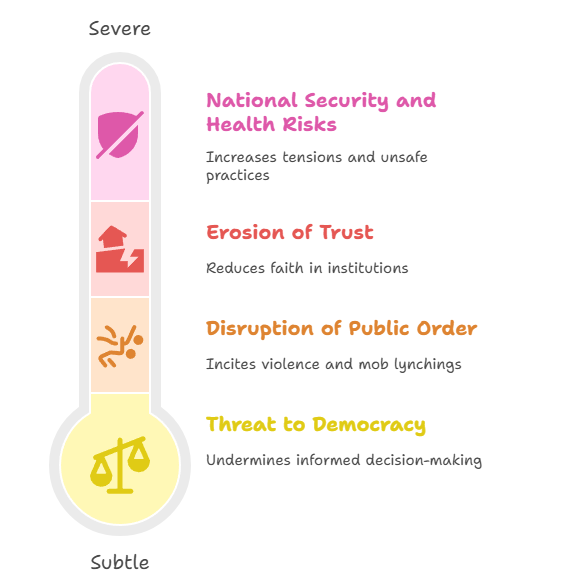
Threat to Democracy:
Misinformation can manipulate elections, influencing voter behavior and undermining informed decision-making.
Habermas’ public sphere theory stresses rational-critical debate as central to democracy; fake news disrupts this deliberative space, fragmenting citizens’ shared reality.
Disruption of Public Order:
In 2018, false WhatsApp messages alleging child kidnappers led to mob lynchings in multiple states, demonstrating how misinformation can incite violence.
Erosion of Trust:
Fake news reduces trust in media, government institutions, and scientific authorities.
During the COVID-19 pandemic, misinformation on vaccines and treatments delayed public health responses, illustrating Bourdieu’s notion of social capital: diminished trust weakens collective action.
National Security and Health Risks:
Misinformation during events like the anti-CAA protests in 2020 increased tensions and unrest.
False health information can cause panic, fear, and unsafe practices, highlighting the sociotechnical dimension of risk in Beck’s risk society theory.
Challenges in Regulating Fake News
Defining Fake News: Subjective and contested, making legislation difficult. Satire, opinion, and dissent often get blurred with misinformation.
Freedom of Speech: Over-regulation risks curtailing Article 19 rights. Striking a balance between democratic freedoms and content regulation is complex.
Rapid Digital Spread: Information goes viral faster than fact-checking, amplified by algorithms prioritizing engagement over accuracy.
Technological Complexity: AI-generated content and deepfakes create sophisticated misinformation that is hard to detect.
Cross-Border Platforms: Many social media platforms are headquartered outside India, raising jurisdictional challenges.
Sociologically, these challenges demonstrate the structural tension between state authority, individual rights, and technological networks, highlighting the emergent risks in the digital public sphere.
India’s Initiatives Against Fake News
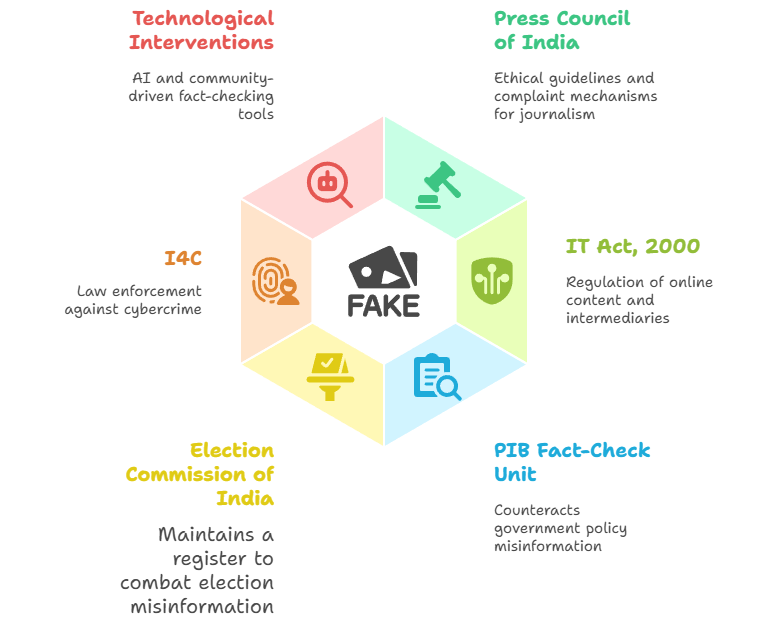
Press Council of India (PCI): Provides ethical journalism guidelines and complaint mechanisms.
Information Technology (IT) Act, 2000: Regulates intermediaries and online content, including under the IT (Intermediary Guidelines and Digital Media Ethics Code) Rules, 2021.
Press Information Bureau (PIB) Fact-Check Unit: Counteracts misinformation related to government policy.
Election Commission of India (ECI): Maintains a “Myth vs. Reality Register” to combat election-related misinformation.
Indian Cyber Crime Coordination Centre (I4C): Provides law enforcement mechanisms to track and prevent cybercrime.
These measures illustrate a socio-technical approach to governance, combining institutional regulation with technological innovation and citizen participation.
Recommendations for a Robust Mechanism
Legal and Regulatory Clarity: Laws must distinguish fake news from satire or opinion to avoid misuse and protect democratic rights. Insights can be drawn from Singapore’s criminal law frameworks and the EU Digital Services Act.
Institutionalized Fact-Checking: Central certification of fact-checking bodies, regular audits, and transparent protocols for verification.
Platform Accountability: Mandatory disclosure of algorithms and AI content labeling. Platforms should also be held accountable for rapid removal of illegal content.
Media Literacy and Awareness: Incorporate digital literacy into education, encourage critical thinking, and use local influencers to reach linguistically diverse populations.
Inter-Ministerial Coordination: Synchronize efforts of MeitY, MIB, MHA, and Consumer Affairs to create a unified framework for detection, monitoring, and enforcement.
Sociologically, these steps reflect Sen’s capability approach—empowering citizens to access, assess, and act on information responsibly, enhancing democratic participation and social resilience.
Sociological Insights
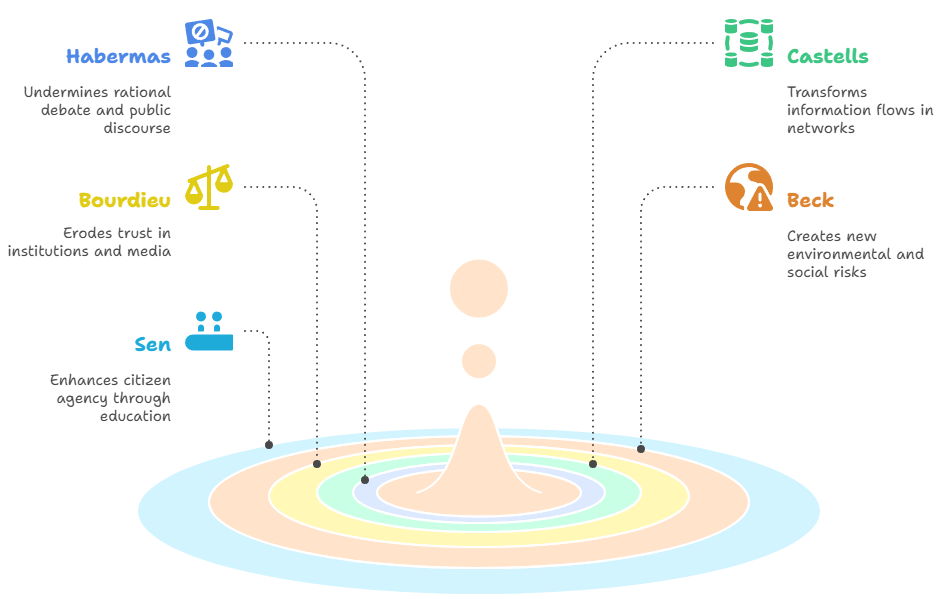
Habermas and the Public Sphere: Fake news undermines rational-critical debate, fragmenting public discourse. Effective regulation and fact-checking aim to restore deliberative spaces in a digital democracy.
Castells’ Network Society: Highlights how social media transforms information flows, creating both opportunities and vulnerabilities in urban and rural networks.
Bourdieu’s Social Capital: Trust in institutions, media, and peers is crucial; fake news erodes this capital, reducing collective problem-solving and civic cooperation.
Beck’s Risk Society: Modern information technologies create new environmental and social risks, with disproportionate impacts on vulnerable populations.
Sen’s Capability Approach: Policies must enhance the agency of citizens, particularly through education, media literacy, and participatory governance, allowing them to navigate misinformation safely.
Conclusion
Fake news in India is not merely an informational challenge—it is a social, political, and technological phenomenon with profound implications for democracy, public health, and social cohesion. Effective mitigation requires a multi-layered approach:
Institutional Regulation: PCI, ECI, and I4C frameworks provide oversight and enforcement.
Technological Tools: AI detection, content labeling, and community-driven fact-checking enhance timely intervention.
Social Interventions: Media literacy, citizen participation, and trust-building strategies empower individuals to navigate information critically.
From a sociological lens, the interplay between technology, society, and governance illustrates the need for structurally informed, citizen-centric policies. By balancing regulation, education, and participatory mechanisms, India can protect democratic discourse, enhance social trust, and build resilience against the ever-evolving threat of misinformation.