Kerala has emerged as a pioneer in sustainable urban planning with the establishment of the Kerala Urban Policy Commission (KUPC), marking the first state-level initiative in India to create a 25-year roadmap for managing rapid urbanization. Unlike conventional urban strategies focused solely on infrastructure, the KUPC adopts a people-centered, climate-sensitive, and data-driven approach. From a sociological perspective, this initiative highlights the intersection of urban governance, social equity, and environmental resilience, resonating with the ideas of Henri Lefebvre on the social production of space, David Harvey on spatial justice, and Ulrich Beck on risk society. Kerala’s model offers lessons for other states on harmonizing growth with ecological sustainability, governance reform, and inclusive urban development.
Kerala Urban Context
Kerala’s urbanization trajectory is unique within India. While India’s overall urban population is projected to reach 600 million (40%) by 2036, Kerala anticipates over 80% urbanization by 2050. This rapid transformation is driven by:
Demographic Transition and Migration: Rural-to-urban migration accelerated by employment opportunities, educational facilities, healthcare access, and amenities. Agrarian distress, shrinking landholdings, and climate-induced pressures push populations toward urban centres.
Economic Transformation: Transition from agriculture to services, IT, and manufacturing has made cities engines of growth, innovation, and employment.
Policy Push & Urban Missions: National initiatives such as Smart Cities Mission, AMRUT, PMAY-U, and the National Infrastructure Pipeline are reshaping urban infrastructure.
Technological Integration: AI, IoT, and Digital Public Infrastructure (DPIs) facilitate smart governance, better service delivery, and resource management.
Globalization & Aspirations: Integration into global markets and rising youth expectations amplify demand for modern urban spaces.
From a sociological lens, these trends can be analyzed through Wirth’s urbanism theory, which emphasizes how dense, diverse, and dynamic urban environments reshape social interactions, inequalities, and cultural patterns.
Kerala Urban Policy Commission: Vision and Approach
The KUPC reframes cities as climate-aware ecosystems, rather than merely clusters of infrastructure. Its approach integrates place-based strategies, participatory governance, and financial empowerment, acknowledging both ecological constraints and social diversity.
Key objectives include:
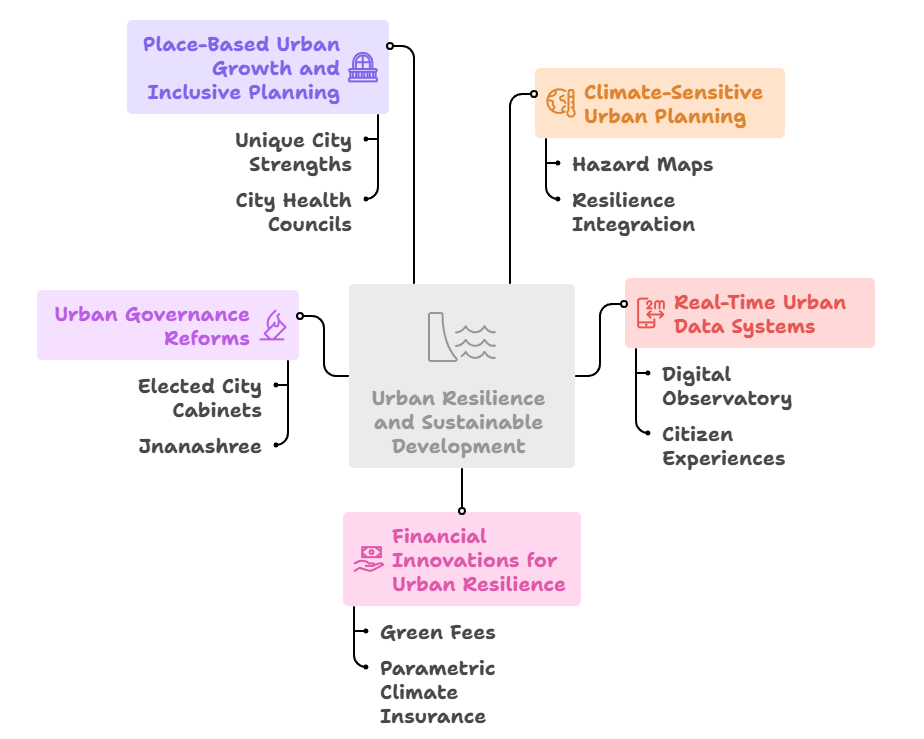
Climate-Sensitive Urban Planning:
Use hazard maps for floods, landslides, and coastal risks in zoning rules.
Integrate resilience into every stage of planning, aligning with Beck’s risk society theory, which emphasizes proactive management of environmental hazards affecting vulnerable populations.
Real-Time Urban Data Systems:
Establish a digital observatory with LiDAR satellite data, weather sensors, and municipal inputs.
Blend citizen experiences, including fisherfolk and street vendors, into planning, reflecting participatory urbanism as advocated by Lefebvre, who emphasized the social production of urban space.
Financial Innovations for Urban Resilience:
Implement green fees and parametric climate insurance to fund eco-sensitive projects.
Enable municipalities to issue bonds, while smaller towns adopt pooled bond models for infrastructure financing, promoting fiscal autonomy and self-reliance.
Urban Governance Reforms:
Establish elected city cabinets led by mayors, complemented by expert municipal teams for climate, transport, waste, and healthcare management.
Launch Jnanashree to recruit skilled youth into local governance, addressing both technocratic efficiency and democratic participation.
Place-Based Urban Growth and Inclusive Planning:
Promote the unique strengths of cities: Kochi as a FinTech hub, Thiruvananthapuram-Kollam as a knowledge corridor, Kozhikode as a literary city, and Palakkad-Kasargod as smart-industrial centres.
Restore wetlands, waterways, and heritage zones to preserve ecosystems and cultural heritage.
Form City Health Councils to provide healthcare and welfare for migrants, gig workers, and students.
Sociological Perspectives on Kerala’s Model
Equity and Spatial Justice:
David Harvey’s framework on spatial justice emphasizes fair distribution of resources and services across urban spaces. KUPC’s place-based strategies and focus on equitable service delivery address spatial inequalities, particularly for marginalized populations like migrants and informal workers.
Social Participation and Democracy:
Lefebvre’s “Right to the City” advocates citizen participation in urban decision-making. By integrating community-driven data and establishing elected city cabinets, KUPC enhances local agency and participatory governance, ensuring that urban planning reflects residents’ lived realities.
Risk Society and Environmental Governance:
Ulrich Beck’s risk society theory highlights that modern societies produce new environmental risks. By embedding climate resilience, hazard mapping, and disaster financing into urban planning, KUPC exemplifies a proactive approach to managing urban risks.
Human Capabilities and Well-Being:
Amartya Sen’s capability approach stresses that development should expand people’s freedoms and opportunities. By prioritizing inclusive services, healthcare, and livelihood-sensitive planning, KUPC strengthens human capabilities and urban well-being.
Social Capital and Community Networks:
Putnam’s theory of social capital suggests that trust, networks, and civic engagement enhance collective resilience. KUPC’s citizen-centric data systems, participatory planning, and community councils reinforce social capital, enabling cities to adapt better to shocks and changes.
Kerala Urban Policy Commission: Key Pillars for Sustainable Urbanisation
The KUPC report organizes its recommendations around five thematic pillars, providing a roadmap for inclusive, climate-resilient, and citizen-focused urban development:
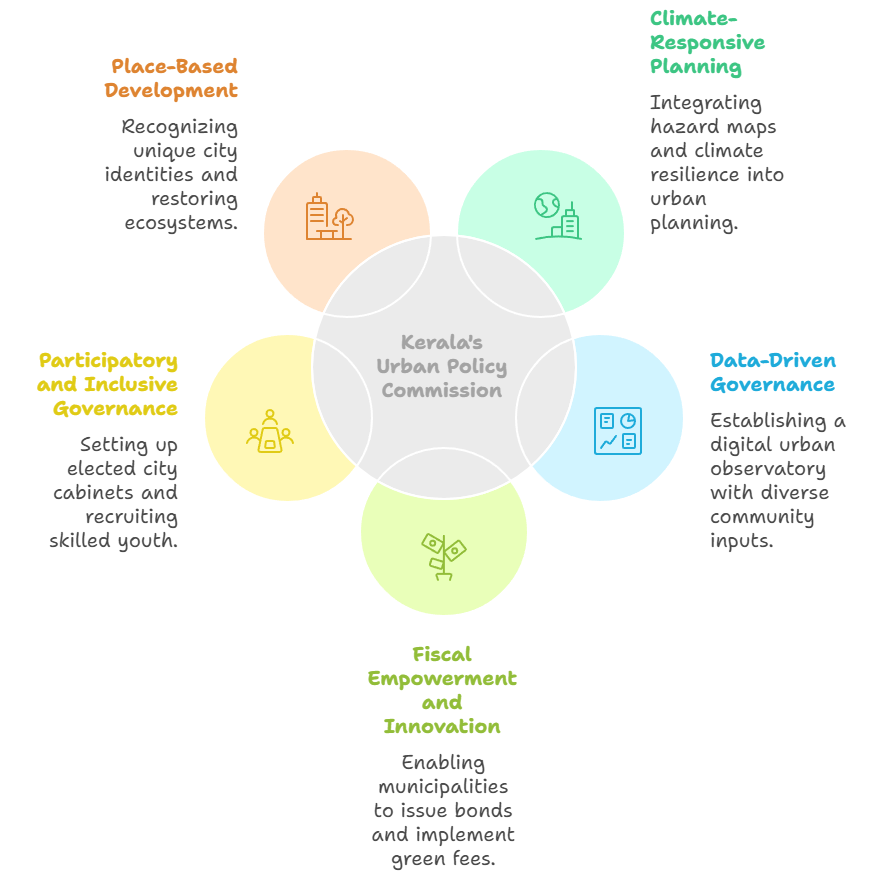
Climate-Responsive Planning
Integrate hazard maps for floods, landslides, and coastal risks into zoning and land-use regulations.
Make climate resilience and disaster risk management central to every stage of urban planning.
Data-Driven Governance
Establish a digital urban observatory with LiDAR satellite data, weather sensors, and municipal inputs.
Include community experiences, such as those of fisherfolk, street vendors, and other vulnerable groups, to ensure policies reflect lived realities.
Fiscal Empowerment and Innovation
Enable municipalities to issue bonds, adopt pooled financing models, and implement green fees for eco-sensitive projects.
Introduce parametric climate insurance to fund resilience measures and disaster response.
Participatory and Inclusive Governance
Set up elected city cabinets led by mayors, supported by expert municipal teams for transport, waste, climate, and health.
Recruit skilled youth into local governance, fostering innovation and accountability.
Place-Based and Livelihood-Sensitive Development
Recognize the unique economic and cultural identity of each city, such as FinTech hubs, knowledge corridors, literary cities, or industrial centres.
Restore wetlands, waterways, and heritage zones to preserve ecosystems and cultural heritage.
Establish City Health Councils for equitable access to healthcare and welfare services for migrants, gig workers, and students.
Lessons for India’s Urban Planning
Kerala’s model offers several key takeaways:
Place-Based Approach: Recognize the unique geography, culture, and economy of each city rather than applying uniform frameworks.
Climate-Integrated Urbanism: Embed resilience and hazard management into zoning, infrastructure, and public services.
Participatory Governance: Shift from bureaucratic centralization to elected, accountable city administrations with citizen involvement.
Financial Autonomy: Equip municipalities with innovative fiscal tools to ensure sustainable infrastructure and disaster preparedness.
Inclusive Services: Provide healthcare, welfare, and economic opportunities to migrants, gig workers, and other vulnerable groups.
Technology for Governance: Use digital observatories, IoT sensors, and AI-based planning to improve service delivery while blending community knowledge for context-specific solutions.
Sociological Implications
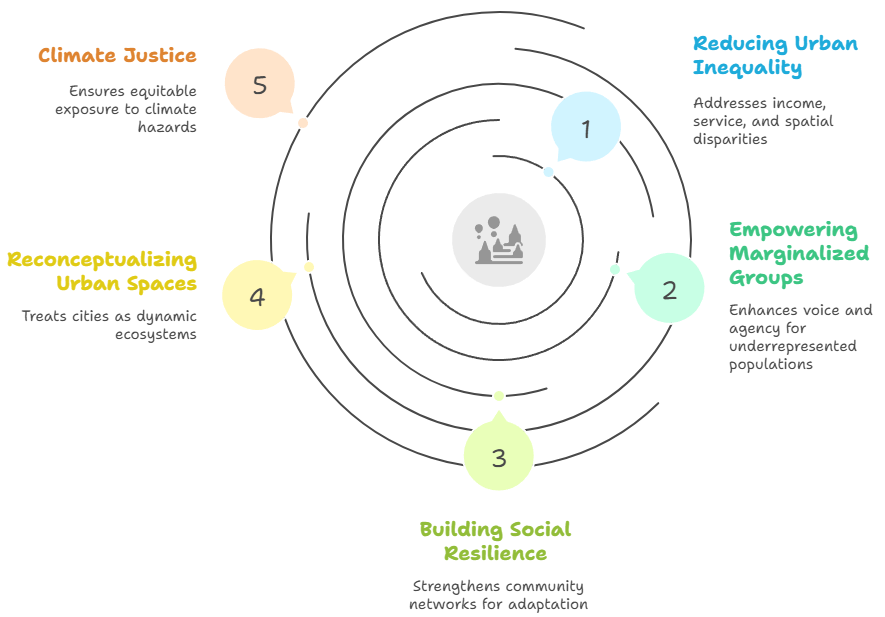
Reducing Urban Inequality: Place-based and participatory planning addresses income, service, and spatial disparities across cities.
Empowering Marginalized Groups: Inclusive governance structures enhance voice and agency for historically underrepresented populations.
Building Social Resilience: Integrating local knowledge and citizen participation strengthens community networks, enhancing adaptation to environmental and social risks.
Reconceptualizing Urban Spaces: Reflecting Lefebvre’s and Harvey’s theories, Kerala treats cities as dynamic ecosystems rather than mere infrastructure clusters, balancing social, economic, and ecological dimensions.
Climate Justice: KUPC aligns with environmental sociology, ensuring that development does not disproportionately expose marginalized communities to climate hazards.
Conclusion
The Kerala Urban Policy Commission sets a new benchmark for sustainable urbanization in India, combining climate-sensitive planning, fiscal innovation, and participatory governance. From a sociological perspective, KUPC illustrates how urban policies can integrate equity, resilience, and social well-being, resonating with the ideas of Lefebvre, Harvey, Beck, Sen, and Putnam. By emphasizing place-based growth, inclusive governance, and community-driven data, Kerala offers a model for other Indian states grappling with rapid urbanization, climate risks, and social inequalities. The KUPC roadmap demonstrates that sustainable urbanization is not only about technological solutions or infrastructure but fundamentally about people, governance, and ecological justice, ensuring that cities remain livable, resilient, and socially inclusive for generations to come.






One comment