M.N. Srinivas: The Sociologist Who Made Caste and Social Change Visible | Sociology Optional Coaching | Vikash Ranjan Classes | Triumph IAS 2026-27 | UPSC Sociology Optional
Mysore Narasimhachar Srinivas (1916–1999) is one of the most influential Indian sociologists and social anthropologists of the 20th century. Often credited with transforming the study of Indian society, Srinivas bridged the gap between classical sociology and empirical fieldwork in India. Unlike earlier theorists like G.S. Ghurye, who largely emphasized historical and textual perspectives, Srinivas focused on lived realities, highlighting processes of social mobility, change, and power within the caste system.
Early Life and Education
Born in Mysore, Karnataka in 1916, Srinivas grew up in a scholarly Brahmin family.
Graduated from Mysore University, later joining the University of Bombay (now Mumbai) for postgraduate studies in sociology.
Studied under G.S. Ghurye, which provided a strong foundation in Indian social structures and historical sociology.
He earned his D.Phil from Oxford University, where he was influenced by British social anthropology, particularly the works of Radcliffe-Brown and Malinowski, integrating ethnography into Indian sociological research.
Key takeaway: His background combines Indian classical sociology and modern empirical anthropology, explaining why his work is both contextually rooted and methodologically rigorous.
Methodological Innovations
Srinivas is particularly noted for introducing empirical fieldwork in Indian sociology, moving away from purely historical or textual approaches:
Ethnography of Rampura
His village study in Karnataka became the basis for understanding caste in practice.
Emphasized participant observation, in-depth interviews, and longitudinal study, making social realities visible in the context of everyday life.
Micro-Macro Linkage
Linked village-level observations to larger social processes, showing how local changes reflect broader societal transformations.
Important for answering UPSC questions on rural sociology, caste dynamics, and social change.
Dynamic View of Social Structures
Srinivas viewed caste as fluid, adaptive, and negotiable, countering earlier notions of caste as rigid and static.
Major Works and Core Ideas
Here’s a hierarchical overview of his key books and ideas, crucial for Sociology Optional:
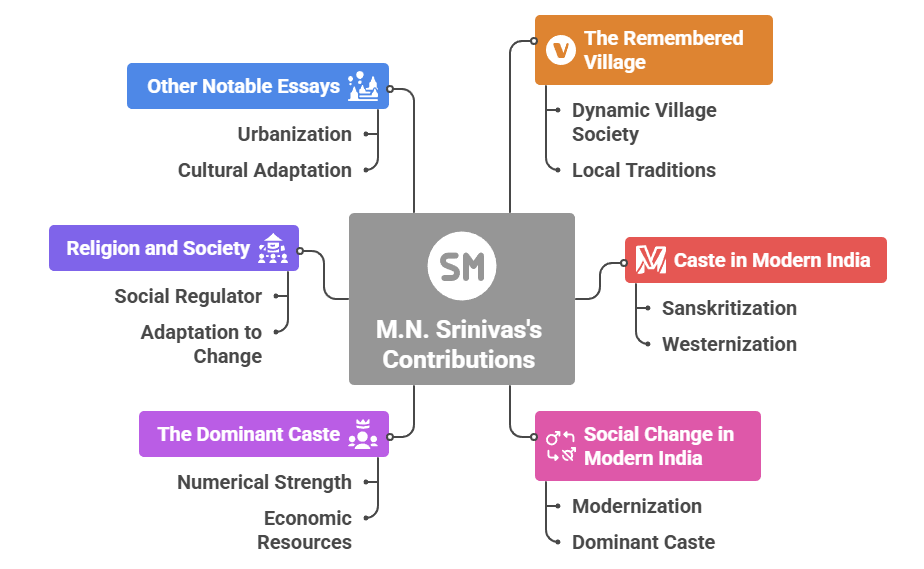
The Remembered Village (1978)
Ethnographic account of a South Indian village, Rampura.
Main ideas:
Village society is dynamic, with caste relations and power structures evolving over time.
Introduced the interplay of local traditions with modern influences.
Emphasized lived experiences over theoretical abstraction.
Caste in Modern India and Other Essays (1962)
Essays on caste and social change.
Core concepts:
Sanskritization: upward social mobility by emulating higher castes.
Westernization: influence of Western education, technology, and lifestyles on traditional communities.
Secularization: diminishing role of religion in public and economic spheres.
Application : Explains social mobility, transformation of caste, and modernization.
Social Change in Modern India (1966)
Focused on modernization processes, urbanization, and economic change.
Key insights:
Social change is a gradual process influenced by education, politics, and economy.
Introduced the concept of dominant caste as central to power in villages.
The Dominant Caste (1959)
Based on fieldwork in Rampura and other villages.
Core idea: A caste gains dominance not only through ritual status but also through numerical strength, economic resources, and political influence.
relevance: Explains rural power hierarchies, local leadership, and social stratification beyond textual hierarchy.
Religion and Society (1980s essays)
Explored the interaction between religion and social structure.
Religion acts as a social regulator but also adapts to changes brought by modernization and Western influence.
Other Notable Essays
Urbanization studies: highlighted rural-urban migration, its impact on caste relations, and social identity.
Studies on festivals, rituals, and everyday life, showing how culture adapts to economic and political changes.
Work on family, kinship, and marriage patterns, providing insights for Paper 1 Indian Society sections.
Key Sociological Concepts Introduced
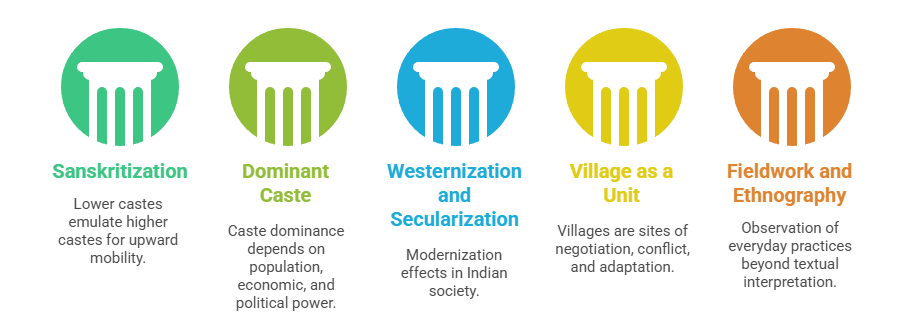
Sanskritization
Lower castes emulate higher castes for upward mobility.
Highlights agency within caste, a concept frequently asked in sociology answers.
Dominant Caste
Caste dominance depends on population size + economic + political power.
Explains why ritual purity alone does not determine real power.
Westernization and Secularization
Explains modernization effects in Indian society.
Helps answer questions on social change, urbanization, and globalization.
Village as a Unit of Analysis
Villages are not static but sites of negotiation, conflict, and adaptation.
Links micro-level social processes to macro-level social change.
Fieldwork and Ethnography
Emphasized observation of everyday practices, beyond textual interpretation.
Comparative Perspective: Srinivas vs G.S. Ghurye
Aspect
G.S. Ghurye
M.N. Srinivas
Approach
Historical-textual, structural-functional
Empirical, field-based, dynamic
Focus on caste
Static, ritual hierarchy
Dynamic, includes power, economy, and politics
Methodology
Literature, historical records
Ethnography, participant observation
Social Change
Gradual, evolutionary
Fluid, influenced by Sanskritization, Westernization
Usefulness
Classical foundations
Contemporary applications, rural sociology, social change
Critiques and Debates
Overemphasis on Sanskritization:
Critics argue it focuses too much on imitation of higher castes rather than structural change.
Limited Macro Perspective:
Fieldwork-heavy approach sometimes underplays state, market, and national policies’ role.
Neglect of Gender:
Early studies focused mainly on caste and village men; women’s roles were underexplored.
Later sociologists like Patricia Uberoi and Leela Dube expanded this perspective.
Relevance Debate:
While highly influential, some argue modern urban India requires adaptation of his concepts to new contexts, like neoliberalism and digital influence on caste identity.
Conclusion
M.N. Srinivas redefined Indian sociology by placing lived social realities at the center of analysis, offering dynamic insights into caste, rural life, and social change. His concepts of Sanskritization, dominant caste, and the focus on ethnographic methodology provide indispensable tools for understanding Indian society. Unlike Ghurye, Srinivas emphasized agency, power, and adaptability within social structures, making his work directly relevant to contemporary sociological analysis.
His legacy is foundational, linking classical sociological insights to practical, empirical observation, offering a holistic framework to understand caste, power, social change, and rural society.