Women’s labor force participation has been a persistent concern in India’s development trajectory. Despite significant strides in education and health, India’s female labor force participation rate (LFPR) has fallen from nearly 30% in 2005 to around 20% in 2025 (Periodic Labour Force Survey). This paradox—rising education but declining employment—reflects deep-rooted patriarchal norms, structural barriers, and policy design flaws. In this context, state-led interventions become crucial in creating enabling environments for women’s economic empowerment.
Bihar’s Mukhyamantri Mahila Rozgar Yojana (2025) is one such initiative aimed at fostering women’s entrepreneurship and self-employment. While ambitious in scope, the scheme raises questions about its design, inclusivity, and long-term impact. This blog critically examines the scheme through a sociological lens, engaging with theories, laws, case studies, and comparative experiences, to assess its potential in reshaping women’s socio-economic position.
Key Features of the Scheme
Financial Assistance: An initial grant of ₹10,000, with potential for an additional ₹2 lakh in phased support.
Eligibility: One woman per family, above 18 years of age.
Implementation: Linked to Self-Help Groups (SHGs), especially Jeevika Didis, with digital and SHG-based application processes.
Objective: Promote self-reliance and local entrepreneurship among women.
Political Framing: Public events and festivals branding it as a transformative women’s initiative.
On the surface, the scheme appears to blend financial aid with SHG networks. However, when viewed sociologically, several weaknesses become evident.
Critical Weaknesses
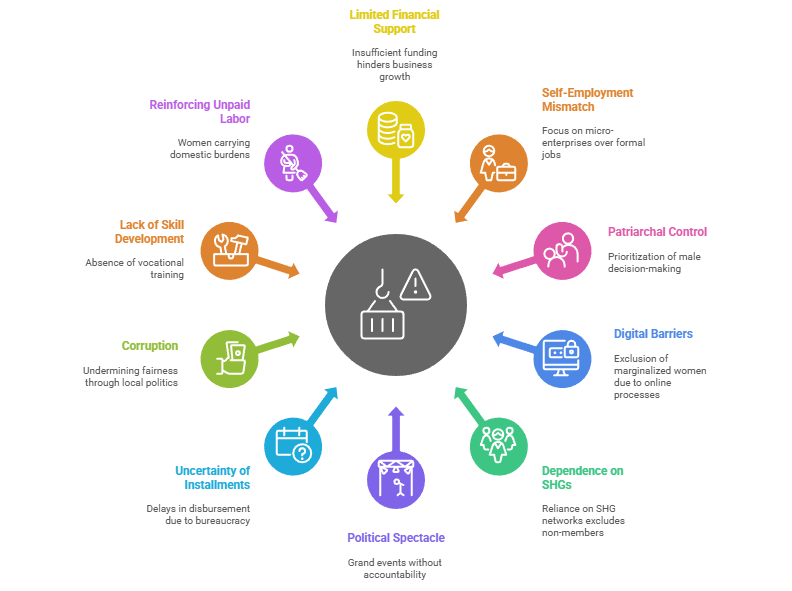
Limited Financial Support: ₹10,000 is inadequate for meaningful business ventures; even ₹2 lakh is insufficient without training and infrastructure.
Self-Employment vs. Employment Mismatch: The scheme pushes women into micro-enterprises rather than addressing formal job creation.
One Woman per Family Condition: Reinforces patriarchal control within households—prioritization of male decision-making over female autonomy.
Digital & Bureaucratic Barriers: Online application and reliance on SHGs exclude the most marginalized, particularly Dalit and minority women.
Dependence on SHGs: Excludes women not integrated into SHG networks. Risks overburdening SHG leaders.
Political Spectacle vs. Reality: Grand launch events but weak monitoring and accountability mechanisms.
Uncertainty of Second Installment: Disbursement depends on bureaucratic approval, risking delays and leakages.
Corruption & Middlemen: Local politics and elite capture may undermine fairness.
Lack of Skill Development: No provision for vocational training or market linkages.
Reinforcing Unpaid Labor: Women entrepreneurs continue to carry unpaid domestic and care burdens, leading to a “double burden” (Oakley).
Sociological Perspectives
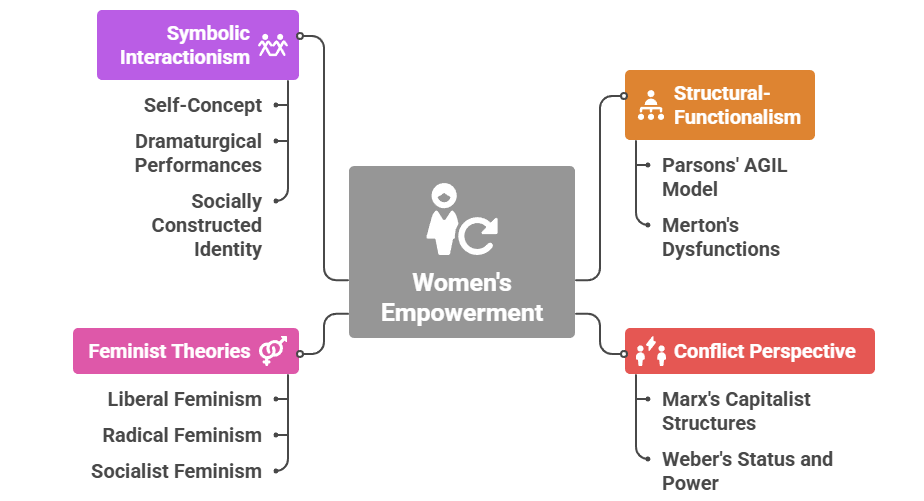
Structural-Functionalism (Parsons, Merton)
Parsons’ AGIL model:
Adaptation: Integrates women into economy.
Goal Attainment: Helps state achieve development targets.
Integration: Strengthens SHG solidarity.
Latency: Reinforces gender roles.
Critique: As Merton’s “dysfunctions” highlight, such schemes may reinforce patriarchy while appearing empowering.
Conflict Perspective (Marx, Weber)
Marx: Women drawn into petty self-employment reproduce capitalist structures by supplying cheap, precarious labor, without real control over capital.
Weber: Even if women gain “class position” (income), their status (social respect) and power (decision-making in family/community) remain weak, limiting true empowerment.
Feminist Theories
Liberal Feminism (Betty Friedan): Sees such schemes as expanding opportunities, but inadequate without systemic changes.
Radical Feminism (Shulamith Firestone): Argues that patriarchal family structure remains intact; “one woman per family” clause strengthens male authority.
Socialist Feminism (Hartmann): Women face a “dual system” of oppression—capitalism and patriarchy—leading to unpaid SHG work + household labor.
Symbolic Interactionism (Mead, Goffman)
Women being publicly recognized as “entrepreneurs” alters their self-concept.
Public festivals act as “dramaturgical performances” (Goffman), symbolizing empowerment while concealing structural inequalities.
Empowerment here is a socially constructed identity, varying across caste, class, and region.
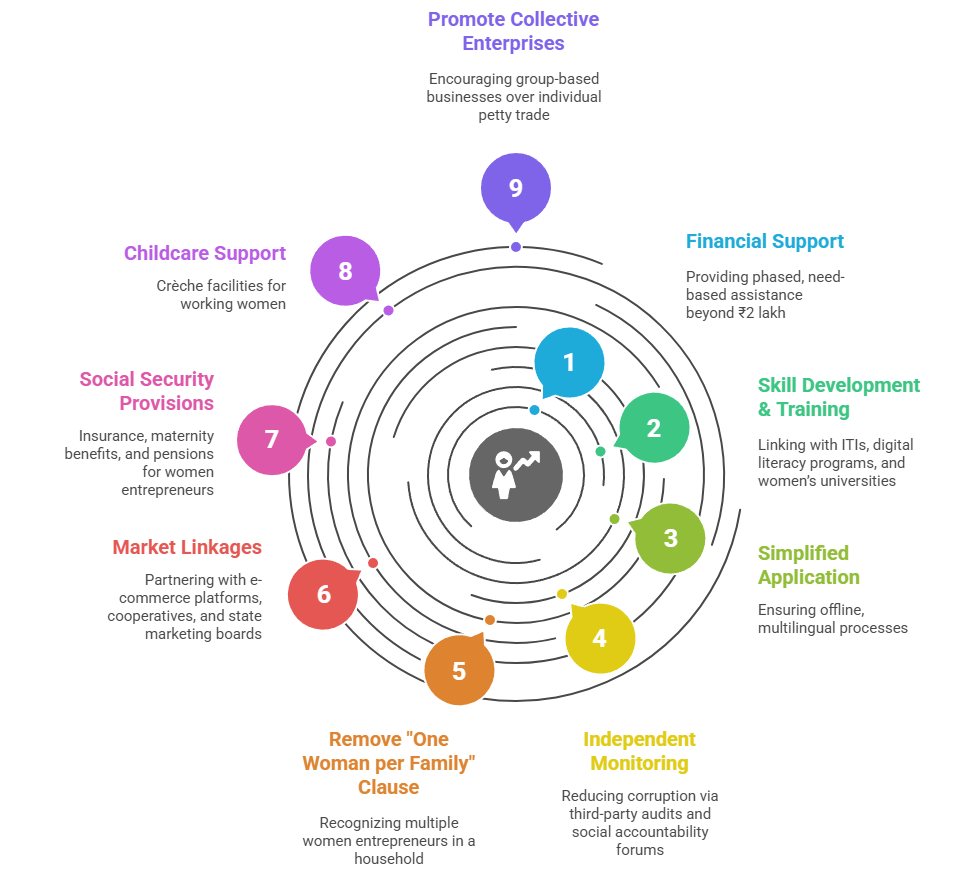
Independent Monitoring: Reduce corruption via third-party audits and social accountability forums.
Remove “One Woman per Family” Clause: Recognize multiple women entrepreneurs in a household.
Market Linkages: Partner with e-commerce platforms, cooperatives, and state marketing boards.
Social Security Provisions: Insurance, maternity benefits, and pensions for women entrepreneurs.
Childcare Support: Crèche facilities for working women.
Promote Collective Enterprises: Encourage group-based businesses over individual petty trade.
Conclusion
The Mukhyamantri Mahila Rozgar Yojana represents Bihar’s effort to mainstream women into the economy and address gendered exclusion. However, sociological analysis reveals that without structural reforms, it risks becoming more of a political spectacle than a transformative intervention.
True empowerment requires not just financial aid but systemic changes in patriarchy, market access, and social recognition. Drawing from feminist theories and successful case studies like SEWA and Grameen, the path forward lies in combining finance, skills, and supportive infrastructure. Only then can such schemes translate into real autonomy, dignity, and equality for women—not just in Bihar, but across India.