Introduction
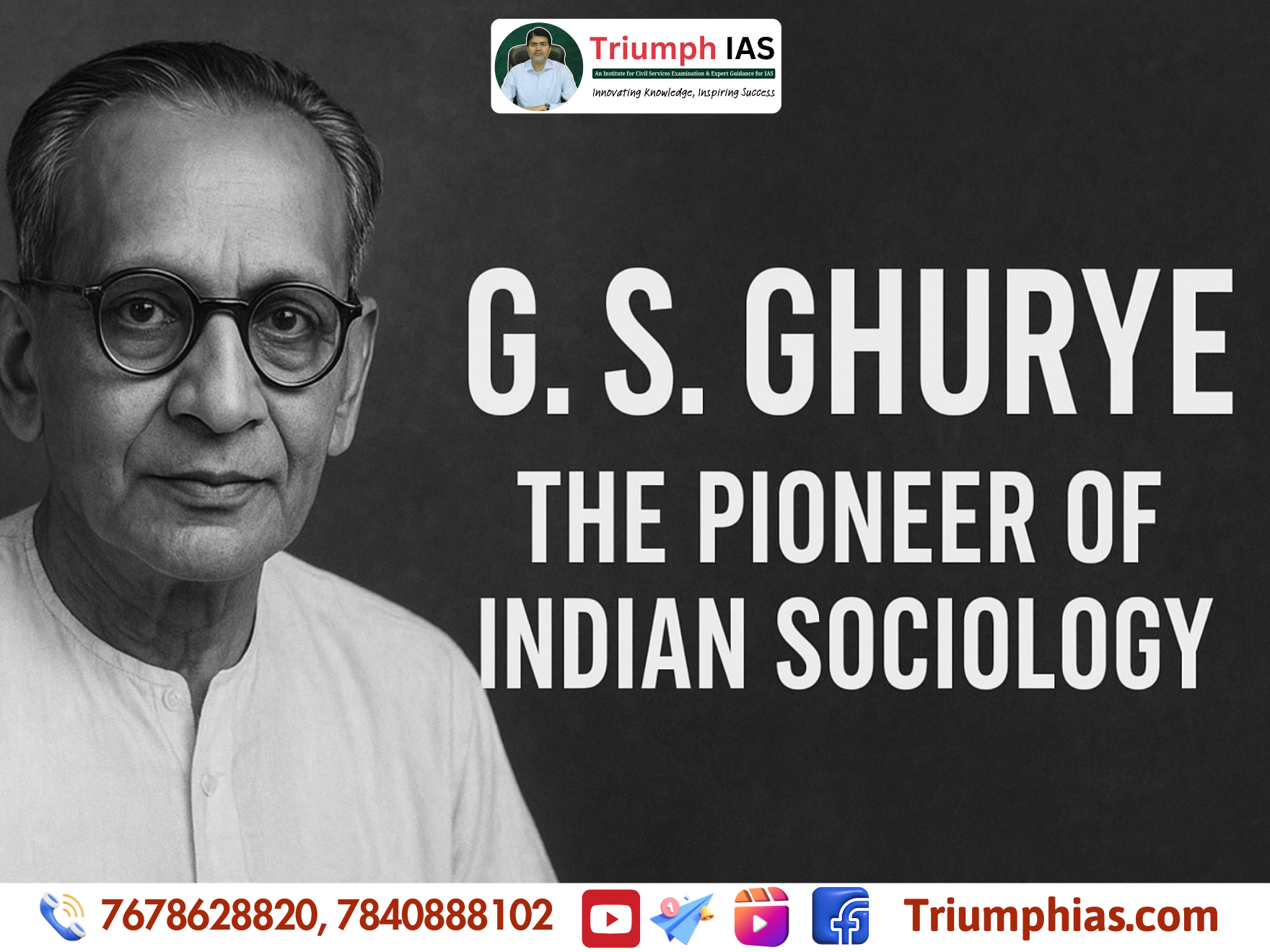
Govind Sadashiv Ghurye (1893–1983) is widely regarded as the “father of Indian sociology”, whose work laid the foundation for the institutionalization of sociology in India. His scholarship spans caste, tribes, race, culture, civilization, urbanization, family, and nationalism, making him one of the most versatile sociologists of the 20th century. While deeply rooted in the Indological tradition, Ghurye’s writings were also influenced by structural-functionalism and classical European thinkers such as Herbert Spencer, Max Weber, and Robert Redfield.
Early Life and Intellectual Journey
- Born in 1893 in Maharashtra, Ghurye pursued philosophy before moving to sociology.
- He studied under W. H. R. Rivers at Cambridge, who influenced his comparative and Indological approach.
- In 1924, he became Professor of Sociology at Bombay University, where he established the first Department of Sociology in India.
- Over a career spanning six decades, he authored more than 30 books, institutionalized sociology as a discipline, and trained generations of sociologists including A. R. Desai, Irawati Karve, and K. M. Kapadia.
Major Works of GS Ghurye
- Caste and Race in India (1932)
- One of the earliest and most cited works on caste.
- Key Ideas:
- Caste has Brahmanical origins, linked to religious notions of purity and pollution.
- Argues caste is not race-based but cultural. Rejects the Aryan race theory.
- Defines six features of caste:
- Segmental division
- Hierarchy
- Civil & religious disabilities/privileges
- Endogamy
- Occupational restrictions
- Commensality (food restrictions)
- The Aborigines – So-called and their Future (1943)
- A path-breaking book on tribes in India.
- Key Ideas:
- Rejects the colonial term “aborigines.” Tribes are “backward Hindus”, not distinct from caste society.
- Advocates for assimilation into Hindu society rather than isolation or separate development.
- Criticized later by tribal-rights scholars for undermining tribal identity.
- Indian Sadhus (1953)
- Study of ascetics in India as carriers of religious traditions.
- Key Ideas:
- Sadhus are both renouncers and social reformers.
- Asceticism ensures continuity of Hinduism by reinterpreting dharma in every age.
- Link between religion, authority, and social control.
- Family and Kin in Indo-European Culture (1955)
- Comparative study of family structures across Indo-European civilizations.
- Key Ideas:
- Traces patrilineal and patriarchal kinship as a dominant form.
- Argues for continuity between ancient Vedic families and modern Hindu kinship.
- Culture and Society (1947)
- A broad text on Indian cultural traditions.
- Key Ideas:
- Indian culture is plural yet unified.
- Introduces “Unity in Diversity” theme long before it became a political slogan.
- Cities and Civilization (1962)
- Focused on urban sociology.
- Key Ideas:
- Indian cities historically linked to temples and kingship.
- Modern urbanization brings new class relations, migration, slums, and cultural mixing.
- Religion and Society in India (1965)
- A synthesis of religious traditions and social structures.
- Key Ideas:
- Hinduism as an integrating force despite sectarian diversity.
- Religion both unites and divides Indian society.
- The Scheduled Tribes (1963)
- Extension of his earlier work on tribes.
- Key Ideas:
- Advocates assimilation through education, Hindu reform movements, and nationalism.
- Sees tribal culture as part of the larger Indian civilization.
- Social Tensions in India (1968)
- A study of caste conflicts, regionalism, linguistic issues.
- Key Ideas:
- Caste is a source of both conflict and social order.
- Regional movements are products of uneven modernization.
- Whither India? (1974)
- A late-career work, reflecting on nation-building.
- Key Ideas:
- Balancing modernization with cultural traditions is India’s challenge.
- Warns against excessive Westernization.
Key Ideas and Sociological Contributions
- Caste
- Ghurye defined caste through six features: segmental division, hierarchy, endogamy, restrictions on food and social interaction, civil and religious disabilities, and occupational association.
- He argued that caste originated from Brahmanical scriptures (Indological perspective), linking caste hierarchy with religious sanctions.
- While Louis Dumont later emphasized caste as a religious hierarchy of purity and pollution, Ghurye stressed both structural and cultural dimensions.
- Tribes
- Ghurye rejected the British anthropological notion of tribes as “primitive isolates.”
- He argued tribes are “backward Hindus” undergoing Hinduization, a process of cultural assimilation.
- Critics like Verrier Elwin emphasized tribal distinctiveness, but Ghurye saw assimilation as inevitable for national integration.
- Race and Civilization
- In Caste and Race in India, he argued caste has racial origins, tracing it to the Aryan invasion/migration theory, where fair-skinned Aryans established dominance over darker natives.
- He later shifted from race to cultural explanations of caste and hierarchy.
Thinker Comparison: Unlike M. N. Srinivas, who explained caste change via Sanskritization, Ghurye emphasized the historical Brahmanical foundation.
- Family and Kinship
- In Family and Kin in Indo-European Culture, Ghurye explored kinship as a central organizing principle of Indian society.
- He highlighted the patriarchal, patrilineal, and patrilocal features of Indian families but also showed their flexibility under modernization.
Comparison: Irawati Karve later deepened kinship studies, but Ghurye laid the comparative foundation.
- Urbanization
- In Cities and Civilization, he examined the historical role of cities in shaping culture.
- He contrasted traditional Indian cities (linked to kings, temples, and caste hierarchies) with modern industrial cities (linked to commerce, individualism, and social mobility).
- His insights prefigured later works on Indian urban sociology.
- Religion and Asceticism
- In Indian Sadhus, Ghurye analyzed renunciation as a counter-culture within Hindu society.
- He argued that asceticism both challenges and sustains social order, as sadhus reject worldly life but legitimize Hindu ideals.
- Nationalism and Culture
- Ghurye was deeply concerned with nation-building.
- He believed integration of castes and tribes into Hindu society was essential for Indian unity.
- He criticized Western anthropologists for portraying Indian society as fragmented, insisting on its cultural continuity.
Methodological Approach
- Indological Tradition: Ghurye used Sanskrit texts, scriptures, and historical sources to study caste, religion, and culture.
- Comparative Method: Influenced by Rivers and Spencer, he drew comparisons across Indo-European societies.
- Criticism: His Indological bias meant neglecting empirical fieldwork, unlike M. N. Srinivas who pioneered field-based ethnography in India.
Criticisms of Ghurye
- Textual Bias: Over-reliance on Sanskrit and elite sources, ignoring lived experiences of lower castes and tribes.
- Assimilationist View of Tribes: His “backward Hindus” thesis has been criticized for denying tribal autonomy (contrasted with Verrier Elwin’s isolationist view).
- Neglect of Social Change: He emphasized tradition but did not fully capture processes of modernization, urban class formation, or gender inequality.
- Ideological Leaning: Critics argue his views aligned with Hindu nationalist ideology, emphasizing assimilation into Hindu society.
Ghurye in Comparison with Other Thinkers
- M. N. Srinivas: Field-based, emphasized change (Sanskritization, Westernization) vs. Ghurye’s textual, historical focus.
- A. R. Desai: Marxist critique of Indian society as shaped by colonial capitalism vs. Ghurye’s Indological emphasis.
- Irawati Karve: More nuanced kinship and regional studies, while Ghurye was broader and comparative.
- Louis Dumont: Focused exclusively on purity/pollution in caste; Ghurye gave a more multi-dimensional view (race, scriptural, occupational).
Legacy
- His works help frame critical debates: isolation vs. assimilation (tribes), textual vs. field-based methods, caste as tradition vs. caste in change.
- Modern policies on tribal integration, caste reforms, urban planning, and cultural nationalism can be analyzed using Ghurye’s insights.
Conclusion
GS. Ghurye remains a towering figure in Indian sociology, not just for founding the discipline institutionally but for creating a comprehensive sociological imagination rooted in Indian realities. His insistence on studying caste, tribes, family, religion, and culture as interconnected systems gave Indian sociology its unique identity.
While criticized for his textual bias and assimilationist approach, his legacy lies in opening up questions that subsequent scholars—Srinivas, Karve, Desai, Dumont—engaged with, refined, and challenged. For UPSC aspirants, Ghurye is not just a thinker to memorize but a lens to understand continuities and contestations in Indian society, making him eternally relevant in both academic and policy debates.
|



GOOD