The concept of accountability in the Indian judiciary is evolving rapidly, propelled by rising public scrutiny, landmark judgements, and institutional reforms. This blog explores the importance of judicial accountability, existing challenges, recent developments, and actionable measures to enhance transparency and trust.
Why Judicial Accountability Matters
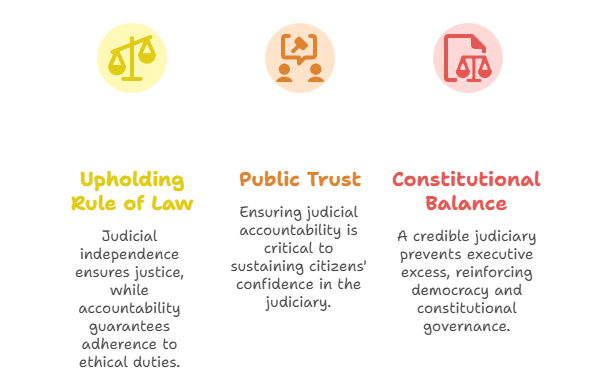
Upholding Rule of Law: While judicial independence ensures justice without interference, accountability guarantees that judges adhere to ethical and legal duties.
Public Trust: In an era marked by misconduct allegations and transparency demands, ensuring judicial accountability is critical to sustaining citizens’ confidence.
Constitutional Balance: A credible judiciary prevents executive excess, reinforcing democracy and constitutional governance.
Key Mechanisms for Accountability
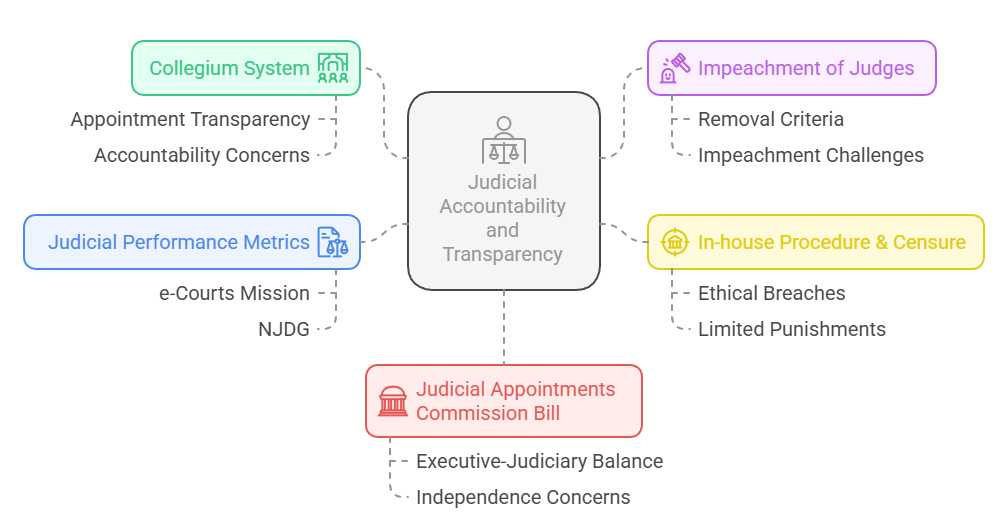
Collegium & Appointment Transparency
The collegium system (Supreme Court–appointed panel) remains the primary method for appointing judges. A landmark 2015 Supreme Court ruling in In re Supreme Court Advocates-on-Record Association upheld its primacy but mandated disclosure of reasons behind appointments and rejections.
Despite improved disclosures, critics argue the process lacks comprehensive accountability and remains opaque.
Impeachment of Judges
Under Articles 124(4) & 217(1), judges can be removed for “proved misbehavior or incapacity.”
Only one removal (Justice V. Ramaswami, 1993) has occurred, highlighting the near-impossible nature of impeachment.
In-house Procedure & CJI-led Censure
The SC/HC can initiate in-house inquiries on ethical breaches. Censure is possible, but punishments are limited.
In 2022, the Supreme Court strongly rebuked Indore Chief Justice S. P. Shirvastava for misconduct—showing willingness to enforce internal discipline.
Judicial Performance Metrics
The e-Courts Mission and NJDG enhance accountability by monitoring caseloads, pendency, and disposal rates.
As of May 2025, over 5.2 crore cases are pending across Indian courts, with average case pendency exceeding three years in High Courts and ten years in some sessions courts.
Judicial Appointments Commission Bill
First introduced in 2014, the JAC Bill sought alternating appointment powers between executive and judiciary.
Though struck down by the Supreme Court in 2015, discussions continue about revisiting a balanced model to improve transparency without compromising independence.
Challenges in Judicial Accountability
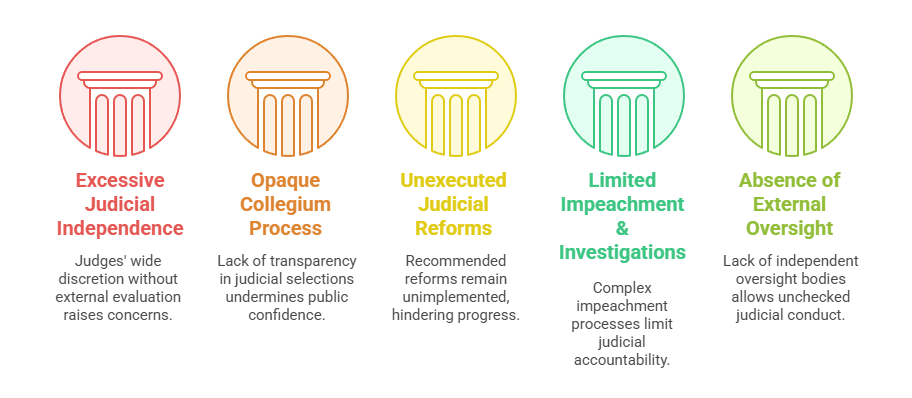
Excessive Judicial Independence
Judges enjoy wide discretion with little external evaluation of competence or integrity.
The Five Judges’ Bench of the Supreme Court (2015) cautioned against unchecked judicial power.
Opaque Collegium Process
The lack of rationale behind clerical selections raises concerns about nepotism and regional bias, undermining confidence.
Unexecuted Judicial Reforms
Despite numerous Law Commission reports (e.g., 227th in 2009), recommended reforms—such as fixed tenures, judicial appraisal, and regulating judicial conduct—remain largely unimplemented.
Limited Impeachment & Internal Investigations
The complexity of the impeachment process results in minimal judicial accountability, often yielding mere “naming and shaming.”
Absence of External Oversight
No independent, statutory body oversees judicial conduct. The National Judicial Oversight Commission, proposed via NALSA’s Justice Verma process (post–2012 Delhi rape case), was rejected by the Supreme Court for threatening independence.
Recent Trends & Reform Initiatives
Increased Transparency in Collegium Decisions
Since 2016, reasons for transfers and rejections are published, enhancing accountability.
As of 2024, around 50 judge transfers have been accompanied by written explanations.
Digital Case Management
e-Courts, via NJDG dashboards, now offer real-time data on case disposals and pendency, aiding performance assessment.
Judicial Ethics & Training
The National Judicial Academy, alongside State Judicial Academies, now conducts mandatory annual ethics training.
Plans are underway to formalize a Judicial Code of Conduct.
Ombudsman Proposals
NALSA has advocated for a judicial ombudsman with quasi-judicial oversight, though the idea hasn’t yet been adopted.
Media & Civic Engagement
NGOs like the Commonwealth Human Rights Initiative (CHRI) and Satark Nagrik Sangathan actively track judicial behavior, filing PILs, and litigating for transparency improvements.
Recommendations for Strengthening Accountability
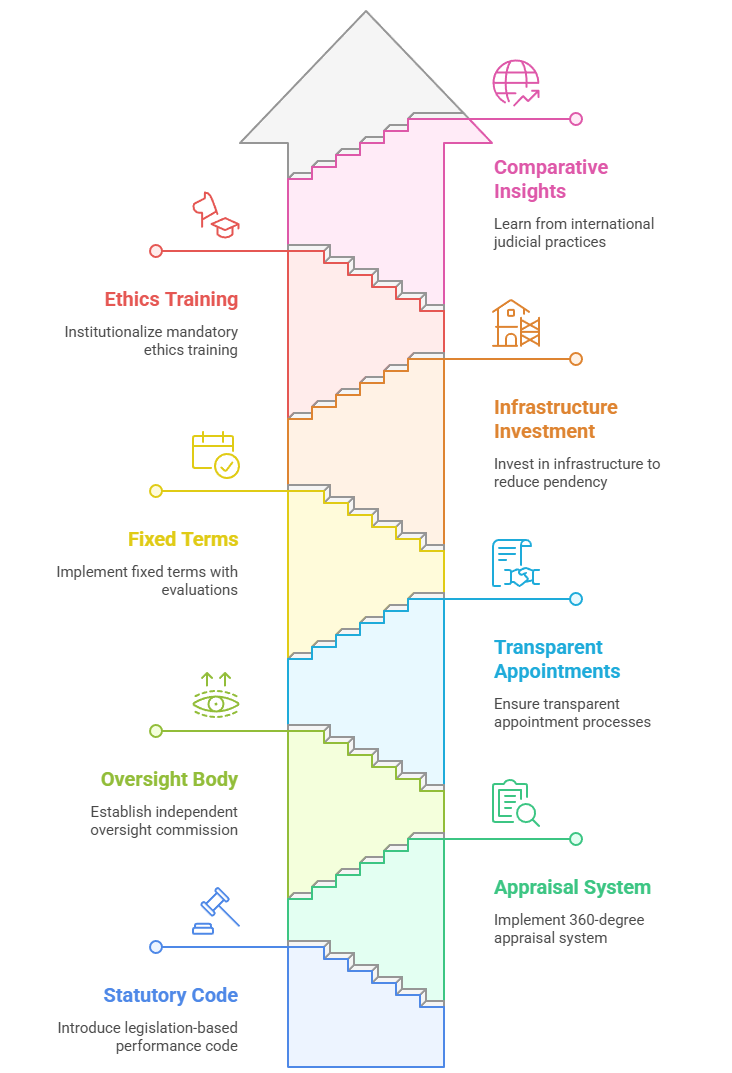
Statutory Code of Conduct
Introduce a legislation-based performance code, containing clear standards, disciplinary mechanisms, and periodic reviews.
Judicial Appraisal System
Implement a 360-degree appraisal involving peers, litigants, lawyers, and academics. Collect feedback in confidentiality to reduce bias.
Independent Oversight Body
A statutory oversight commission could investigate allegations, subject to legislative safeguards and judicial vetting, to maintain independence.
Transparent Appointments
Combine independent experts with collegium; publish full minutes and rationales for appointment decisions.
Fixed Terms with Evaluations
Judges may have fixed tenures (e.g., 4 years), with reappointment contingent upon performance and integrity evaluations.
Improve Infrastructure & Reduce Pendency
Invest ₹10,000 crore by 2027 (e.g., as per 14th Finance Commission recommendation) to create fast-track courts and digital infrastructure, reducing pendency and improving judicial responsiveness.
Mandatory Ethics Training
Institutionalize compulsory training; include counseling and monitoring for judicial officers.
Comparative Insights
UK: Utilizes the Judicial Conduct Investigations Office (JCIO), a transparent, quasi-autonomous government agency to handle complaints.
Canada: Judicial Council oversees formal complaints and publishes detailed annual performance reports.
Australia: Combines the Australian Judicial Commission with court-administered peer review panels.
India could model a similar hybrid—judicial-led yet independent oversight with published findings.
Conclusion
For democracy to thrive, India’s judiciary must be both independent and accountable. Implementing statutory codes, transparent appointment systems, oversight mechanisms, performance appraisals, and infrastructure upgrades can ensure justice is not only done but also seen to be done.
Such measures align with UPSC ideals—constitutionalism, ethical governance, innovation, and public trust. Strengthening judicial accountability is essential to addressing systemic delays, curbing judicial impropriety, and repositioning the judiciary as a pillar of transparent democracy.










2 comments