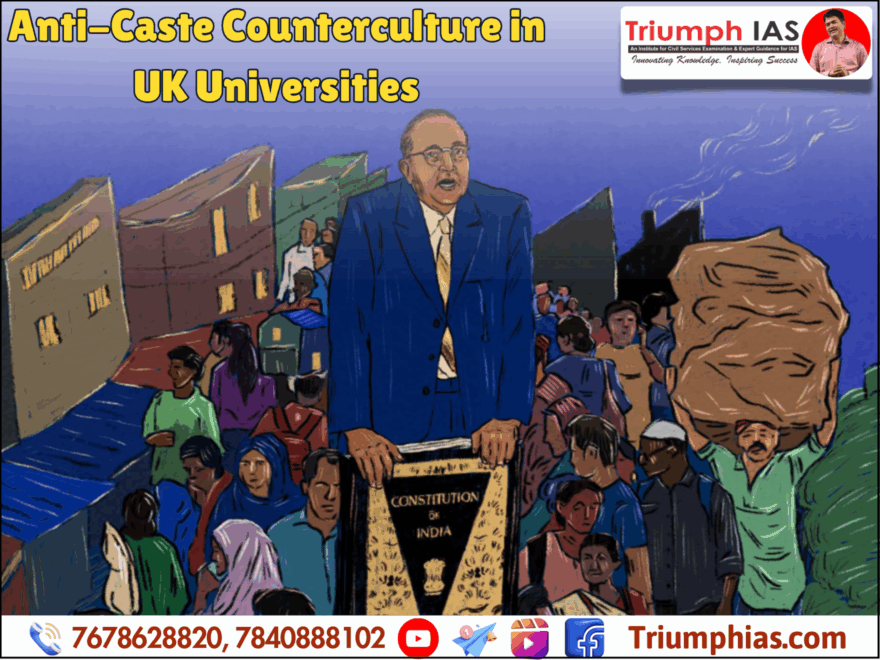
Caste, a deeply entrenched social hierarchy in Indian society, is now being confronted on global platforms, especially in UK universities. As more Dalit, Bahujan, and Adivasi students travel to the UK for higher education, they are sparking a new anti-caste counterculture on campus. Their initiatives challenge existing narratives about ‘India’ and ‘South Asia’ among international students and faculty, highlighting caste-based discrimination and promoting social justice and equality.
Core Issues:
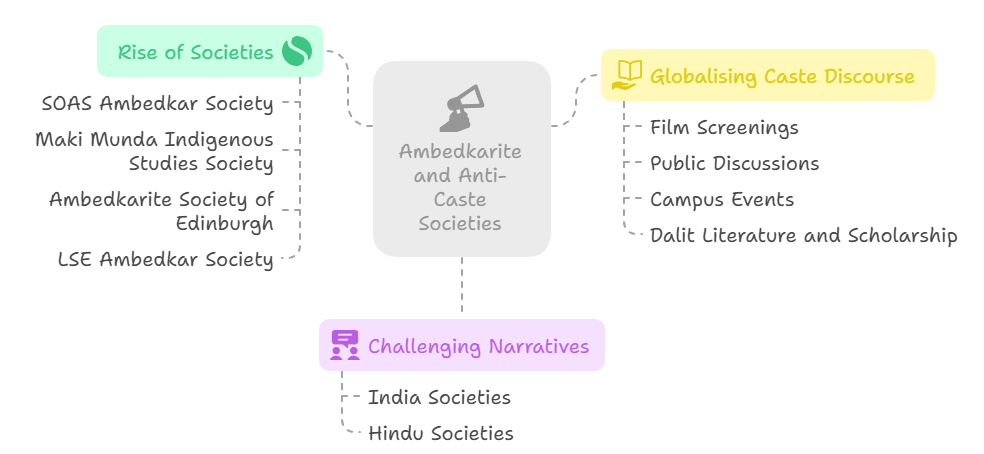
Rise of Ambedkarite and Anti-Caste Societies: Dalit, Bahujan, and Adivasi students in the UK are actively forming dedicated societies such as the SOAS Ambedkar Society, Maki Munda Indigenous Studies Society, Ambedkarite Society of Edinburgh, and LSE Ambedkar Society. These groups organise lectures, workshops, film festivals, and discussions on books to address issues of caste and marginalisation, while also celebrating Dalit and Adivasi heritage. Their presence introduces new narratives and perspectives into the global academic space.
Challenging Dominant Narratives: While traditional ‘India Societies’ and ‘Hindu Societies’ on UK campuses typically celebrate Indian festivals, Bollywood, and mainstream cultural themes, Dalit and Adivasi students have found these spaces to be unrepresentative of their realities. By forming Ambedkarite societies, they are working to democratise campus culture and promote greater inclusivity for historically marginalised voices.
Globalising Caste Discourse: Through activities such as film screenings (including movies like Court and Jai Bhim Comrade), public discussions, and campus events, these student groups are raising awareness about caste inequalities and resistance. Their efforts have also prompted libraries and universities to showcase Dalit literature and scholarship, increasing awareness of caste issues among the international academic community.
Sociological Analysis:
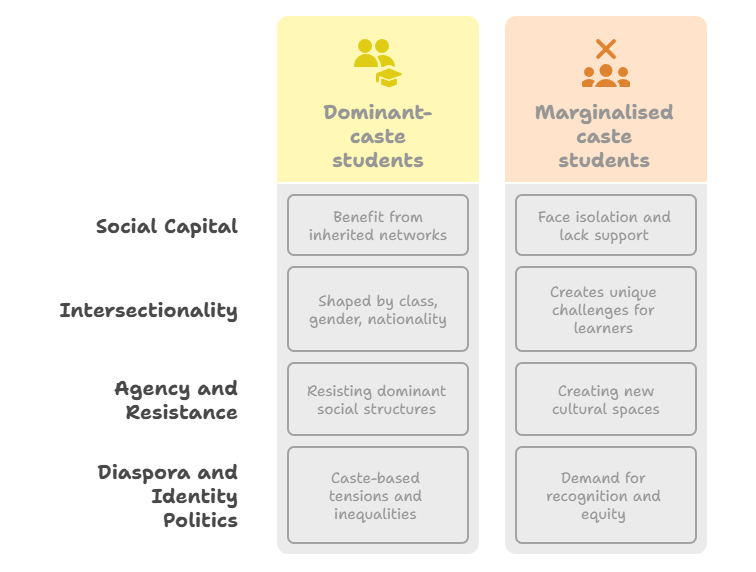
Social Stratification and Marginalisation: Echoing B.R. Ambedkar’s argument that caste is a portable system of hierarchy, sociologists observe that caste-based privilege and exclusion travel with migrants. Pierre Bourdieu’s concept of ‘social capital’ helps explain how dominant-caste students benefit from inherited networks and privilege, while students from marginalised castes often face isolation and lack support, even abroad.
Intersectionality (Kimberlé Crenshaw): The experience of caste-based discrimination abroad is shaped not only by caste, but also by intersecting factors such as class, gender, and nationality. This intersectionality creates unique challenges for first-generation learners and students from marginalised backgrounds, influencing their access to resources and social networks.
Agency and Resistance: The formation of Ambedkarite and anti-caste societies reflects collective agency, as theorised by Anthony Giddens. By organising and advocating, students are resisting dominant social structures, creating new cultural spaces, and redefining the campus environment according to their experiences and aspirations.
Diaspora and Identity Politics: The South Asian diaspora is far from homogenous; caste-based tensions and inequalities are mirrored within it. The emergence of anti-caste countercultures on UK campuses highlights these intragroup dynamics and parallels other global justice movements, such as Black Lives Matter, where lived experience and insider perspectives drive the demand for recognition and equity.
Policy Push:
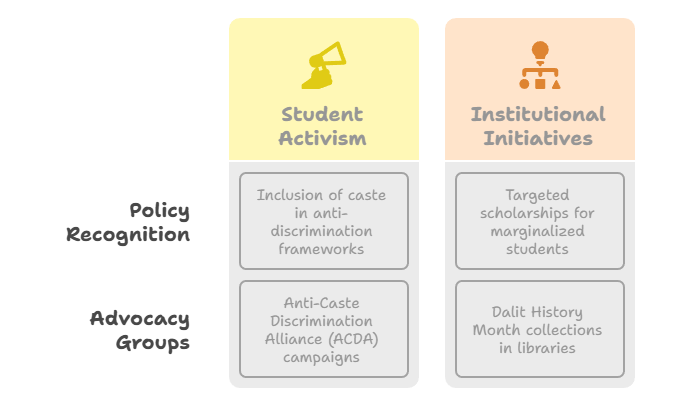
Demand for Policy Recognition: Marginalised students are actively lobbying for caste to be formally recognised in university diversity and equality policies. Their advocacy has led to notable successes, such as the inclusion of caste in the SOAS Students’Union and White Rose Doctoral Studentship anti-discrimination frameworks. These efforts are further supported by activist networks like the Anti-Caste Discrimination Alliance (ACDA), which campaign for caste to be added as a protected category under the UK’s Equality Act.
Institutional Response: Universities are beginning to respond by introducing targeted scholarships, such as the Oxford India Centre’s Savitribai Phule Graduate Scholarship, aimed at supporting students from Scheduled Castes, Scheduled Tribes, and Other Backward Classes. Libraries are also curating collections and displays to mark Dalit History Month, bringing Dalit scholarship and lived experiences into mainstream academic discourse.
Impact and the Road Ahead:
Dalit, Bahujan, and Adivasi voices are changing how caste is perceived and discussed in the UK and globally.
Their activism is paving the way for greater institutional sensitivity, inclusion, and policy reform, both on campus and potentially in national law.
As the number of marginalised caste students grows, the anti-caste movement in UK universities is likely to intensify, forcing a re-examination of privilege, discrimination, and social justicewithin the South Asian diaspora and beyond.
Conclusion:
The emergence of an anti-caste counterculture in UK universities is a powerful example of how grassroots activism by marginalised communities can influence global academic spaces and policy frameworks. It underlines the need for intersectional, inclusive approaches to diversity, not only in India but wherever the diaspora exists. For sociology students, these developments illustrate critical themes from the syllabus: socialstratification, identity, social movements, diaspora studies, and policy advocacy. This case study offers a contemporary lens to understand how structures of power and resistance are not just local but global phenomena.
PYQs
Paper 1:
How does caste as a system of social stratification maintain itself in modern India? (2023)
Discuss the changing nature of caste associations in contemporary India. (2022)
Explain B.R. Ambedkar’s approach to the annihilation of caste. (2021)
Discuss how the concept of ‘social exclusion’ is relevant in understanding the situation of Dalits in India. (2021)
Examine the persistence and change in the caste system in the context of contemporary Indian society. (2017)
How have Dalit movements contributed to the social transformation of Indian society? (2017)
Discuss the role of caste in perpetuating social inequalities. (2016)
Explain the concept of ‘dominant caste’ and its significance in rural society. (2015)
Examine the forms and consequences of untouchability in India. (2014)
Paper 2:
How have Dalit, Bahujan and Adivasi movements contributed to democratization and social justice in India? (2023)
Examine the changing patterns of Dalit assertion in contemporary India. (2022)
Discuss the role of caste associations and caste-based political parties in shaping Indian democracy. (2021)
How is the Indian diaspora negotiating caste and identity in foreign countries? (2020)
Explain the significance of Ambedkarite movements in shaping the discourse on caste equality in India. (2020)
Discuss the relevance of Dr. Ambedkar’s ideas in contemporary social movements for marginalized communities. (2019)
How do social movements contribute to the empowerment of marginalized communities in India? (2017)
Discuss the issues of caste-based discrimination among the Indian diaspora. (2017)
Discuss the status of Adivasis in contemporary India and their struggle for identity and rights. (2015)
Analyse the factors responsible for the emergence of new social movements in India. (2014)








One comment