India Dual Engagement: Navigating Ties with the Global South and the West | Sociology Optional Coaching | Vikash Ranjan Classes | Triumph IAS | UPSC Sociology Optional
India Dual Engagement: Navigating Ties with the Global South and the West
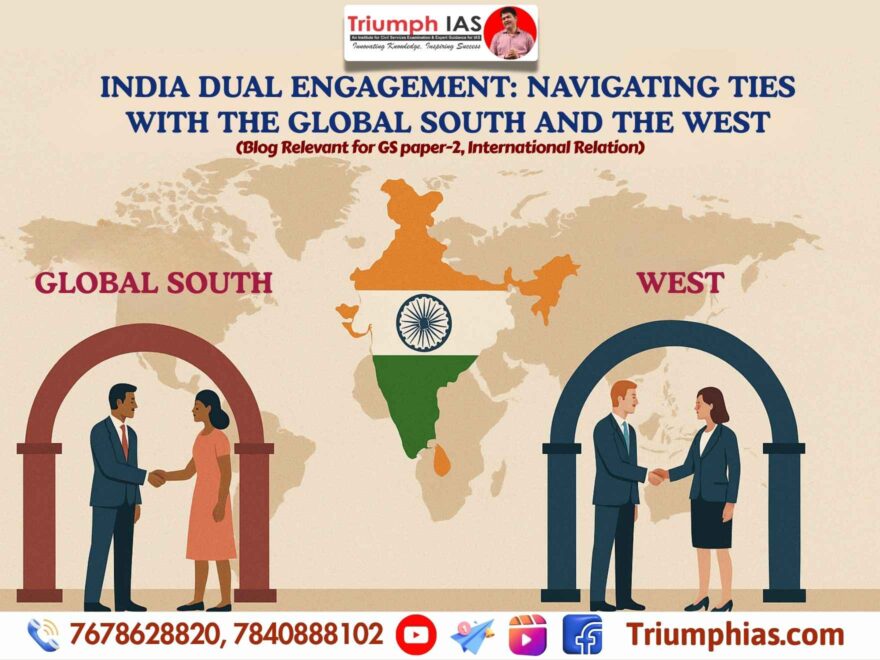
India’s foreign policy in the 21st century has evolved into a dynamic framework that reflects both its historical affiliations and emerging global ambitions. As the world increasingly polarizes between power blocs, India is strategically positioning itself as a bridge between the Global South and the West, championing issues of equity, multilateralism, and economic development while securing its national interests through robust strategic partnerships.
India’s balancing act is not merely diplomatic—it is geopolitical, economic, and ideological, aimed at securing its global stature in an increasingly multipolar world.
Understanding the Global South and the West
Global South refers to developing nations primarily in Asia, Africa, and Latin America that face common challenges such as poverty, underdevelopment, and climate vulnerability. These nations often advocate for equitable global governance and fair trade.
The West typically includes advanced economies like the United States, Canada, and Western European countries—nations that dominate global financial institutions, security frameworks (like NATO), and international discourse.
India’s strategic challenge lies in simultaneously deepening its partnerships with Western powers while retaining leadership and credibility among the Global South, especially in forums like BRICS, NAM, G77, and the United Nations.
India Historical Roots with the Global South
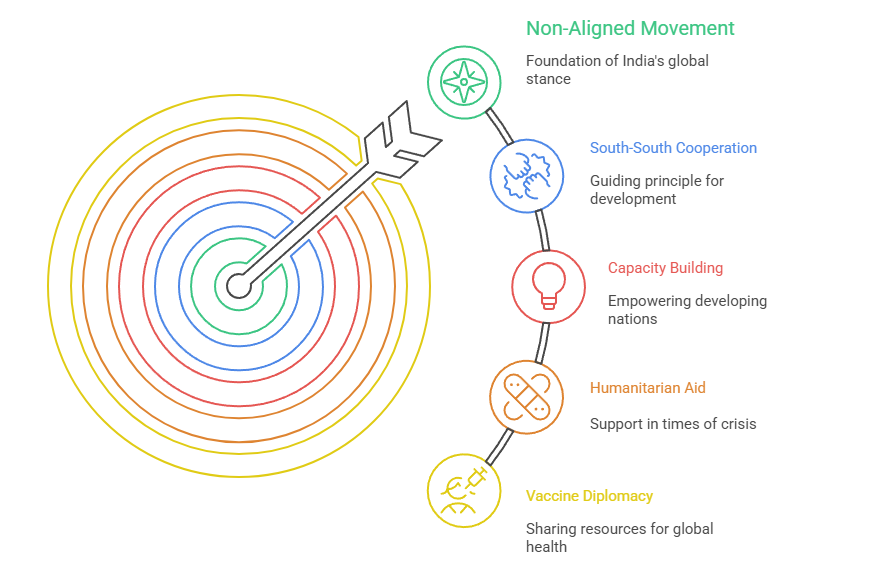
India has traditionally aligned with the Global South, especially during the Cold War as a founding member of the Non-Aligned Movement (NAM).
India’s development cooperation model—based on South-South cooperation, mutual respect, and capacity building—has been lauded across Africa and Southeast Asia.
India’s Pan-African e-Network, humanitarian aid to conflict-affected countries, vaccine diplomacy through Vaccine Maitri, and its support to Least Developed Countries (LDCs) at WTO and climate forums reinforce its leadership role in the Global South.
Strategic Engagements with the West
India–US Partnership
The India–US relationship has transformed from transactional ties to a comprehensive global strategic partnership, especially after the 2008 Civil Nuclear Deal.
Recent developments include:
Initiatives on Critical and Emerging Technologies (iCET) for cooperation in AI, semiconductors, and defense innovation.
India’s inclusion in the Quadrilateral Security Dialogue (Quad) alongside the US, Japan, and Australia.
Joint military exercises such as Yudh Abhyas and Malabar, and defense procurement deals (e.g., GE F414 engine co-production).
India–European Union (EU) Relations
The EU is India’s second-largest trading partner, and ongoing negotiations for an India-EU Free Trade Agreement aim to strengthen economic ties.
India is also engaging with NATO in a non-traditional security dialogue and has signed agreements with France, Germany, and the UK on green energy, mobility, and digital governance.
G20 Presidency and Global South Advocacy
India’s presidency of the G20 in 2023 was a diplomatic milestone that encapsulated this balance.
India positioned itself as the “Voice of the Global South”, hosting a special Virtual Summit of Global South countries in January 2023.
Under India’s presidency:
The African Union was made a permanent member of the G20.
Emphasis was laid on inclusive growth, debt sustainability, and climate finance for developing nations.
India resisted efforts to isolate Russia diplomatically, reflecting a nuanced stance aligned with Global South sensitivities.
Strategic Autonomy: India Defining Approach
India’s foreign policy doctrine has increasingly emphasized strategic autonomy—non-alignment in a new form. This approach is evident in:
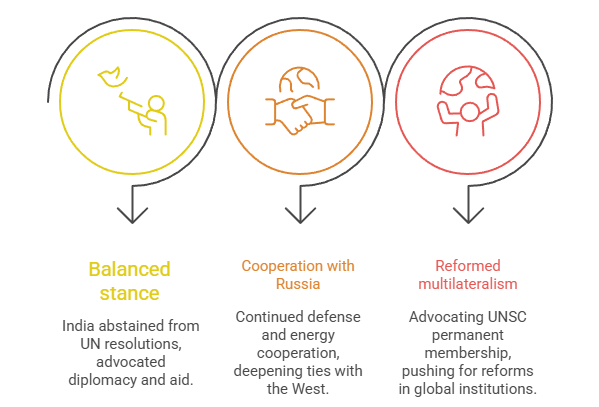
India’s balanced stance on the Russia–Ukraine conflict, where it abstained from UN resolutions but advocated diplomacy and humanitarian assistance.
Continued defense and energy cooperation with Russia, while deepening defense tech and intelligence ties with the West.
Advocating reformed multilateralism, India has sought UNSC permanent membership while pushing for reforms in global institutions like the IMF, World Bank, and WTO, ensuring Global South representation.
India and Multilateral Forums: A Dual Strategy
India tactfully uses both Western and Southern-led platforms:
Western-Led Platforms
G20: Used to highlight Global South issues.
Quad: Used to counter China’s assertiveness in the Indo-Pacific.
I2U2 (India-Israel-UAE-USA): Facilitates cooperation on infrastructure and innovation in West Asia.
Southern-Led Platforms
BRICS: India supports expansion and calls for a multipolar world.
IBSA (India-Brazil-South Africa): Advocates democratic global governance.
ISA (International Solar Alliance) and Coalition for Disaster Resilient Infrastructure (CDRI): Climate-focused initiatives with Global South priorities.
Challenges in Maintaining Balance
Despite successes, India’s tightrope walk faces several challenges:
Perception Management: Aligning with the US and Quad is sometimes seen as undermining India’s non-aligned legacy.
China Factor: India’s Western tilt is partly driven by China’s aggression, but overdependence could constrain India’s maneuverability.
Energy and Trade Dependencies: India imports defense from Russia, oil from West Asia, and seeks Western technology—balancing all these interests requires careful diplomacy.
Institutional Inequity: Global governance institutions still favor Western countries, making India’s efforts to amplify Southern voices difficult without structural reforms.
Way Forward
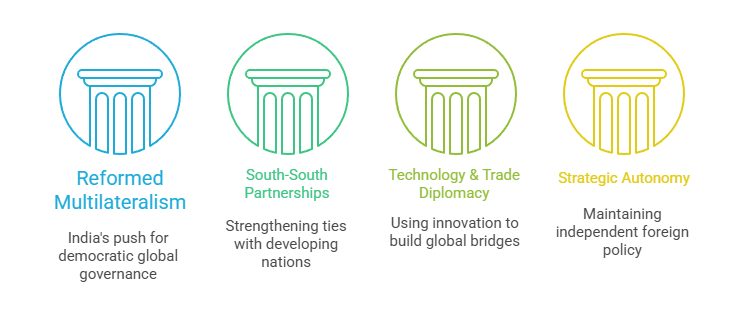
Champion Reformed Multilateralism
India must continue pushing for democratization of global institutions to give voice to the developing world.
Enhance South–South Partnerships
Expand lines of credit, technology transfer, and capacity building across Africa, Latin America, and ASEAN.
Leverage Technology and Trade Diplomacy
Use innovation and digital diplomacy to build bridges with both blocs, focusing on sectors like clean energy, health tech, and fintech.
Institutionalize Strategic Autonomy
Maintain a clear, principled foreign policy that avoids entangling alliances while ensuring strong bilateral and multilateral ties.
Conclusion
India’s ability to balance relations between the Global South and the West is a testament to its mature, multi-aligned foreign policy. As India aspires to become a leading power rather than just a balancing power, this dual engagement—rooted in values of sovereignty, multilateralism, and global justice—can redefine global geopolitics.
India’s role as a consensus-builder, bridge-builder, and rule-shaper positions it not only as a regional power but as a civilizational state with global aspirations, capable of uniting divergent worldviews into a common agenda for peace, development, and equity.