


Empowering Women Entrepreneurs: A Sociological Perspective on the GeM-Womaniya Initiative
(Relevant for Sociology Paper 1: Works and Economic Life)
|
In recent years, the role of women in India’s economy has been increasingly recognized not only as a social justice issue but also as a crucial driver of economic growth. The partnership between the Government e-Marketplace (GeM) and UN Women under the Womaniya initiative marks a pivotal step in this direction. This collaboration aims to boost women entrepreneurs’ participation in public procurement, directly contributing to Sustainable Development Goal 5: Gender Equality. Beyond policy and economics, it is a fascinating case study in how technology, governance, and gender intersect in contemporary India. Womaniya Initiative: Tackling Structural Barriers
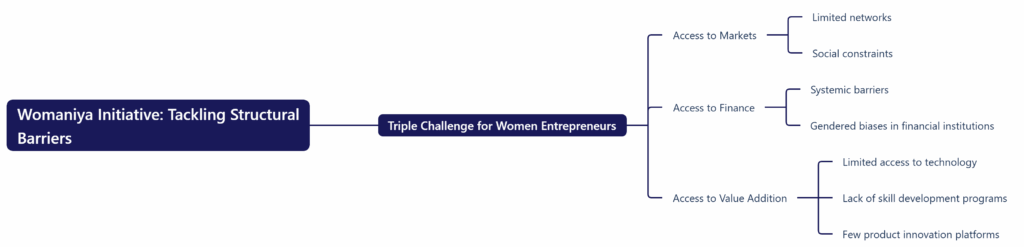
Launched in 2019, the Womaniya initiative targets women-led micro, small, and medium enterprises (MSMEs), self-help groups (SHGs), artisans, and marginalized women. At its core, the program addresses the triple challenge historically faced by women entrepreneurs:
By facilitating direct sales to government agencies and reserving 3% of government procurement for women-owned businesses, Womaniya actively counters these structural disadvantages. According to the Udyam Registration Portal, women-owned MSMEs currently make up 20.5% of all MSMEs, contribute 18.73% to employment, and account for 11.15% of total investment. These figures highlight both progress and the significant potential for expansion. From a sociological lens, this initiative resonates with Amartya Sen’s capabilities approach, which emphasizes the need to create social and economic conditions that allow individuals, particularly marginalized groups, to realize their potential. In this case, Womaniya is not just about providing opportunities—it is about enhancing women’s capabilities to participate meaningfully in the economy. GeM: Digital Infrastructure as a Tool of InclusionThe Government e-Marketplace (GeM), launched in 2016, provides the technological backbone for initiatives like Womaniya. GeM allows central and state government ministries, departments, PSUs, and other government bodies to procure goods and services online. By digitizing procurement, GeM ensures transparency, efficiency, and fairness, addressing long-standing issues of corruption and bureaucratic delays. Independent assessments, including those by the World Bank, indicate nearly 10% cost savings due to GeM adoption. Today, GeM operates in all 36 States and Union Territories, with states like Uttar Pradesh leading the charge, and others such as Maharashtra, Gujarat, and Assam mandating its use. Beyond cost savings, GeM has significant implications for social inclusivity. The platform empowers over 10 lakh MSEs, 1.3 lakh artisans and weavers, 1.84 lakh women entrepreneurs, and 31,000 startups. Furthermore, innovations like GeMAI, India’s first AI-powered public sector chatbot supporting 10 Indian languages, help democratize access for rural and non-English speaking women entrepreneurs. From the perspective of Pierre Bourdieu’s theory of social capital, GeM functions as a mechanism that transforms social and cultural capital into economic capital. By providing a digital network where women can engage directly with government procurement, GeM allows them to convert knowledge, skills, and social networks into tangible economic opportunities. Gender, Technology, and Structural Inequality
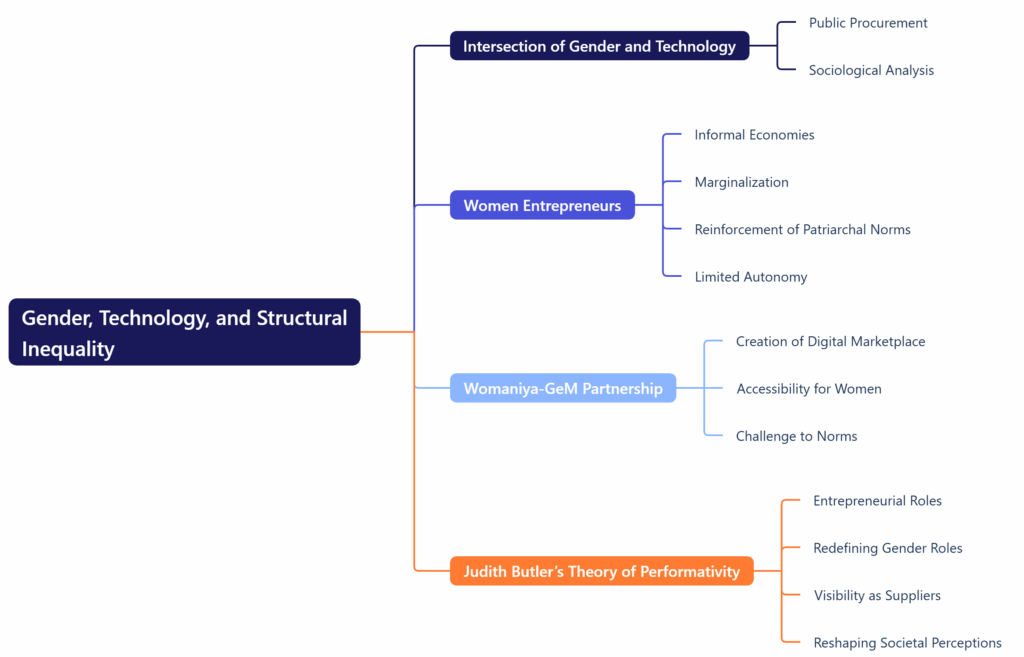
The intersection of gender and technology in public procurement is a fertile area for sociological analysis. Historically, women entrepreneurs have been confined to informal economies or marginalized sectors, often reinforcing patriarchal norms and limiting autonomy. The Womaniya-GeM partnership challenges these norms by creating a formal, digital, and accessible marketplace for women. Judith Butler’s theory of performativity can be applied here: by enabling women to assume entrepreneurial roles in public procurement, the initiative helps redefine socially constructed gender roles. As more women become visible as suppliers to government agencies, societal perceptions of what women can do economically are gradually reshaped. Moreover, the initiative speaks to structural functionalist perspectives, which emphasize the role of institutions in maintaining societal equilibrium. Government procurement, when inclusive, does not merely serve economic goals but also fosters social cohesion and gender equity, correcting imbalances in participation and representation. The Sociological Significance of Economic EmpowermentEconomic empowerment of women has cascading effects on social structures. According to Max Weber, access to economic resources is a source of social power. By integrating women into formal procurement channels, Womaniya does more than create business opportunities—it enhances women’s agency, bargaining power, and societal status. Research in development sociology consistently shows that when women control financial resources, outcomes improve across households, communities, and local economies. Investments in women entrepreneurs have been linked to better health, education, and intergenerational mobility. Therefore, programs like Womaniya are not only economic interventions but strategic social investments. Challenges and OpportunitiesDespite its promise, the Womaniya initiative faces challenges. Social norms, digital literacy gaps, and limited access to credit continue to constrain many women, particularly in rural areas. To address these challenges, there is a need for complementary policies, such as digital literacy training, microfinance schemes, and mentorship networks. Sociologically, these challenges reflect structural inequality, which cannot be remedied by policy alone. As bell hooks argued, empowerment is multidimensional—it requires economic, social, and cultural transformation. Technology and government initiatives can catalyze change, but sustained impact requires shifts in attitudes, norms, and institutional frameworks. Looking Ahead: Toward Inclusive GrowthThe collaboration between GeM and Womaniya is a model of policy-driven social innovation. By combining digital infrastructure with targeted support for women, it demonstrates how governments can use technology to democratize access to economic opportunities. From a broader sociological perspective, this initiative illustrates the interconnectedness of gender, technology, and development. It shows that achieving gender equality is not only a matter of social justice but also a strategic imperative for economic and social progress. As more women enter public procurement and gain visibility in the marketplace, India moves closer to realizing the vision of inclusive, equitable growth. ConclusionThe GeM-Womaniya partnership is more than an administrative program; it is a sociological experiment in restructuring power, agency, and opportunity. By integrating technology, policy, and gender-sensitive design, it empowers women entrepreneurs to overcome structural barriers, redefine societal norms, and participate fully in India’s economic life. This initiative underscores a vital lesson: achieving gender equality requires coordinated efforts across policy, technology, and social structures. As more women engage in public procurement, the ripple effects on families, communities, and society at large will be profound, reinforcing the idea that economic empowerment and social transformation are inseparable. In the words of Amartya Sen, development is about expanding people’s capabilities. Through Womaniya and GeM, women in India are gaining not just markets, but the freedom to define their own economic destinies. |


To Read more topics, visit: www.triumphias.com/blogs
Read more Blogs:
When Society Fails Its Children: A Sociological Analysis of India’s Juvenile Justice Crisis
Triumph IAS Gives Tips on How to Get Ready for the UPSC Prelims 2026
One comment