


Unite Against Violence: A Sociological Reading of Gendered Power, Technology, and Resistance
(Relevant for Sociology Paper 2: Challenges of Social Transformation)
Unite Against ViolenceViolence against women is not an event—it is a structure. As the world observes the International Day for the Elimination of Violence Against Women each year on 25 November, the 2025 theme, “UNiTE to End Digital Violence Against All Women and Girls,” draws attention to a reality long analysed by sociologists: patriarchy adapts. When society evolves, so do the tools of domination. Despite historic frameworks such as CEDAW (1979) and the UN Declaration on the Elimination of Violence Against Women (1993), gender-based violence remains distressingly widespread. This persistence, in sociological terms, reveals the resilience of patriarchal social institutions and cultural norms that shape behaviour across generations. Violence as a Sociological Phenomenon: Beyond Individual ActsSociology treats violence not as isolated “incidents” but as a manifestation of structural inequality, a system of power embedded in social life. Patriarchy and Structural Power – Sylvia Walby’s FrameworkSylvia Walby identifies six structures of patriarchy—household, paid work, the state, male violence, sexuality, and cultural institutions. Violence is not simply an outcome but a mechanism of control, reinforcing women’s subordination in:
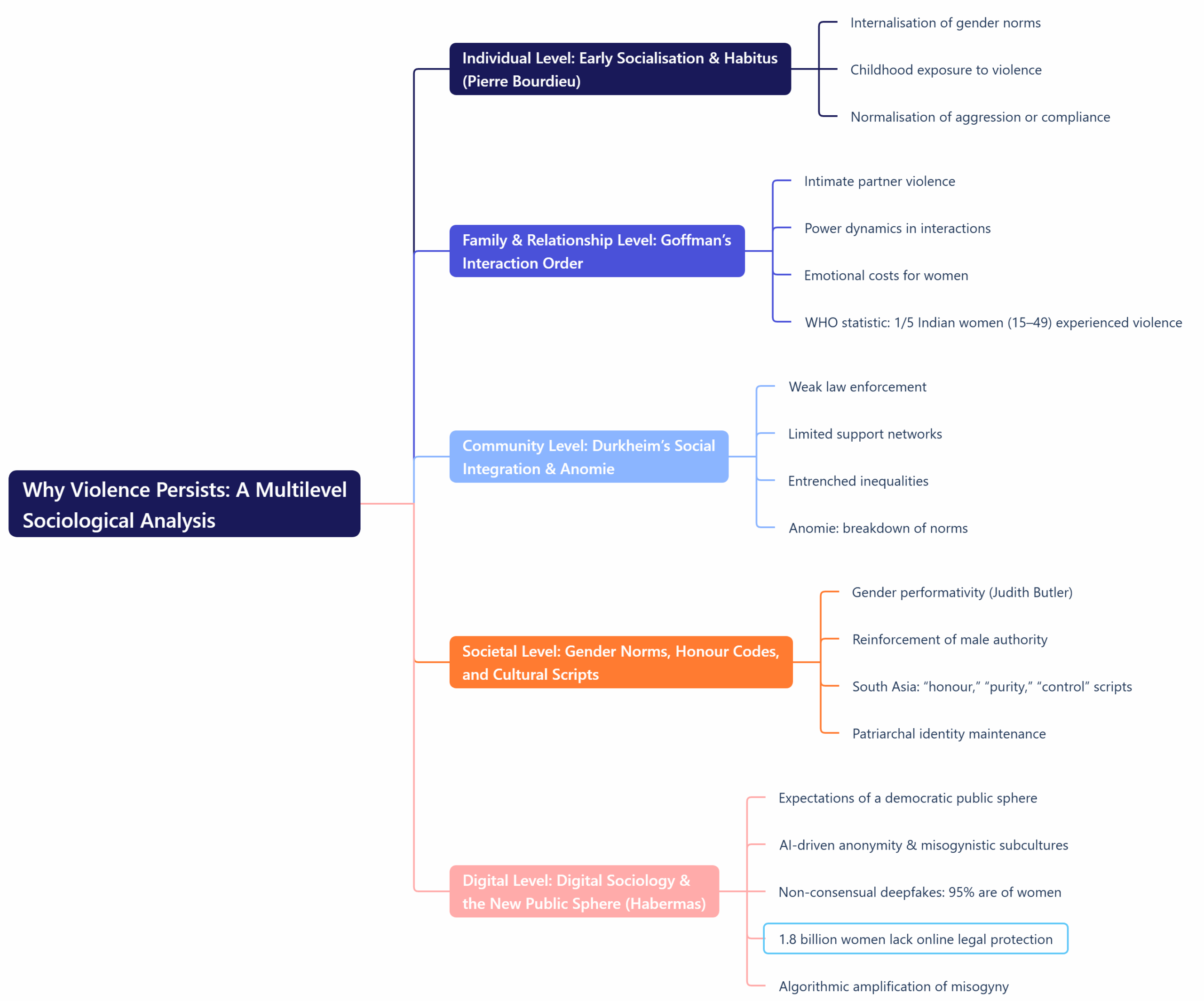
Walby’s insight explains why more than 30% of women globally still experience violence despite new laws. The structural roots remain. Why Violence Persists: A Multilevel Sociological Analysis
Bourdieu’s concept of habitus illuminates how gender norms are internalised early. Childhood exposure to violence or authoritarian gender roles produces dispositions that normalise aggression or compliance.
Erving Goffman helps us understand intimate partner violence as part of the “interaction order,” where everyday interactions are shaped by power, impression management, and emotional labour. Women often bear the emotional cost of maintaining stability, even when abused. According to WHO, over one-fifth of Indian women (15–49) experienced intimate partner violence in 2023—an outcome of deeply unequal interactional dynamics.
Communities with weak law enforcement, limited support networks, and entrenched inequalities exhibit higher rates of violence. Durkheim might argue such communities are marked by anomie—a breakdown of norms—where harmful behaviours become normalised.
Feminist sociologists like Judith Butler highlight how “gender performativity” reinforces stereotypes of male authority and female submission.
The digital world should have been a democratic public sphere, as envisioned by Habermas. Instead, AI-driven anonymity and misogynistic subcultures create a hyper-patriarchal digital environment:
Digital violence is the new mechanism through which patriarchal power reorganises itself. India’s Response: Laws Through a Sociological LensIndia’s frameworks—NCW, PWDVA (2005), POSH (2013), and the Bharatiya Nyaya Sanhita (2023)—represent what Parsons would call institutional mechanisms for maintaining social equilibrium. They attempt to correct dysfunctions caused by gender inequality. Yet, feminist scholars argue that laws alone cannot dismantle patriarchy. The gap between law and lived reality reflects:
Policies like Mission Shakti, One Stop Centres, Women Help Desks, and Fast Track Courts offer multi-layered support, but without transforming attitudes, they remain reactive rather than preventive. Deep Dive: How Sociological Theories Explain Gender Violence
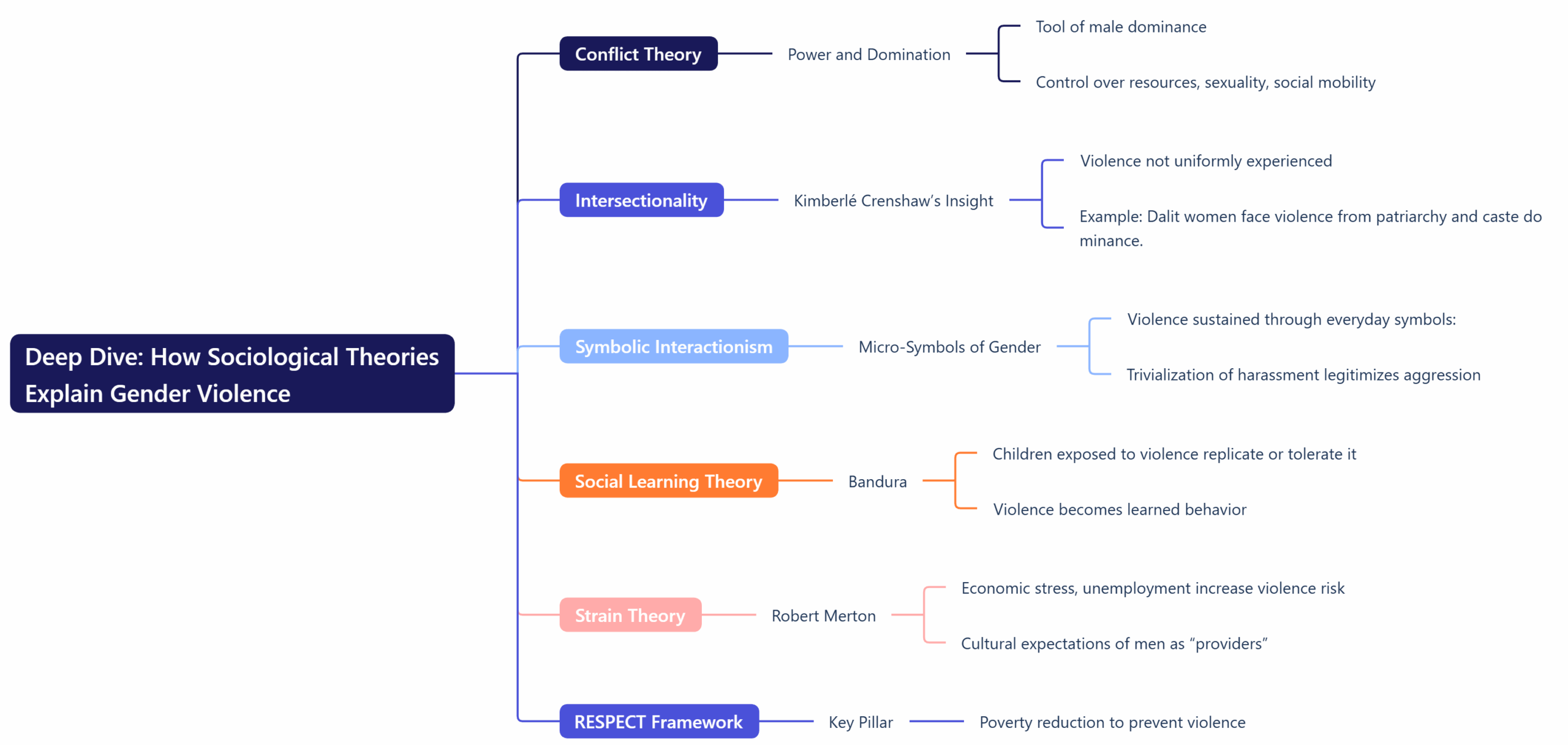
From Marx to contemporary feminist conflict theorists, violence is seen as a tool of male dominance to maintain control over resources, sexuality, and social mobility.
Violence is not experienced uniformly. Women’s vulnerability varies by:
For example, Dalit women face violence grounded not only in patriarchy but caste dominance. Queer women face erasure within legal and support systems.
Violence is sustained through everyday symbols: jokes, slurs, stereotypes, and norms around masculinity.
Children exposed to violence often replicate or tolerate it as adults. Violence becomes a learned behaviour embedded in the social environment.
Economic stress, unemployment, and social frustration can increase the risk of violence, especially in contexts where men are culturally expected to be “providers.” This links directly with the RESPECT framework, which includes poverty reduction as a key pillar in preventing violence. Digital Violence as the New Frontier: A Sociological Problem
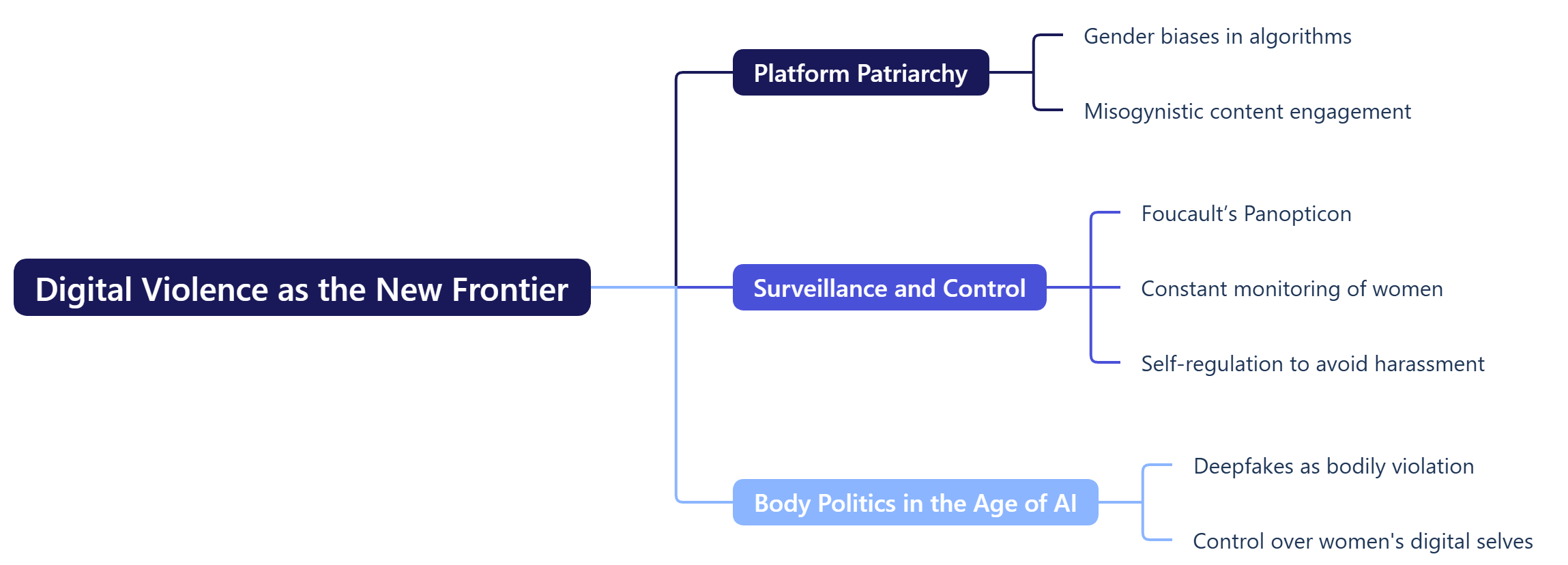
Technology has not erased patriarchy—it has digitised it. Digital sociology highlights three transformations:
Algorithms built predominantly by men often reflect gender biases. Misogynistic content tends to travel faster because it provokes engagement.
Women are constantly watched—on social media, at workplaces, even at home through digital tools. This creates a digital panopticon where women self-regulate to avoid harassment.
Deepfakes and morphing technologies represent a new form of bodily violation, extending control over women’s digital selves. Thus, digital violence is not a technological glitch—it is a continuation of patriarchal power through new mediums. Preventing Violence: A Sociological RoadmapWhile the WHO–UN Women RESPECT framework offers a global blueprint for eliminating violence against women, sociology helps us understand how and why these strategies work. Violence is a product of unequal power relations, gendered socialisation, cultural norms, and institutional biases—so prevention must happen at multiple levels. R – Strengthening Relationship Skills Sociology sees relationship dynamics as shaped by interactional power (Goffman), emotional labour (Hochschild), and gender performance (Judith Butler). Violence often emerges from unequal expectations within intimate relationships. E – Empowering Women This aligns with feminist theory, Marxist feminist critiques, and social capital theory:
Empowerment is not merely material—it is symbolic, relational, and structural. S – Ensuring Services Access to healthcare, legal help, police support, and crisis centres reflects the functionalist principle that institutions must protect vulnerable groups. P – Reducing Poverty Poverty heightens vulnerability through stress, dependency, limited mobility, and reduced exit options.
Reducing poverty is therefore a violence prevention strategy, not just an economic one. E – Making Environments Safe Public spaces, workplaces, and schools reflect urban sociology, environmental criminology, and space-and-power theory (Foucault). C – Preventing Child and Adolescent Abuse Early socialisation shapes gender identities. According to Bourdieu’s habitus, children internalise norms about masculinity, dominance, and silence. T – Transforming Attitudes, Beliefs, and Norms This is the most deeply sociological pillar. It addresses:
Violence persists because society normalises it, excuses it, or silences survivors. Transforming norms is therefore a cultural revolution—not an awareness campaign. What Sociology Ultimately Teaches About PreventionSociology shows that violence cannot be eliminated through laws alone. Violence is:
Therefore, prevention demands:
Only when society transforms its norms, institutions, and power relations can violence decline meaningfully. Conclusion: Toward a Society Free From FearSociologically, violence against women is a product of power, culture, technology, and inequality. It is not a private matter but a public issue, as C. Wright Mills would insist—a structural problem requiring structural solutions. A society where half the population lives in fear cannot call itself modern, democratic, or humane. Ending violence is not just a women’s issue; it is a societal re-engineering project. To eliminate violence against women is to imagine a new social order—one rooted not in dominance but in dignity, equality, and justice. |



To Read more topics, visit: www.triumphias.com/blogs
Read more Blogs:
Empowering Women Entrepreneurs: A Sociological Perspective on the GeM-Womaniya Initiative
Triumph IAS Introduces Interactive Live Tablet Classes for Civil Service Aspirants