


When Society Fails Its Children: A Sociological Analysis of India’s Juvenile Justice Crisis
(Relevant for Sociology Paper 1 & Paper 2: Stratification and Mobility and Challenges of Social Transformation)
|
The India Justice Report’s new study on the juvenile justice system exposes severe institutional breakdowns—high pendency, poorly staffed Juvenile Justice Boards (JJBs), weak transparency, and ineffective coordination. But these findings tell a deeper story. They reveal how Indian society constructs childhood, crime, and deviance, and how institutions mirror these social attitudes. To understand why the juvenile justice system continues to fail, we must turn to sociology’s most influential thinkers—Durkheim, Merton, Becker, Foucault, Parsons, Bourdieu, Luhmann, Giddens, and Indian scholars like Upendra Baxi and Marc Galanter. Their theories illuminate why systems meant to protect children often end up reproducing inequality and stigma. High Pendency of JJB Cases: Durkheim’s “Anomie” and Breakdown of Social Solidarity
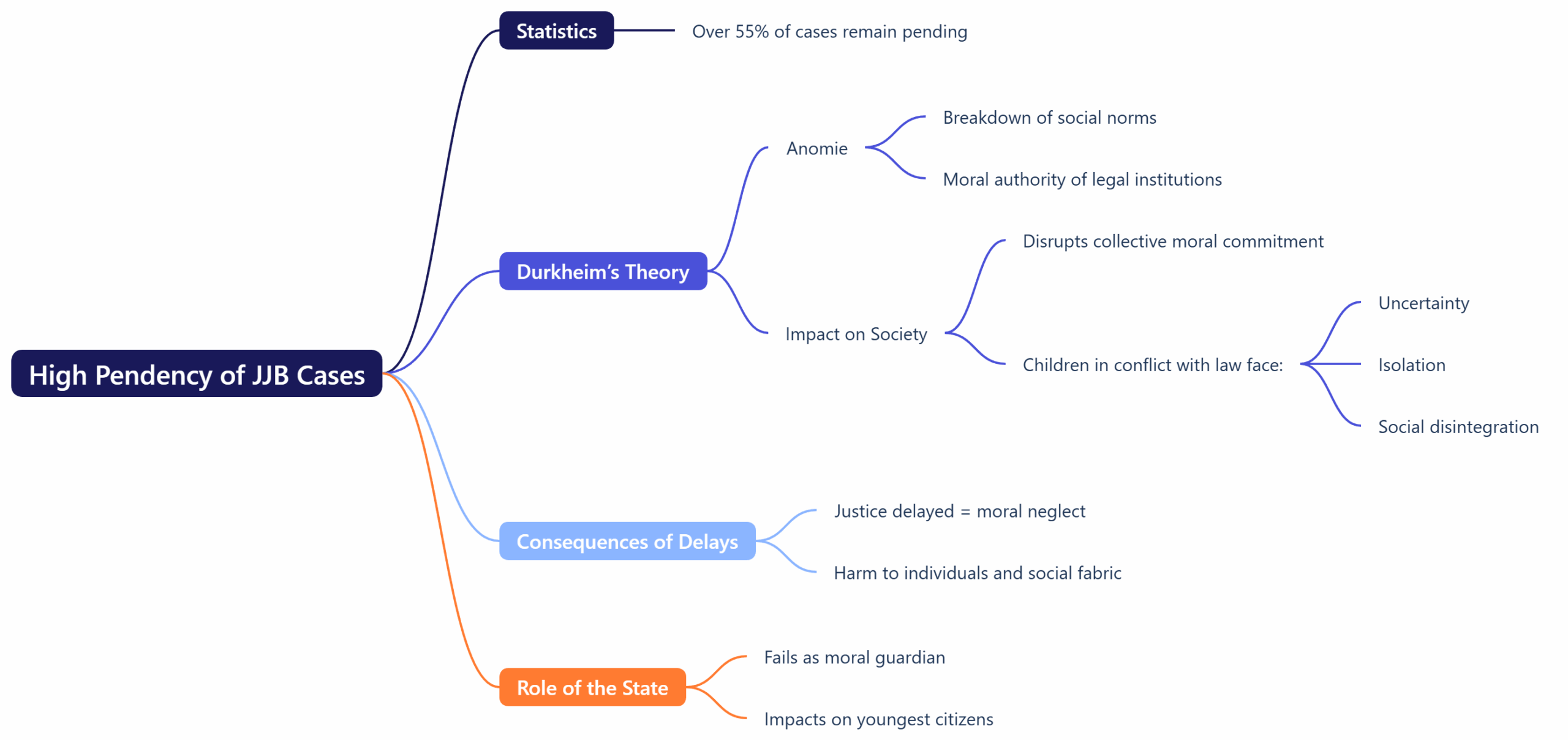
Over 55% of all cases before JJBs remain pending. Durkheim’s viewpoint applied: Pendencies of this magnitude mean the state is no longer performing its role as the moral guardian of its youngest citizens. Incomplete JJBs and Weak Infrastructure: Parsons’ System FailureWith 24% of JJBs not fully constituted and 30% lacking legal services clinics, the system cannot meet its basic functional requirements. According to Talcott Parsons’ structural-functionalism, societies survive when institutions perform four key functions (AGIL). When institutions fail to achieve these, systems destabilise. Parsons’ viewpoint applied: Thus, the system’s design produces injustice. Weak RTI Responses and Institutional Opacity: Bourdieu’s “Symbolic Violence”Only 36% of RTI queries received complete responses. Bourdieu’s viewpoint applied: Poor Inter-Agency Coordination: Luhmann’s “Decoupled Subsystems”The JJ system relies on police, WCD departments, State Child Protection Societies, Legal Services Authorities, and CCIs. The report notes weak coordination and fragmented data-sharing. Niklas Luhmann argued that modern societies contain self-referential subsystems (law, politics, welfare) that often fail to communicate with one another. Luhmann’s viewpoint applied:
The complexity of the system itself becomes a barrier to justice. Absence of a National Data Grid: Giddens’ Lack of “Reflexive Monitoring”Experts highlight the need for a child-centric data grid. Giddens’ viewpoint applied: Criminalising Children: Becker’s Labelling Theory and the Social Construction of DevianceHoward Becker argued that deviance is not inherent in the act but in the label society attaches to individuals. Becker’s viewpoint applied:
The label becomes a self-fulfilling prophecy. By delaying hearings and failing to rehabilitate, the system deepens the deviant identity rather than dissolving it. Trying 16–18-Year-Olds as Adults: Foucault’s Disciplinary Power and Punitive LogicThe JJ Act allows children aged 16–18 to be tried as adults for heinous crimes. Foucault’s viewpoint applied: Foucault’s insight helps explain why institutions prefer punishment—it is easier to control than to reform. Why Marginalised Children Suffer Most: Merton’s Strain TheoryRobert Merton argued that deviance arises when social structures prevent individuals from achieving socially approved goals through legitimate means. Merton’s viewpoint applied:
Their conflicts with the law often reflect structural strain—not inherent criminality. Inequality Before Institutions: Indian Thinkers Galanter & Baxi
Galanter’s theory explains that powerful institutions (like the police or state departments) are “repeat players” who benefit from delays and complexity, whereas children are “one-shotters” with minimal institutional knowledge.
Baxi argues that formal justice systems often exclude the poor through cost, delay, procedure, and institutional arrogance. Applied here: What a Sociologically Informed Reform Should Look Like
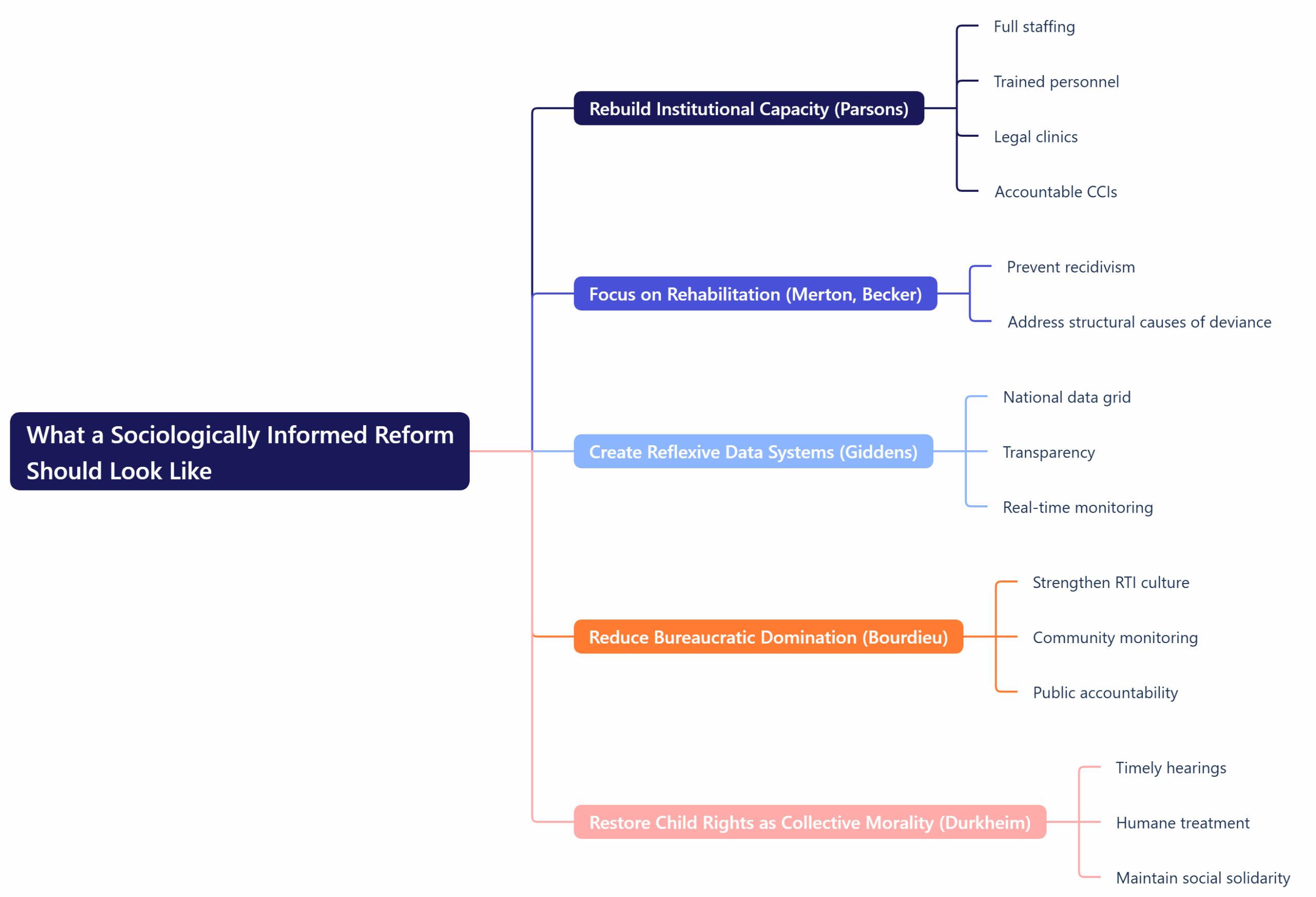
Full staffing, trained personnel, legal clinics, and accountable CCIs.
Prevent recidivism by addressing structural causes of deviance.
A national data grid for transparency and real-time monitoring.
Strengthen RTI culture, community monitoring, and public accountability.
Ensure timely hearings and humane treatment to maintain social solidarity. Conclusion: Beyond Law, A Sociological CrisisThe gaps exposed by the India Justice Report show that India’s juvenile justice system is not merely administratively weak—it is sociologically misaligned.
A humane juvenile justice system requires more than laws—it requires confronting the social structures that shape childhood, deviance, and institutional power.India must choose whether it wants a system that disciplines children or one that nurtures them.Only one of these choices leads to a just society. |


To Read more topics, visit: www.triumphias.com/blogs
Read more Blogs:
Four Labour Codes and the Transformation of India’s World of Work: A Sociological Analysis
One comment