


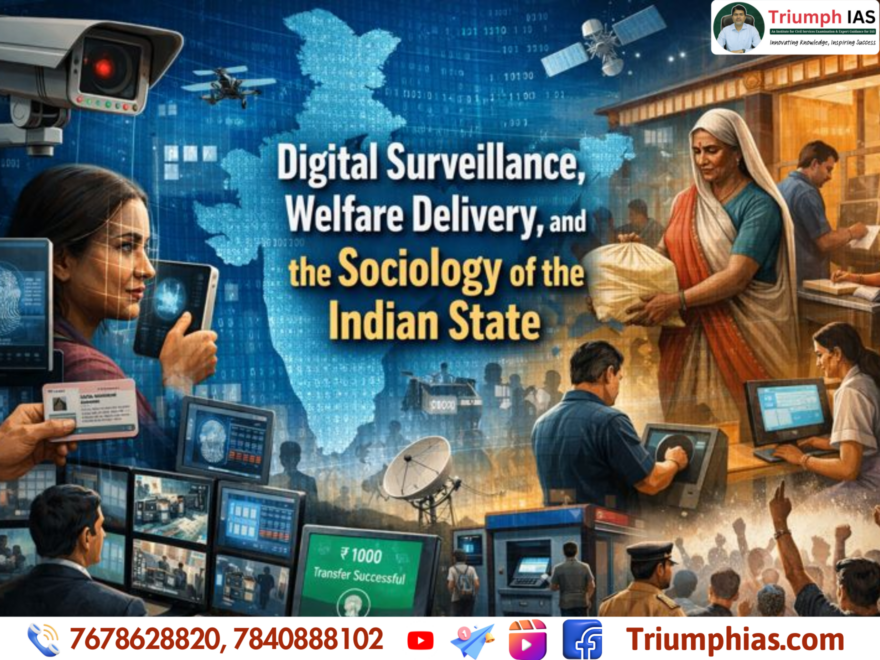
Digital Surveillance, Welfare Delivery, and the Sociology of the Indian State
(Relevant for Sociology Paper I and II)
IntroductionIn recent years, India has witnessed an unprecedented expansion of digital governance, ranging from Aadhaar-based identification and Direct Benefit Transfer (DBT) to facial recognition, predictive policing, and AI-enabled welfare targeting. In 2024–25, debates around the Digital Personal Data Protection Act (DPDP Act), expansion of AI surveillance tools, and digitisation of public services have intensified. While the state presents digitalisation as a tool of efficiency, transparency, and inclusion, sociologists raise critical questions about power, exclusion, privacy, and social control. This blog analyses India’s digital governance trajectory through the lens of Sociology Optional, linking current affairs with classical and contemporary sociological theories on the state, bureaucracy, citizenship, and inequality. Digital Governance as a Contemporary State ProjectFrom a sociological perspective, the state is not merely an administrative apparatus but a structure of power and legitimacy. Max Weber described the modern state as one that monopolises the legitimate use of force, operating through rational-legal authority and bureaucracy. Digital governance represents a new phase of this bureaucratic rationality. In India, initiatives such as:
reflect what scholars call the “digital Weberian state”—where rules, records, and surveillance are embedded in algorithms and databases. However, unlike classical bureaucracy, digital systems:
This transformation raises fundamental sociological concerns about accountability and democratic control. Welfare State, Technology, and Social StratificationDigital Welfare Delivery and DBTIndia’s welfare architecture increasingly relies on digital platforms for targeting and delivery. Direct Benefit Transfer has been praised for reducing leakage and corruption. Yet, from a sociological standpoint, welfare is not just about efficiency but social justice and dignity. Pierre Bourdieu’s concept of social capital helps explain why digital welfare does not benefit all equally. Access to smartphones, internet literacy, biometric accuracy, and documentation varies across:
For instance:
Thus, digital welfare can unintentionally reproduce structural inequalities, reinforcing what sociologists term “digital exclusion”. Citizenship, Identity, and SurveillanceAadhaar and the Reconfiguration of CitizenshipCitizenship in sociology is not merely legal status but a bundle of rights, recognition, and participation (T.H. Marshall). In India, Aadhaar has become a gateway to welfare, banking, and services, effectively turning biometric identity into functional citizenship. This leads to a shift:
Those who fail authentication risk exclusion from basic entitlements, raising questions about procedural justice. Michel Foucault’s concept of governmentality is particularly relevant here. Digital governance allows the state to:
This transforms citizens into data subjects, governed through continuous surveillance rather than episodic law enforcement. Surveillance, Power, and the Digital Panopticon
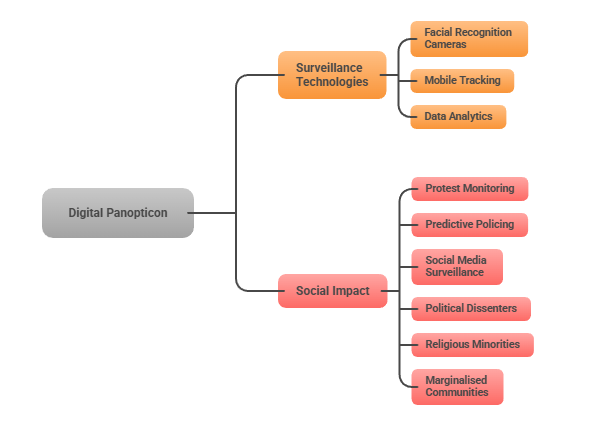
Foucault’s idea of the Panopticon—a system where individuals internalise surveillance—finds renewed relevance in the digital age. Facial recognition cameras, mobile tracking, and data analytics create what scholars call a digital panopticon. In contemporary India:
have expanded, especially in urban centres. From a sociological viewpoint, surveillance disproportionately affects:
This aligns with conflict theory, where the state’s technological power serves dominant groups while disciplining weaker sections. Digital Divide and Social InequalityTechnology as a New Axis of StratificationTraditional sociology focuses on class, caste, and gender. Today, digital access has emerged as a new axis of inequality. The “digital divide” is not merely about internet access but about:
In rural India:
This reinforces what sociologist Manuel Castells calls the “network society”, where power flows through digital networks, marginalising those outside them. Bureaucracy, Algorithms, and AccountabilityMax Weber warned that excessive rationalisation could lead to an “iron cage” of bureaucracy. In digital governance, this cage becomes algorithmic. Key sociological issues include:
When an algorithm denies a ration card or pension, responsibility becomes diffused between:
This creates a crisis of accountability, undermining trust in institutions—a crucial theme for Sociology Optional answers. Federalism and Digital CentralisationIndia’s digital infrastructure is largely centralised, raising concerns within the framework of political sociology. While welfare delivery is constitutionally a shared responsibility, digital platforms often:
This creates tension between:
From a sociological lens, this reflects the dominance of technocratic rationality over contextual governance. Gender, Care Work, and Digital ExclusionFeminist sociology highlights how state policies often ignore unpaid care work and gendered constraints. Digital governance assumes:
However, women—especially in rural India—face:
Thus, digitalisation may deepen gendered power hierarchies, contradicting its promise of empowerment. Resistance, Agency, and Digital CitizenshipDespite these challenges, citizens are not passive recipients. Sociological studies show:
This reflects Anthony Giddens’ structuration theory, where individuals exercise agency even within constraining structures. Digital citizenship, therefore, is not only about compliance but also about negotiation and resistance. ConclusionIndia’s digital transformation marks a profound shift in the relationship between the state and society. While technology promises efficiency and inclusion, sociology reminds us that technology is never neutral. It operates within existing structures of power, inequality, and ideology. For policymakers, the challenge lies in designing human-centred digital governance that balances efficiency with equity, surveillance with rights, and innovation with accountability. For sociology students, this moment offers a rich terrain to connect theory with contemporary reality, making digital governance one of the most important current affairs themes of our time. |

To Read more topics, visit: www.triumphias.com/blogs