


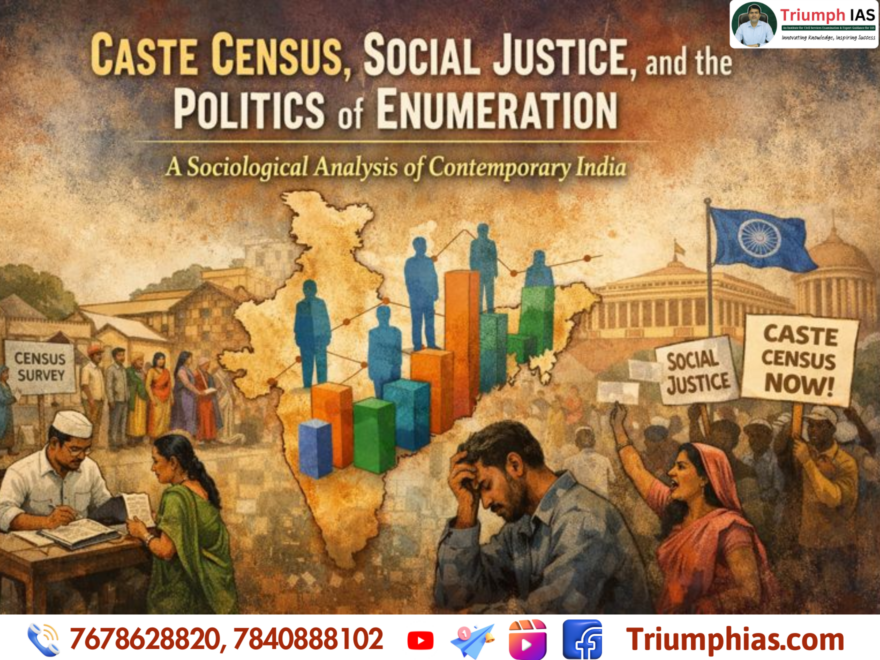
Caste Census, Social Justice, and the Politics of Enumeration: A Sociological Analysis of Contemporary India
(Relevant for Sociology Paper I and II)
IntroductionThe renewed national debate around conducting a caste census in India has emerged as one of the most significant social and political issues in recent years. While the Indian state has periodically collected caste data for Scheduled Castes and Scheduled Tribes, comprehensive enumeration of all caste groups has not been undertaken since 1931. Recent demands by political parties, state governments, and civil society organisations for a nationwide caste census have brought questions of social justice, representation, and equality to the forefront of public discourse. For sociologists, the caste census is not merely an administrative exercise; it is deeply intertwined with power, knowledge, identity, and state control. Who is counted, how they are classified, and how data is used have far-reaching implications for policy-making and social relations. This blog examines the caste census debate through classical and contemporary sociological perspectives, situating it within India’s current socio-political context. Census as a Social and Political InstrumentSociologically, a census is not a neutral statistical tool. Michel Foucault’s concept of knowledge–power highlights how data collection enables governance. By classifying populations, the state acquires the capacity to regulate, manage, and intervene in social life. Colonial censuses in India played a crucial role in fixing fluid caste identities into rigid categories, transforming social hierarchies into administratively manageable units. Post-independence India inherited this classificatory logic but attempted to balance it with constitutional ideals of equality and social justice. The renewed call for a caste census revives these tensions: while data promises transparency and targeted welfare, it also risks reifying caste identities. Caste Census and the Question of Social JusticeProponents argue that without accurate caste data, social justice policies remain blind and inefficient. Reservation policies, welfare schemes, and affirmative action rely on assumptions about population proportions that may no longer reflect social realities. From a Rawlsian perspective of justice, equitable distribution requires awareness of existing inequalities. A caste census could provide empirical evidence to address historical disadvantage more effectively. However, critics warn that enumeration may deepen caste consciousness, reinforcing divisions rather than dismantling them. This reflects the classic sociological debate between recognition and redistribution, articulated by Nancy Fraser. Marx, Ambedkar, and the Material Basis of CasteKarl Marx viewed class as the primary axis of inequality, but Indian sociologists have long argued that caste operates as a unique form of stratification that intersects with class, power, and status. B.R. Ambedkar conceptualised caste not merely as a division of labour but as a division of labourers, rooted in graded inequality. From an Ambedkarite perspective, a caste census becomes a tool of emancipation, exposing structural injustice and enabling democratic redistribution. Recent political demands for caste-based data reflect Ambedkar’s insistence that social democracy must precede political democracy. Weberian Status Groups and Caste EnumerationMax Weber’s concept of status groups offers a nuanced understanding of caste. Caste is not solely about economic position but also about social honour, lifestyle, and exclusion. A caste census could reveal how status hierarchies persist even when economic conditions change. For instance, certain groups may experience social discrimination despite upward mobility, highlighting the autonomy of status from class. Thus, enumeration helps uncover multi-dimensional inequality, a key concern of Weberian sociology. Intersectionality: Caste, Gender, and RegionA major limitation of existing caste data is its failure to capture intersectional realities. Caste disadvantage is experienced differently by women, rural populations, and minorities. Dalit and Adivasi women, for example, face compounded oppression based on caste, gender, and class. A disaggregated caste census could inform gender-sensitive and region-specific policies. Feminist sociologists argue that without intersectional data, welfare interventions remain incomplete and exclusionary. Political Mobilisation and Identity PoliticsThe caste census debate has intensified identity-based political mobilisation. Political parties frame enumeration either as a step towards equality or as a threat to national unity. From a political sociology perspective, caste enumeration becomes a resource for bargaining power. Groups seek numerical strength to negotiate representation, reservations, and political influence. Paul Brass’s theory of elite mobilisation explains how caste identities are activated strategically in competitive political environments. Caste Census and FederalismSeveral state governments have conducted or proposed caste surveys, raising questions about centre–state relations. Social policy increasingly reflects regional priorities and demographic realities. This aligns with cooperative federalism, where states act as laboratories of social reform. However, lack of uniform methodology may produce inconsistent data, complicating national policy-making. Sociologically, this reflects the decentralisation of welfare governance. Risks of Reification and Social FragmentationCritics argue that enumeration risks freezing caste identities, contradicting the constitutional goal of a casteless society. Pierre Bourdieu’s concept of symbolic power is relevant here. Labels imposed by the state carry legitimacy and permanence, shaping how individuals perceive themselves and others. The challenge lies in using data for redistribution without reinforcing stigma—a delicate sociological balance. Caste Census and Development DiscourseIndia’s development narrative often emphasises economic growth while underplaying social inequality. A caste census challenges this narrative by foregrounding structural disparities. Amartya Sen’s capability approach reminds us that development is about expanding freedoms, not merely increasing GDP. Accurate social data is essential for enhancing capabilities among marginalised groups. Comparative PerspectivesGlobally, many societies collect ethnic and racial data to address inequality. The Indian caste census debate can be situated within comparative sociology, examining how plural societies manage diversity through data. However, caste differs from race or ethnicity due to its deep ritual and social embeddedness, requiring context-sensitive approaches. ConclusionThe caste census debate encapsulates the central dilemmas of Indian society: how to balance equality with unity, recognition with redistribution, and data with dignity. Sociology offers tools to move beyond polarised narratives and examine the deeper structural forces at play. A caste census, if designed and implemented carefully, can become a powerful instrument of social justice. However, without reflexive governance and ethical safeguards, it risks reinforcing the very hierarchies it seeks to dismantle. For Sociology Optional aspirants, this topic exemplifies the sociological imagination—connecting historical structures with contemporary politics and future possibilities. As Ambedkar warned, democracy without social equality remains hollow. Enumeration, therefore, must serve emancipation, not merely administration. |
To Read more topics, visit: www.triumphias.com/blogs
2 comments