(Relevant for Sociology Paper I: Stratification and Mobility and Sociology Paper II: Rural and Agrarian Transformation in India; Challenges of Social Transformation)
In the past decade, India’s progress in reducing extreme poverty has been widely recognized. The World Bank and government sources highlight a dramatic drop in poverty from over 27% in 2011–12 to just over 5% by 2022–23. While this appears to be a milestone for India’s development story, a closer look at ground-level realities, as reflected in research from Azim Premji University, Hunger Watch, Pew Research Centre, and others, reveals a much more complex—and sometimes troubling—picture.
Understanding Multidimensional Poverty
Most poverty discussions focus on income-based definitions. But sociologists and economists now stress the importance of multidimensional poverty—which looks beyond earnings to include access to education, healthcare, nutrition, clean water, safe housing, and energy.
Recent data exposes persistent access inequalities:
Uttar Pradesh and Bihar still have some of the lowest rates of LPG and health insurance access.
Many regions lack basic digital and public health infrastructure, especially in rural India.
Despite policy expansions like the Ujjwala Yojana and Ayushman Bharat, large populations remain excluded from tangible benefits, revealing gaps between policy announcements and real-life outcomes.
COVID-19: A Shock That Widened Social Divides
The pandemic was a powerful stress test for India’s welfare architecture.
Findings from the State of Working India 2021 report and the Hunger Watch survey indicate:
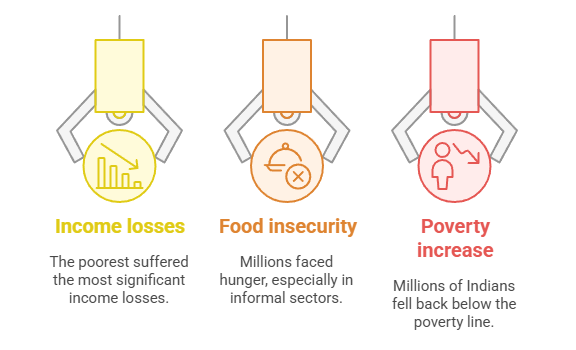
Income losses were most severe among the poorest.
Millions experienced hunger and food insecurity, particularly in informal and casual labor sectors.
Pew estimates that COVID-19 pushed at least 75 million Indians back below the poverty line, exposing the fragility of recent poverty gains.
This disruption underscores how relative poverty and social vulnerability can persist even when headline statistics improve.
Welfare Schemes: Progress, Pitfalls, and Persistent Gaps
Flagship schemes like Ujjwala Yojana (for LPG), Ayushman Bharat (health insurance), and rural housing programs have achieved wide geographic coverage. However:
Ujjwala Yojana’s actual increase in sustained LPG usage was limited, with many reverting to traditional fuels due to refill costs.
Ayushman Bharat improved access to health insurance, but large segments, especially the poor in remote areas, struggle to use these benefits due to weak last-mile delivery.
Implementation challenges, awareness gaps, and bureaucratic inefficiency often limit the effectiveness of these schemes—raising questions about social policy effectiveness in India
Sociological Analysis:
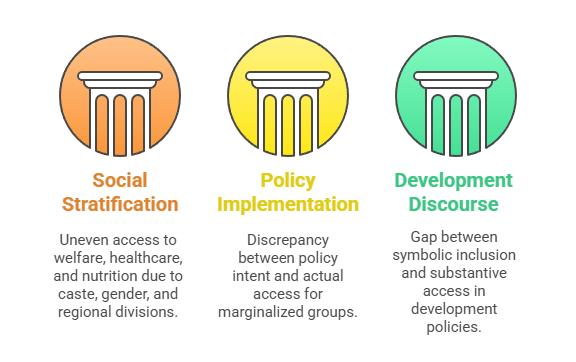
Social Stratification and Persistent Inequality: Poverty in India cannot be separated from caste, gender, and regional divisions. Access to welfare, healthcare, and nutrition is unevenly distributed. The rural poor, Scheduled Castes, Scheduled Tribes, and women remain most vulnerable, perpetuating social stratification despite progress in income metrics.
State, Policy, and Social Exclusion: While universal schemes are vital for inclusive growth, their real impact is undermined if marginalized groups cannot actually access or utilize them. The concept of social exclusion is a key: many communities remain “included” in policy, but “excluded” in practice due to poor implementation, lack of information, or social barriers.
Development Discourse: There’s a growing gap between symbolic inclusion (enrolling beneficiaries) and substantive access (actual use of services). This reflects a wider critique in sociology—that development policy must move from just “counting numbers” to genuinely transforming lives through sustained, equitable access.
Conclusion:
India’s dramatic fall in extreme poverty is an important achievement. Yet, social scientists warn against complacency. For true social transformation, India must focus on reducing access gaps, strengthening last-mile delivery, and addressing deep-rooted inequalities. Only then can the promise of poverty reduction become a reality for all—across every caste, class, gender, and region.
Previous Year Questions
Paper 1:
Discuss the relationship between poverty and social exclusion. How do different sociological perspectives explain this relationship? (2022)
How does social policy contribute to social justice? Discuss with examples from India. (2021)
How do health and education contribute to human development and reduction of poverty? (2020)
Explain the concept of social stratification and examine its persistence in modern India. (2019)
How does social mobility influence patterns of inequality and poverty in society? (2018)
Examine the functional and conflict perspectives on social inequality in India. (2017)
Analyse the impact of globalization on poverty and inequality in developing countries like India. (2016)
Discuss the importance of the concept of relative deprivation in understanding poverty. (2015)
Examine the role of the state in reducing social inequalities in contemporary societies. (2014)
Paper 2:
Critically examine the effectiveness of government welfare schemes in reducing poverty and inequality in India. (2023)
Discuss the impact of social policies such as MGNREGA, Mid-Day Meal Scheme, and Public Distribution System on rural poverty in India. (2021)
How has the COVID-19 pandemic affected pattern of poverty, employment, and social security in India? (2021)
Evaluate the role of public health initiatives like Ayushman Bharat in addressing health inequalities in India. (2020)
Examine the challenges in achieving inclusive development in India in the context of rural-urban disparities. (2019)
How effective are schemes like Ujjwala Yojana in improving the quality of life for women in rural India? (2019)
Examine the impact of LPG (Liberalization, Privatization, and Globalization) reforms on poverty and employment patterns in India. (2018)
Analyse the multidimensional nature of poverty in India and discuss recent policy measures to address it. (2017)
Discuss the role of social movements and civil society organizations in advocating for the rights of the poor and marginalized in India. (2015)








2 comments