


Begging and Homeless Communities in India
(Relevant for Sociology Paper I: Stratification and Mobility and Sociology Paper II: Challenges of Social Transformation)

IntroductionIn the urban sprawl of India’s rapidly developing cities, the presence of begging and homeless communities is a stark reminder of deep-rooted socio-economic inequalities. From traffic intersections to railway platforms, beggars and homeless individuals are part of an often-ignored population segment that raises serious questions about the failure of inclusive development, urban poverty, and state welfare mechanisms. Understanding these phenomena is crucial as they intersect with key concepts like social exclusion, poverty, urban deprivation, and marginalization. Major Causes of Begging and Homelessness in India
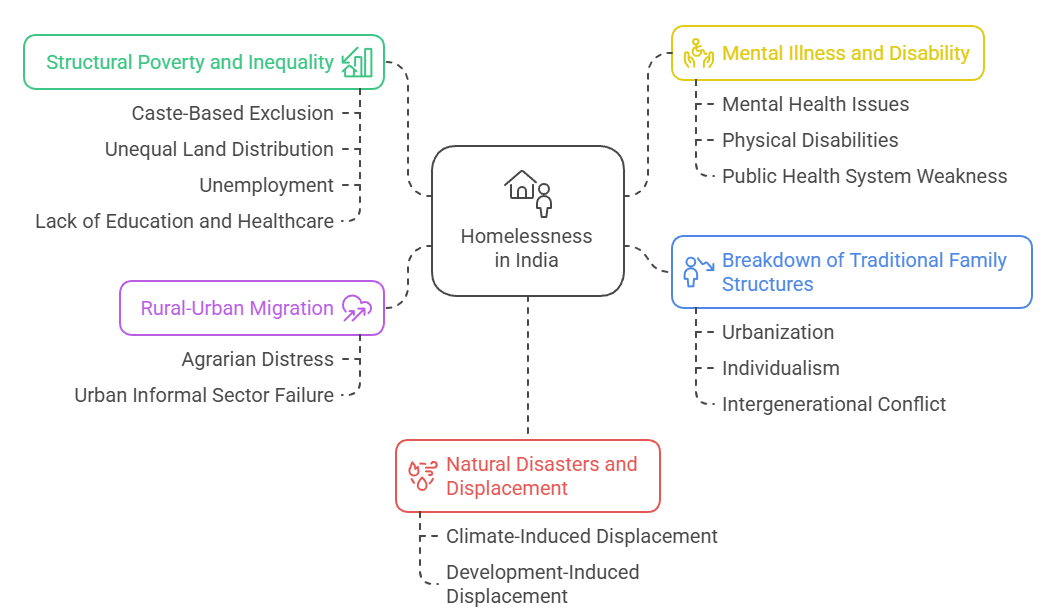
India’s economic development has not translated into equal opportunities for all. Structural poverty persists due to caste-based exclusion, unequal land distribution, unemployment, and lack of access to quality education and healthcare. These factors often push individuals into begging as a last resort for survival.
Due to agrarian distress, especially among landless agricultural laborers, many migrate to urban areas in search of better livelihoods. When the urban informal sector fails to absorb them, they are left homeless and jobless, often resorting to begging.
Many homeless people suffer from mental health issues or physical disabilities. Without a robust public health system or community-based care, they are often abandoned by families and forced into streets, becoming easy targets for exploitation.
In rural India, traditional joint family structures provided some level of social security. However, with urbanization, individualism, and intergenerational conflict, there is an increasing trend of the elderly, widows, and disabled being abandoned.
Floods, droughts, and other climate-induced displacement cause homelessness. Development-induced displacement, such as dam construction or slum demolition, further exacerbates the problem, particularly for Scheduled Castes (SCs) and Scheduled Tribes (STs). Sociological Analysis
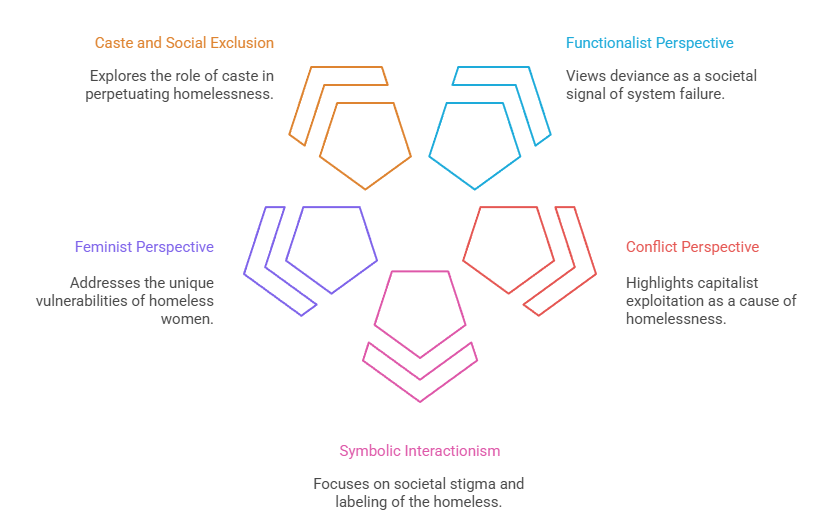
Functionalists like Talcott Parsons argue that deviance has a function in society. Begging might be seen as a form of deviant behavior but also as a signal of system failure. It reflects the malfunctioning of social institutions like economy, education, and health.
Inspired by Karl Marx, this perspective views begging and homelessness as outcomes of capitalist exploitation. The urban elite accumulates wealth while the proletariat or marginalized are pushed into conditions of extreme deprivation. Homelessness is a visible manifestation of the class divide.
According to Erving Goffman, beggars and homeless individuals are stigmatized and labeled as “undeserving poor”. Their identities are shaped by public perception, affecting how society interacts with them. This lens helps understand the micro-level interactions between homeless individuals and the broader public.
Women among the homeless face double marginalization. Not only are they poor, but they are also more vulnerable to sexual violence, trafficking, and exploitation. The feminization of homelessness is a critical area of sociological concern.
As noted by Andre Béteille and G.S. Ghurye, caste continues to play a major role in social stratification. Many beggars belong to Dalit and lower caste communities who face systemic discrimination, exclusion from the job market, and denial of basic human rights. Recent Developments
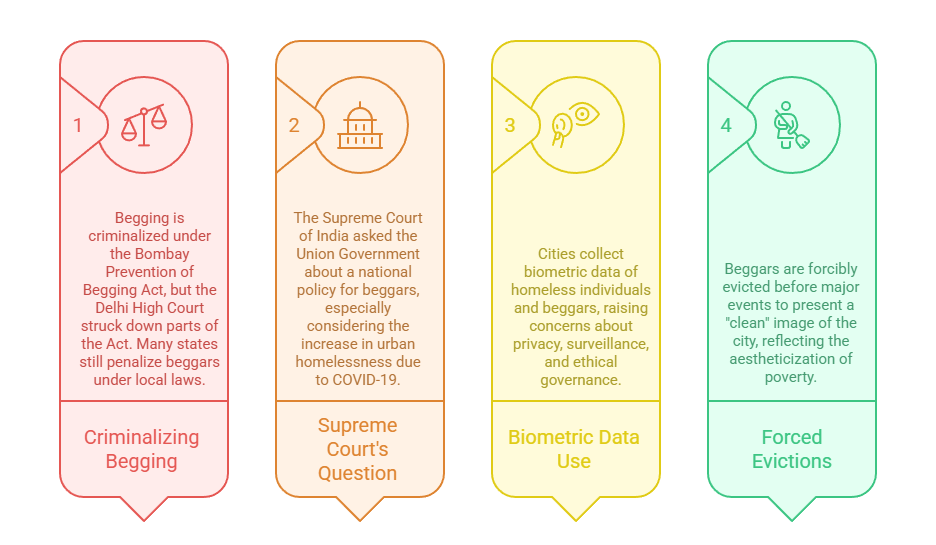
India’s Bombay Prevention of Begging Act, 1959, criminalizes begging. In 2018, the Delhi High Court struck down parts of the Act, stating that begging is not a crime but a symptom of systemic failure. Yet, many states still penalize beggars under local laws.
In February 2021, the Supreme Court of India asked the Union Government whether there is any national policy for beggars, especially in light of COVID-19, which increased urban homelessness.
Cities like Hyderabad and Mumbai have initiated biometric data collection of homeless individuals and beggars. While framed as a rehabilitative measure, this raises questions about privacy, surveillance, and ethical governance.
Before high-profile events like the G20 Summit or Commonwealth Games, beggars are forcibly evicted to present a “clean” image of the city. This reflects the aestheticization of poverty, where the problem is hidden instead of addressed. Government and Civil Society Interventions
Organizations like Goonj, Aashray Adhikar Abhiyan, and SPYM work to rehabilitate homeless individuals through night shelters, skill-building programs, and community kitchens.
Some private companies fund urban shelters, hygiene kits, and community health programs, providing immediate relief to homeless populations. Policy Challenges and the Way Forward
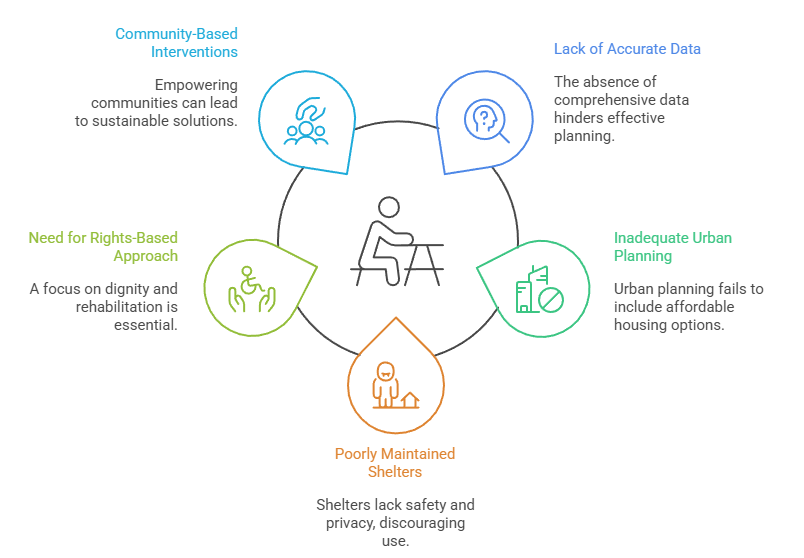
There is no comprehensive national census on homelessness or begging, making it difficult to plan effective interventions. The 2011 Census recorded 1.77 million homeless individuals, but experts believe the actual number is much higher.
Urban planners often do not factor in inclusive housing or low-cost rental homes. The result is a spatial exclusion of the poor from the city’s productive spaces.
Government shelters are often overcrowded, unsafe, and lack privacy, especially for women, LGBTQ+ individuals, and the elderly. This discourages homeless people from availing themselves of shelter facilities.
Instead of treating begging as a nuisance, a rights-based approach focusing on dignity, rehabilitation, and social inclusion is essential. International models like “Housing First” in Finland provide homeless individuals with permanent housing first, then focus on their employment and mental health.
Empowering communities to address homelessness—through local governance, participatory budgeting, and neighborhood shelters—can produce sustainable solutions. ConclusionBegging and homelessness are not just issues of poverty but are deeply embedded in the social structure, economic policies, and urban development models. From a sociological perspective, they reflect institutional failure, social exclusion, and the invisibility of marginal communities in the development narrative. Previous Year QuestionsPaper I:
Paper II:
|






To Read more topics, visit: www.triumphias.com/blogs
Read more Blogs:
Honour Killing: A Sociological Analysis with the Radhika Yadav Case
One comment