


Nurturing Innovation for India’s Future
(Relevant for GS paper-3, Economic growth)

Introduction: Nurturing Innovation for India’s FutureIndia, with its vast human capital and a rapidly growing digital economy, stands at the cusp of a transformative era driven by innovation. As the fifth-largest economy in the world, the country is leveraging its demographic dividend, entrepreneurial spirit, and digital infrastructure to build a robust innovation ecosystem. Over the past decade, India has made significant strides in research, startup development, and technological advancement, positioning itself as a global innovation hub. India’s Innovation Ecosystem: An OverviewThe innovation ecosystem in India encompasses startups, academic institutions, R&D centers, public-private partnerships, and government initiatives that nurture creativity and knowledge-driven growth. India ranked 40th in the Global Innovation Index (GII) 2023, a remarkable improvement from the 81st position in 2015. The Index, published by the World Intellectual Property Organization (WIPO), highlights India’s strengths in knowledge creation, ICT services exports, and the number of graduates in science and engineering. India is now recognized as the world’s third-largest startup ecosystem, with over 1.25 lakh registered startups and over 110 unicorns as of 2025. These ventures are not only driving employment and economic growth but also solving critical problems across sectors such as health, agriculture, education, and logistics. Government Initiatives Promoting Innovation
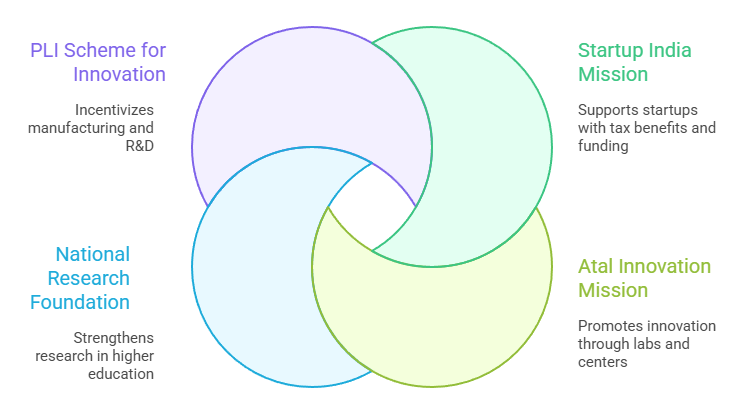
Launched in 2016, the Startup India Mission aims to build a strong ecosystem for innovation and entrepreneurship. It provides tax exemptions, easier compliance, access to funding via the Fund of Funds for Startups (FFS), and the Startup India Seed Fund Scheme (SISFS).
Under NITI Aayog, AIM promotes a culture of innovation through Atal Tinkering Labs (ATL) in schools, Atal Incubation Centres (AICs) for startups, and grand challenges to solve societal issues. As of 2024, over 10,000 ATLs and 70+ AICs have been established across the country.
The NRF, announced under the National Education Policy 2020, aims to strengthen the research ecosystem in higher education institutions with a budgetary allocation of ₹50,000 crore over five years. It focuses on interdisciplinary research and collaboration between academia and industry.
The Production-Linked Incentive (PLI) scheme, launched in 2020, incentivizes domestic manufacturing and R&D in high-tech sectors such as electronics, pharmaceuticals, drones, and solar PV modules. It has drawn global companies to invest in India’s innovation-driven supply chains. Digital Infrastructure and InnovationIndia’s digital infrastructure, built on the pillars of Digital India, JAM Trinity (Jan Dhan, Aadhaar, Mobile), and India Stack, is revolutionizing public service delivery and entrepreneurial innovation. The Unified Payments Interface (UPI) has emerged as the world’s largest real-time digital payments system, processing over 14 billion transactions monthly in 2024. The Open Network for Digital Commerce (ONDC), BharatGPT, and National Data Governance Framework Policy are recent efforts to democratize digital access, promote AI innovation, and ensure responsible data use. Sectoral Innovation Highlights
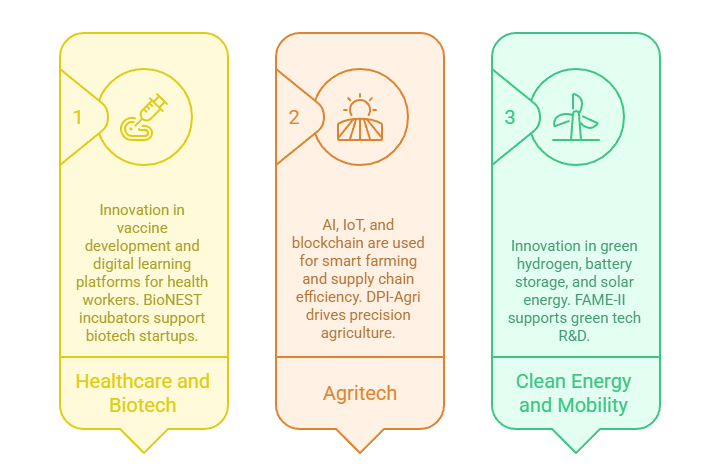
India’s innovation in vaccine development during COVID-19, including Covaxin and Covishield, showcased its R&D prowess. In 2023, India launched iGOT Health, a digital learning platform for health workers, and inaugurated BioNEST incubators to support biotech startups.
With over 1,500 agritech startups, India is using AI, IoT, and blockchain for smart farming, supply chain efficiency, and crop insurance. Initiatives like the Digital Public Infrastructure for Agriculture (DPI-Agri) are driving precision agriculture and financial inclusion in rural areas.
India’s transition to clean energy has led to innovation in green hydrogen, battery storage, and solar energy. Startups like Log9 Materials are developing fast-charging EV batteries, while government-backed FAME-II and National Green Hydrogen Mission are supporting green tech R&D. Challenges to India’s Innovation LandscapeDespite impressive growth, India’s innovation ecosystem faces several hurdles:
Policy Recommendations and Way Forward
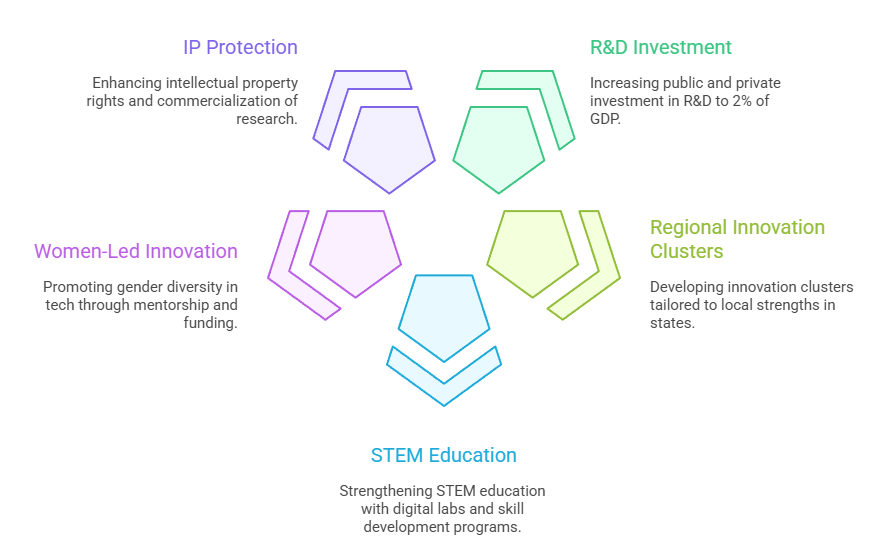
Public and private sector investment in R&D must be enhanced to at least 2% of GDP, as envisaged in India’s Science, Technology, and Innovation Policy.
States should develop innovation clusters tailored to local strengths—like IT in Karnataka, biotech in Telangana, and agritech in Punjab. The State Startup Ranking Framework can be a guiding tool.
Programs like PM Kaushal Vikas Yojana, Skill India Digital Platform, and digital labs in schools should focus on emerging technologies such as AI, robotics, quantum computing, and cyber security.
Only 14% of Indian entrepreneurs are women. Policies should promote gender diversity in tech and innovation through targeted mentorship and funding support.
India must strengthen its Intellectual Property Rights (IPR) regime by streamlining patent processes and promoting commercialization of academic research. ConclusionIndia’s innovation journey is vibrant and dynamic, driven by youth, technology, and digital transformation. With supportive government policies, increasing private sector participation, and a focus on inclusive development, India is poised to become a global innovation leader. To truly harness its potential, a collaborative effort across all stakeholders—government, academia, industry, and civil society—is essential. Strengthening this innovation landscape is not just an economic imperative, but a crucial pathway to sustainable, inclusive, and resilient development. |



To Read more topics, visit: www.triumphias.com/blogs
One comment