


Health for All, or Health for Some? Ayushman Bharat and the Promise of Universal Coverage
(Relevant for Sociology Paper 2: Population Dynamics)
IntroductionIn a country as vast and unequal as India, healthcare access is a measure not just of policy success but of social justice. Launched with the vision of achieving Universal Health Coverage (UHC), Ayushman Bharat–Pradhan Mantri Jan Arogya Yojana (AB-PMJAY) has emerged as one of the largest public health insurance schemes in the world. But as the National Health Authority’s (NHA) Annual Report 2024–25 reveals, this success story is layered with contradictions—between public and private sectors, access and equity, vision and reality. Ayushman Bharat: An OverviewLaunched in 2018, Ayushman Bharat has two key components:
The scheme covers around 55 crore people (the poorest 40%), based on SECC 2011 data and legacy RSBY lists. Over 35 crore Ayushman cards have been issued, with nearly half to women. Key Insights from the NHA Report (2024–25)
Successes and Gains
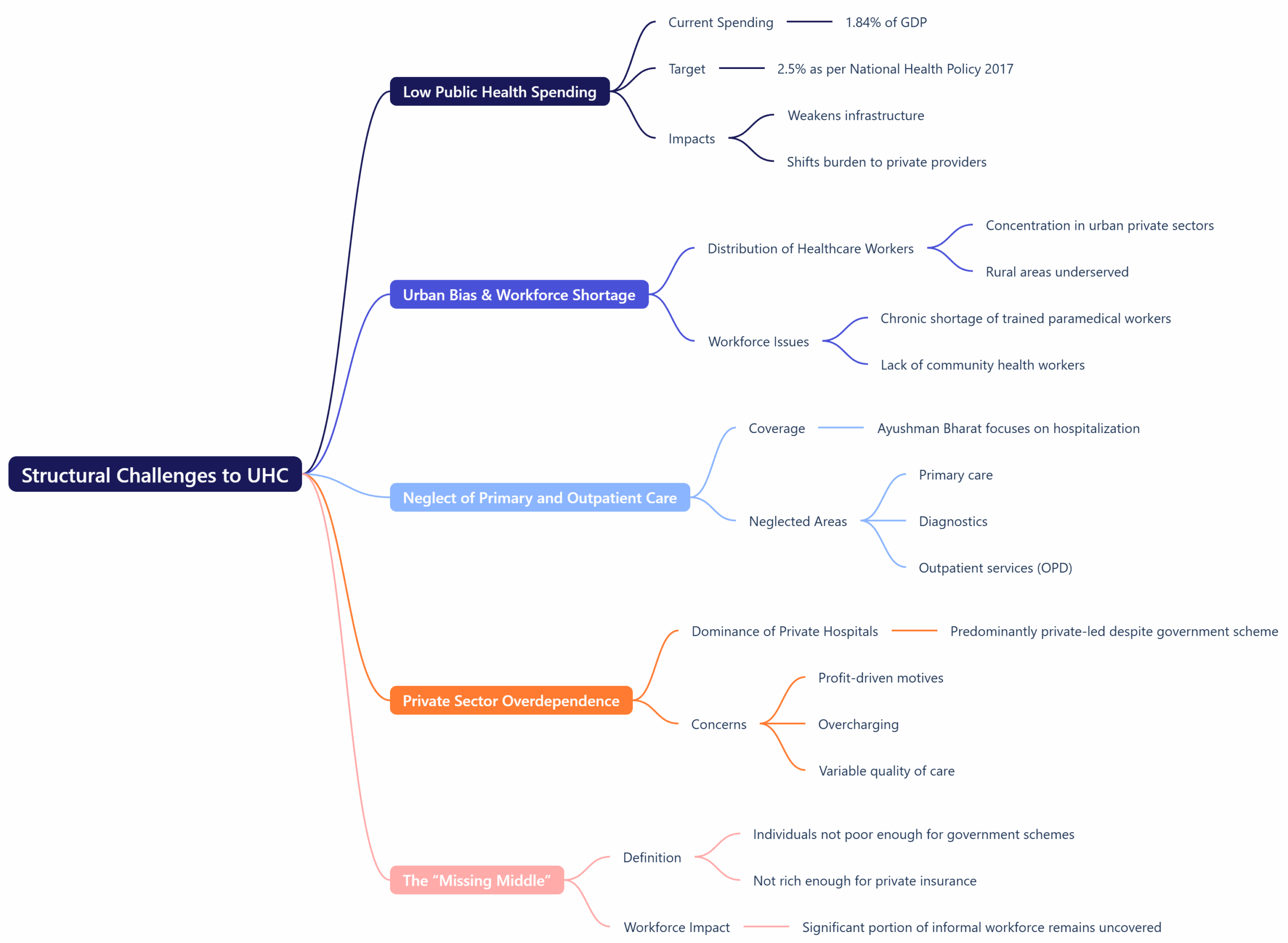
Structural Challenges to UHC
Despite these achievements, deep-rooted issues challenge the goal of “Health for All”:
India spends just 1.84% of GDP on public health, below the 2.5% target set by the National Health Policy 2017. This underfunding weakens infrastructure and shifts burden to private providers.
Doctors and specialists are concentrated in urban private sectors, leaving rural areas underserved. There’s also a chronic shortage of trained paramedical and community health workers.
While Ayushman Bharat covers hospitalisation, it neglects primary care, diagnostics, and OPD services, which form the bulk of healthcare needs and OOPE.
Private hospitals dominate despite the scheme being government-led. This raises concerns over profit-driven motives, overcharging, and variable quality of care.
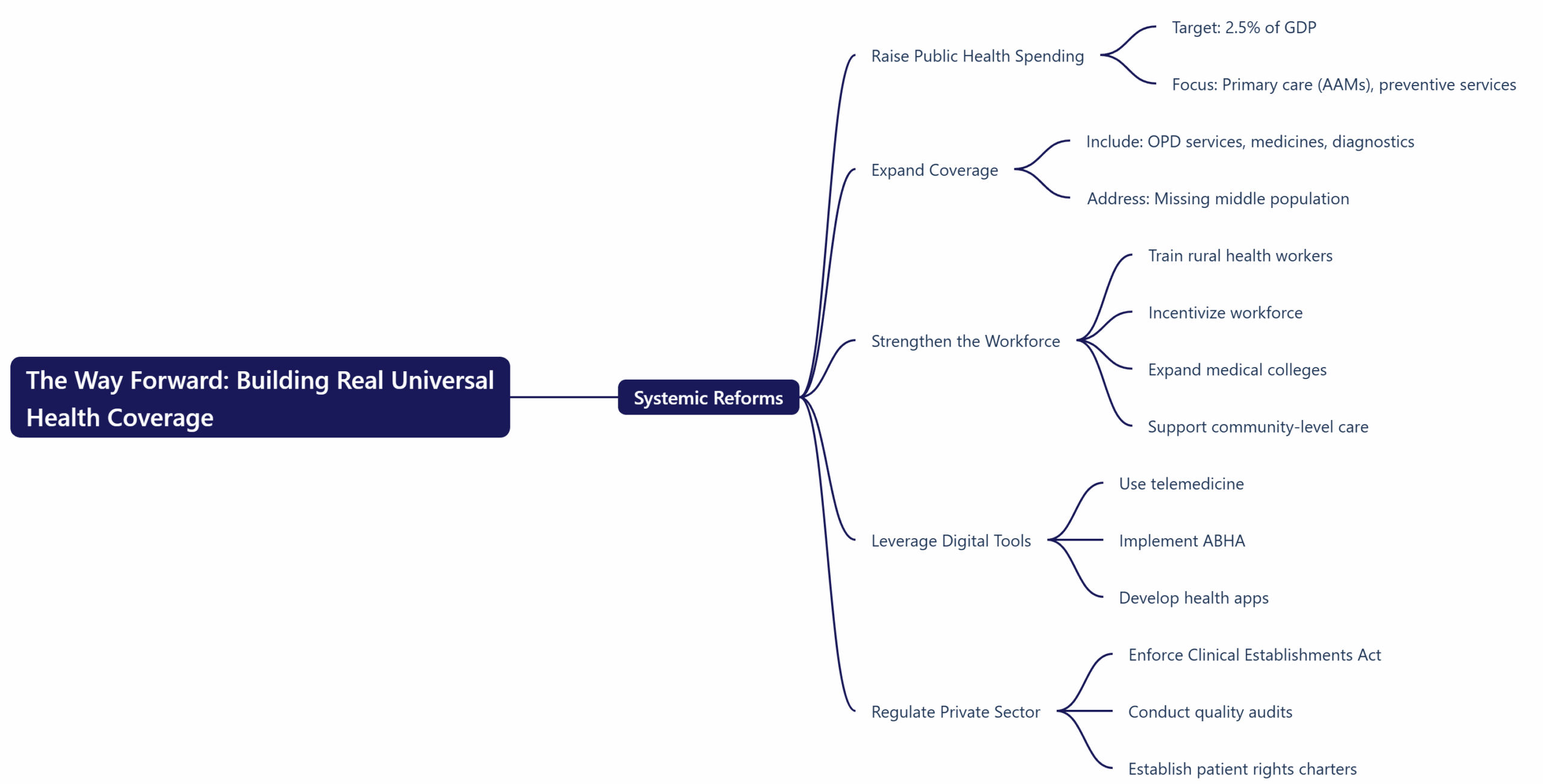
Those not poor enough for government schemes or rich enough for private insurance—the “missing middle”—remain uncovered. They form a significant portion of India’s informal workforce. Sociological Reflections: Health as a Social ContractSociologists have long emphasized the role of healthcare in maintaining social order and justice. Talcott Parsons, in his theory of the sick role, viewed health as a societal function that sustains productivity and stability. From this lens, a failing health system erodes not just well-being but social cohesion. Michel Foucault’s ideas on biopower are also relevant—governments manage populations through healthcare, surveillance, and control over bodies. The digital expansion under Ayushman Bharat (via ABHA) offers empowerment, but also raises ethical concerns about data privacy and access. Meanwhile, Indian sociologist D. Banerji critiqued India’s health model for its “urban elite orientation”, arguing that public health should be people-centric and not hospital-centric—a critique that still resonates. The Way Forward: Building Real Universal Health Coverage
To make UHC a reality, India must go beyond insurance cards and focus on systemic reforms:
ConclusionAyushman Bharat–PMJAY is a milestone in India’s journey toward Universal Health Coverage. It has empowered millions and reduced financial vulnerability—but it also reveals a stark reality: the public health system remains weak, and private players dominate a scheme meant for the poor. If health is a human right and not a privilege, India must urgently shift from hospitalisation-led insurance to community-based wellness, from patchwork coverage to comprehensive care. Only then can Ayushman Bharat truly live up to its name—a “blessed India” where no one is left behind. |



To Read more topics, visit: www.triumphias.com/blogs
Read more Blogs:
Towards Inclusion: The Supreme Court’s Push for Transgender Rights and Social Justice in India
The Quiet Revolution: Natural Farming as a Socio-Ecological Movement in India
This piece does a great job of highlighting how Ayushman Bharat represents both a major leap toward universal health coverage and a mirror reflecting India’s deep social inequalities. I found the idea of health as a ‘social contract’ especially compelling—it reminds us that true universality goes beyond policy design and depends on bridging structural gaps in public health delivery. It would be interesting to see how future reforms address the rural-urban divide in access to quality care.
Very useful content! The points mentioned here are clear, actionable, and easy to understand. Keep up the great work.