(Relevant for Sociology Paper I: Science, Technology and Social Change; Work and Economic Life: Impact of automation and AI on labour; Social Stratification: Class, caste, gender and digital divide and Sociology Paper II: Social Change in India: Impact of globalization and digitalization; Challenges of Social Transformation: Displacement, unemployment, inequality)
In the age of the Fourth Industrial Revolution, Artificial Intelligence (AI) has moved from the realm of science fiction to a routine part of everyday life. From facial recognition and predictive policing to personalized advertisements and algorithmic governance, AI is no longer an exception—it is the norm. This phenomenon, where AI transitions from innovation to infrastructure, is what scholars refer to as “AI as Normal Technology”. This shift holds significant sociological implications, particularly for students preparing for Sociology. Understanding AI not just as a technological tool, but as a sociotechnical system embedded in power structures, social norms, and institutions, is crucial for analyzing the changing nature of work, inequality, surveillance, and social control.
What is “AI as Normal Technology”?
Coined in critical technology studies, the term refers to the routinization and normalization of AI in daily life. It implies that AI is no longer just a scientific advancement but has become part of the social fabric, influencing how decisions are made, how knowledge is constructed, and how social relations are mediated.
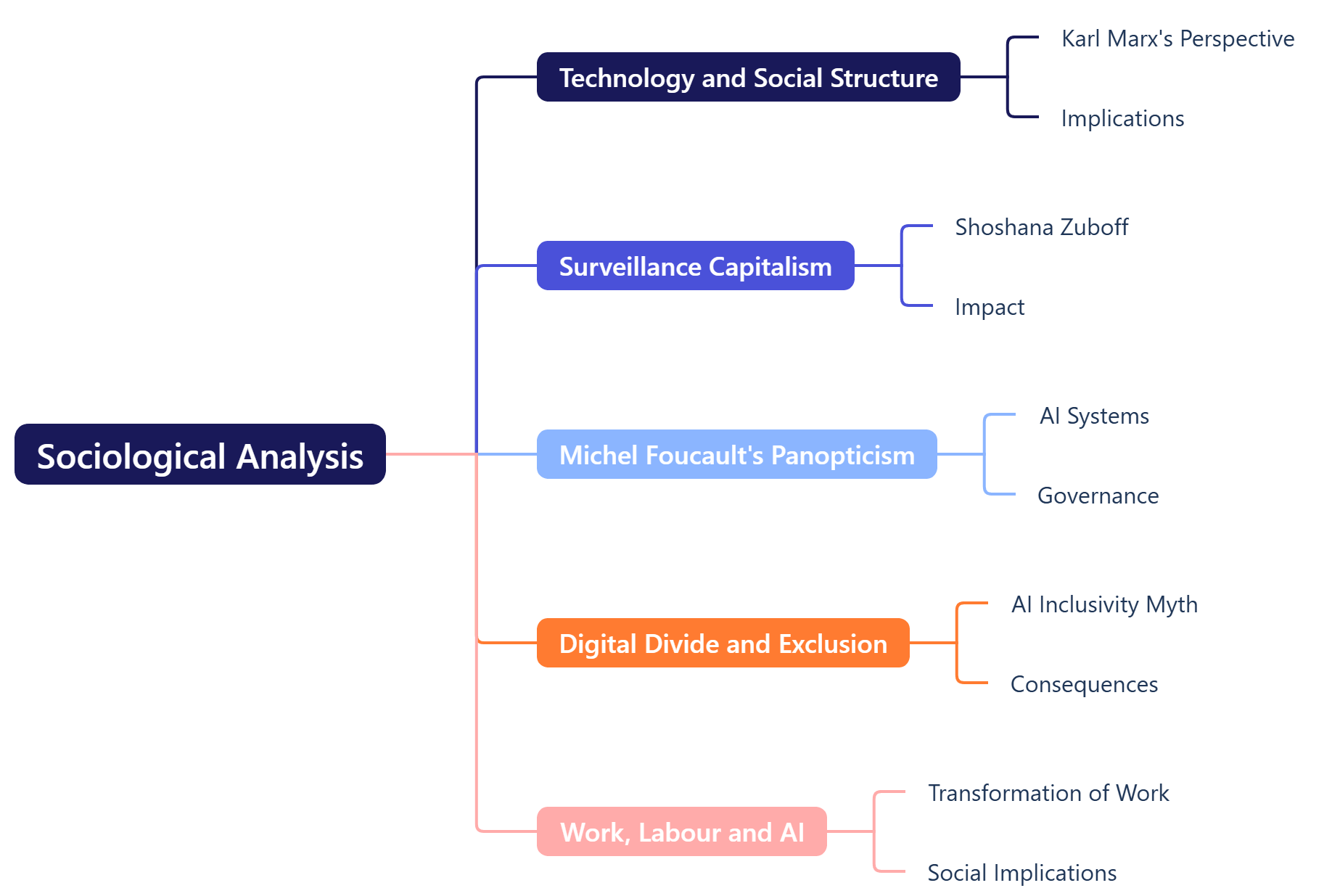
Sociological Analysis
Technology and Social Structure: According to Karl Marx, technology is not neutral—it serves the interests of the ruling class. In the context of AI, algorithmic systems often reproduce and even amplify existing class, caste, and gender inequalities. For instance, hiring algorithms trained on historical data may discriminate against Dalits or women, reflecting embedded biases.
Surveillance Capitalism: AI-driven platforms like Google and Facebook engage in what Shoshana Zuboff calls “surveillance capitalism,” where user data is commodified. This leads to digital profiling, behavioral nudging, and loss of privacy, especially among the economically and socially marginalized.
Michel Foucault’s Panopticism: AI systems (like facial recognition in public surveillance) resemble Foucault’s panopticon, where constant observation leads to self-regulation and discipline. This reflects a new mode of algorithmic governance that affects civil liberties and democratic rights.
Digital Divide and Exclusion: While AI is presented as inclusive, the digital divide in India—especially between urban and rural, rich and poor, men and women—worsens social exclusion. Access to AI-driven services is highly skewed, reinforcing existing stratification.
Work, Labour and AI: AI is transforming the nature of work. While creating high-skilled jobs in data science, it is also leading to automation and job displacement of low-skilled workers, especially in manufacturing and services sectors. This aligns with Emile Durkheim’s concept of anomie, where sudden technological shifts disrupt traditional social norms and structures.
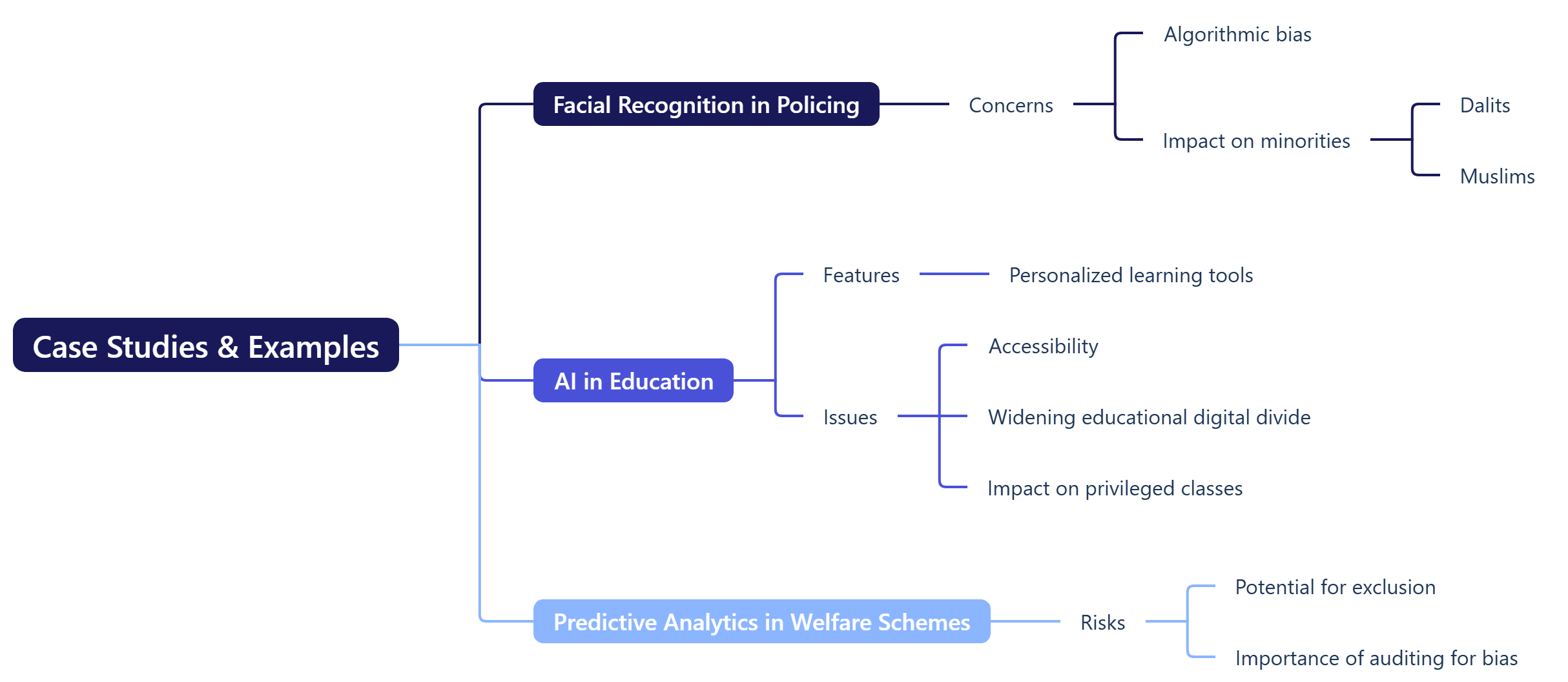
Case Studies & Examples
Facial recognition in policing: Raises concerns about algorithmic bias against minorities, especially Dalits and Muslims.
AI in education: Personalized learning tools are accessible mostly to privileged classes, widening the educational digital divide.
Predictive analytics in welfare schemes: Can automate exclusion if not audited for bias.
Ethical and Policy Implications
As AI becomes normal, the need for data protection laws, ethical frameworks, and algorithmic accountability becomes urgent. Sociologists advocate for a participatory design where marginalized communities are involved in AI governance to ensure social justice.
Conclusion
The normalization of AI is not just a technological transformation—it is a social revolution. Understanding AI through a sociological lens is essential to critically engage with current affairs, governance challenges, and socioeconomic transformation in India. AI must not be viewed as an autonomous force but as a social product shaped by and shaping societal structures. As technology advances, sociology becomes more relevant than ever to ensure that progress does not come at the cost of equity and dignity.
PYQs
Paper 1 –
Science and technology are seen both as agents of social change and sources of new inequalities. Discuss with reference to contemporary India. (2023)
Examine the changing nature of work and its impact on social relationships in the context of the digital economy. (2022)
Explain how sociological theories can help us understand the impact of Artificial Intelligence and automation on employment. (Inferred theme, could be part of a general application-type question) (2021)
Discuss how technology has contributed to the development of social relationships and social structures. (2020)
Write short notes on: “Technology and the transformation of work.” (2019)
How does the growing influence of digital media impact the socialization process in contemporary society? (2018)
Examine how the new communication technologies are bringing about new forms of family relationships. (2017)
How does urbanism affect social relationships in the age of digital connectivity? (2016)
Discuss the relationship between knowledge, technology, and power. (2015)
Write short notes on: “Digital Divide as a cause of inequality in society.” (2014)
Paper 2 –
How does globalization affect the working class structure in India? Discuss with reference to the informal sector and digital economy. (2023)
Discuss the impact of digitalization and Artificial Intelligence on the employment patterns in India. (2022)
Explain the consequences of the digital divide in India and suggest sociological interventions. (2021)
Has the rapid penetration of the internet in rural areas led to social transformation? Substantiate with examples. (2020)
How has the use of digital technology in governance impacted citizen–state relations in India? (2019)
Discuss the challenges posed by algorithmic governance and digital surveillance to democratic rights in India. (2018)
What are the sociological implications of the increasing use of Artificial Intelligence in public administration and policy implementation? (Theme present in digital governance questions) (2017)
Examine the role of information and communication technology in social change in India. (2016)
Discuss how media and technology are influencing caste, class, and gender relations in contemporary India. (2014)
To Read more topics like AI as Normal Technologyin Public Posts, visit: www.triumphias.com/blogs








One comment