(Relevant for Sociology Paper I: Social Stratification and Mobility- Caste and Class; Politics and Society- Identity and representation and Sociology Paper II: Caste System in India; Social Movements; Challenges of Social Transformation)
The debate between the Socio-Economic and Caste Census (SECC) and the Caste Census has taken center stage in Indian policymaking, governance, and electoral politics. While SECC 2011 was India’s most comprehensive data-gathering exercise since independence, it did not fully release caste-based data, sparking demands for a full-fledged Caste Census. This issue is not merely statistical—it carries deep sociological implications tied to social justice, caste stratification, reservation policy, and inclusive governance. Understanding the difference between SECC and caste census is essential to analyze current affairs through the lens of caste, class, power, identity politics, and state policy.
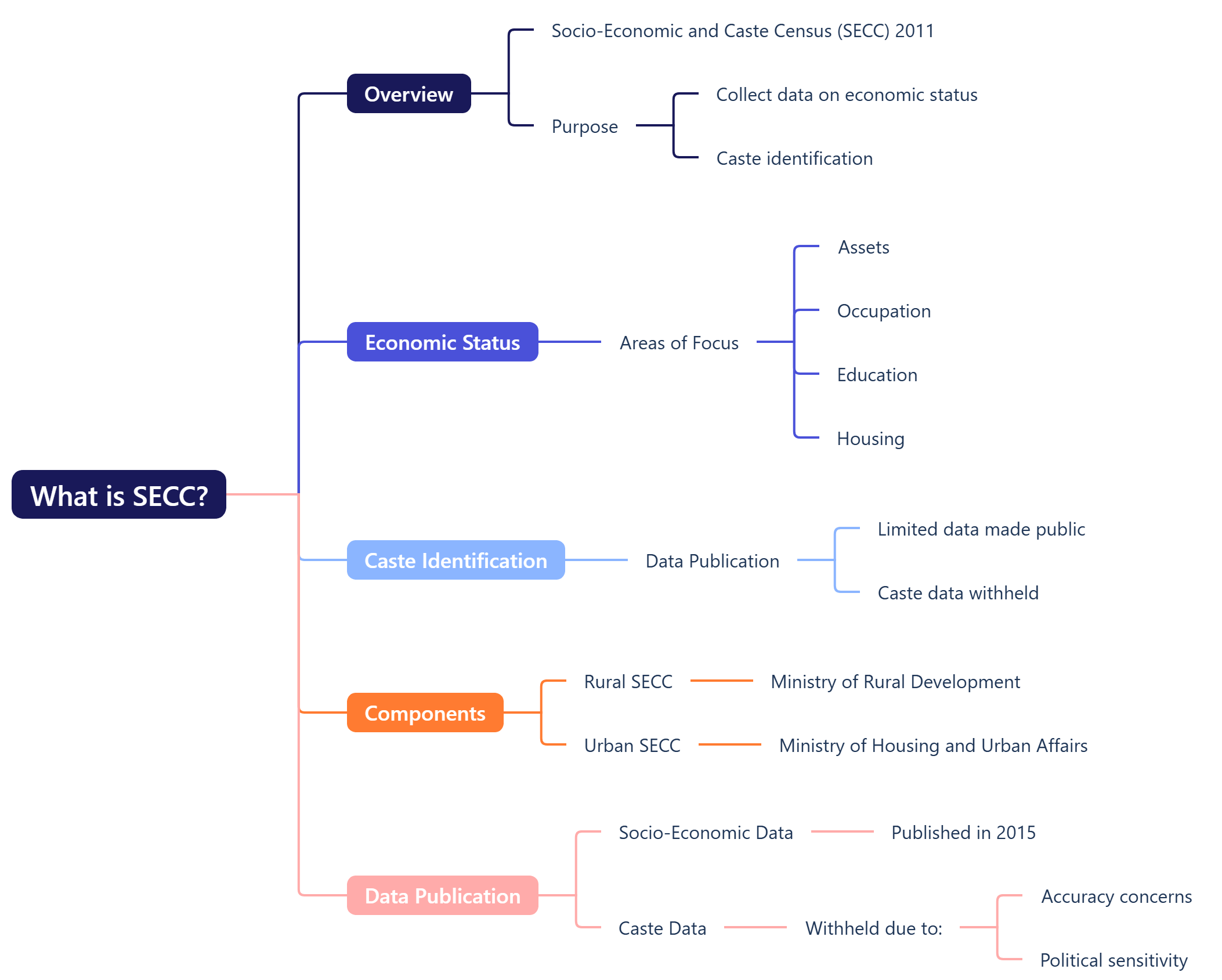
What is SECC?
The Socio-Economic and Caste Census (SECC) 2011 was aimed at collecting data on:
Economic status (assets, occupation, education, housing)
Caste identification (limited data made public)
It had two components:
Rural SECC, under the Ministry of Rural Development
Urban SECC, under the Ministry of Housing and Urban Affairs
While socio-economic data was published in 2015, the caste data was withheld due to concerns over accuracy and political sensitivity.
What is a Caste Census?
A Caste Census is a decadal enumeration of all castes and sub-castes, their population strength, and socio-economic status. India conducted a caste census last in 1931. Post-Independence censuses collect data only on SCs and STs, not on OBCs or general castes.
There have been increasing demands for a full caste-based census to enable:
Evidence-based policymaking
OBC data for reservation policy
Social equity and resource allocation
SECC vs. Caste Census: Key Differences
Feature
SECC 2011
Caste Census
Focus
Socio-economic + caste data (partial)
Full caste enumeration
Release
Socio-economic data released
Not conducted since 1931
Caste Data
Collected but not published
Intended for full transparency
Purpose
Welfare targeting, poverty estimates
Reservation, affirmative action
Issues
Data accuracy, inconsistency
Political sensitivity, identity politics
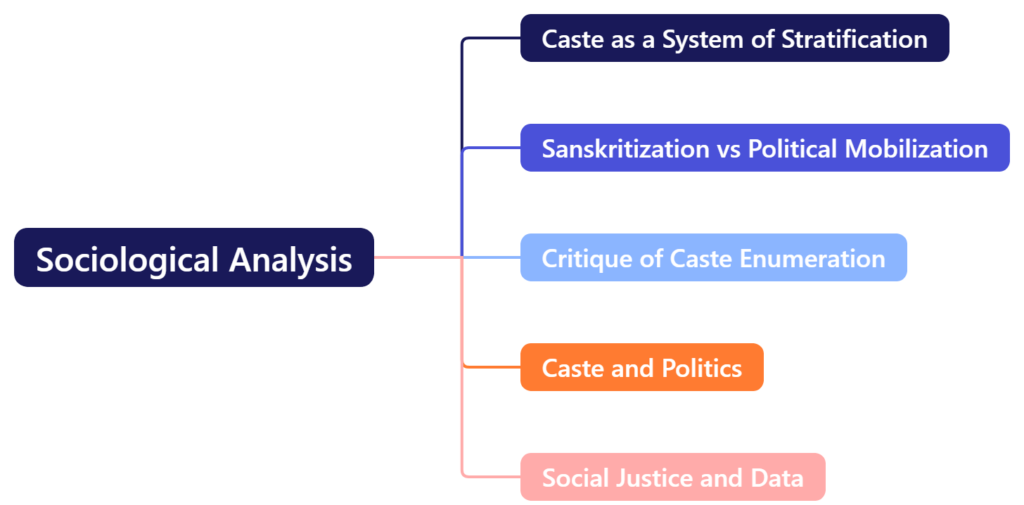
Sociological Analysis
Caste as a System of Stratification: As per Louis Dumont, caste is a hierarchical ideology rooted in purity and pollution. However, modern India sees caste functioning more as a political and economic identity. The absence of updated caste data undermines equity in resource distribution, perpetuating structural inequalities.
Sanskritization vs Political Mobilization: M.N. Srinivas’s idea of sanskritization contrasts with how caste identities are now used for political assertion. Without data from a caste census, OBC communities claim underrepresentation and demand data-backed reservations.
Critique of Caste Enumeration: Andre Béteille argues that overemphasis on caste can reinforce divisions. However, many sociologists counter that invisibility of caste in policy doesn’t reduce inequality but masks it.
Caste and Politics: G.S. Ghurye predicted the fusion of caste with politics. The demand for a caste census reflects this intersection, where caste is a vehicle for resource bargaining and electoral strategy.
Social Justice and Data: In a democracy, affirmative action must be based on empirical evidence. The lack of caste data weakens public policy targeting and limits social mobility.
Case Study: Bihar’s Caste Survey (2023)
The Bihar government released its own caste survey in 2023, revealing detailed OBC data. This initiative has intensified national debate and may push for nationwide caste enumeration, linking data, development, and dignity.
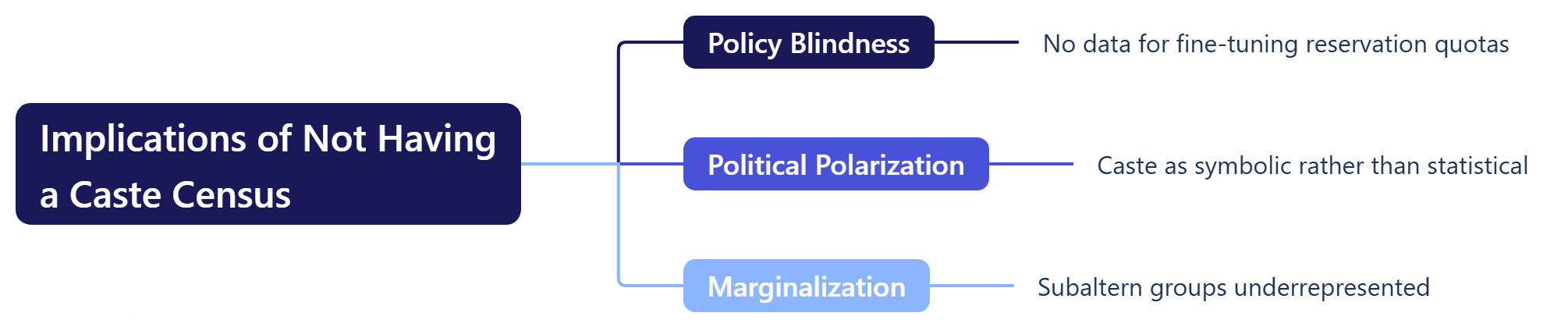
Implications of Not Having a Caste Census
Policy Blindness: No data for fine-tuning reservation quotas.
Political Polarization: Caste becomes symbolic rather than statistical.
Marginalization: Subaltern groups remain underrepresented.
Conclusion
The debate between SECC and caste census reflects the tension between data-driven governance and identity politics. From a sociological standpoint, the lack of caste data impairs efforts toward social justice, inclusive growth, and democratic representation. It’s important to approach this issue through the lens of stratification, social policy, and power dynamics, while linking it to Indian Society.
PYQs
Paper 1
Critically examine Louis Dumont’s perspective on the caste system in India. (2023)
“Caste is not a hierarchy but a series of horizontal solidarities.” Explain. (2022)
Discuss the contemporary relevance of caste in social stratification. (2021)
Distinguish between class and caste as forms of social stratification. (2020)
Write short notes on: “Caste and class in contemporary India.” (2019)
Explain the concept of dominant caste and its relevance in contemporary India. (2018)
How do caste and class intersect in determining social status in India? (2017)
Evaluate the role of caste in shaping social mobility in India. (2016)
Discuss the impact of caste-based reservation on Indian society. (2015)
Critically analyze the structural-functional approach to the study of caste. (2014)
Paper 2
Analyze the relevance of caste in contemporary Indian society despite economic modernization. (2023)
Caste continues to be an important source of social and economic inequality in India. Examine with empirical evidence. (2022)
Discuss the need for a caste census in India in light of inclusive policy-making. (Implicit in reservation-related questions; inferred topic) (2021)
Discuss how caste-based census can influence the formulation of affirmative action policies in India. (Can be derived from themes of social justice and backward class mobilization) (2020)
Describe the changing nature of caste in contemporary India with suitable examples. (2019)
Discuss the role of caste in Indian politics and the demand for caste-based enumeration. (2018)
Explain the significance of Socio-Economic and Caste Census (SECC) in targeting social welfare schemes. (Implicit context) (2017)
Assess the impact of Mandal Commission recommendations and its relation to caste census data. (2016)
How has the idea of ‘social justice’ influenced reservation policies in India? (2015)
What role has the State played in the transformation of caste? (2014)
To Read more topics like A Sociological Insight for SECC vs. Caste Censusin Public Posts, visit: www.triumphias.com/blogs








2 comments