In a significant judgment that throws light on the persistent caste-based discrimination in India, the Madras High Court has condemned the exclusionary practice of rejecting temple donations based on caste. Justice D. Bharatha Chakravarthy remarked that “untouchability is practised in myriad ways”, even in today’s society, and refusing donations from someone considered “lower” caste amounts to untouchability under the Constitution.
This judicial observation arises from a writ petition filed by Ela Pandiyarajan of the Ambedkar Makkal Neethi Iyakkam against the Kamatchi Amman Udanurai Thirunageswaram Temple in Chennai, where caste-based refusal to accept a donation had reportedly occurred.
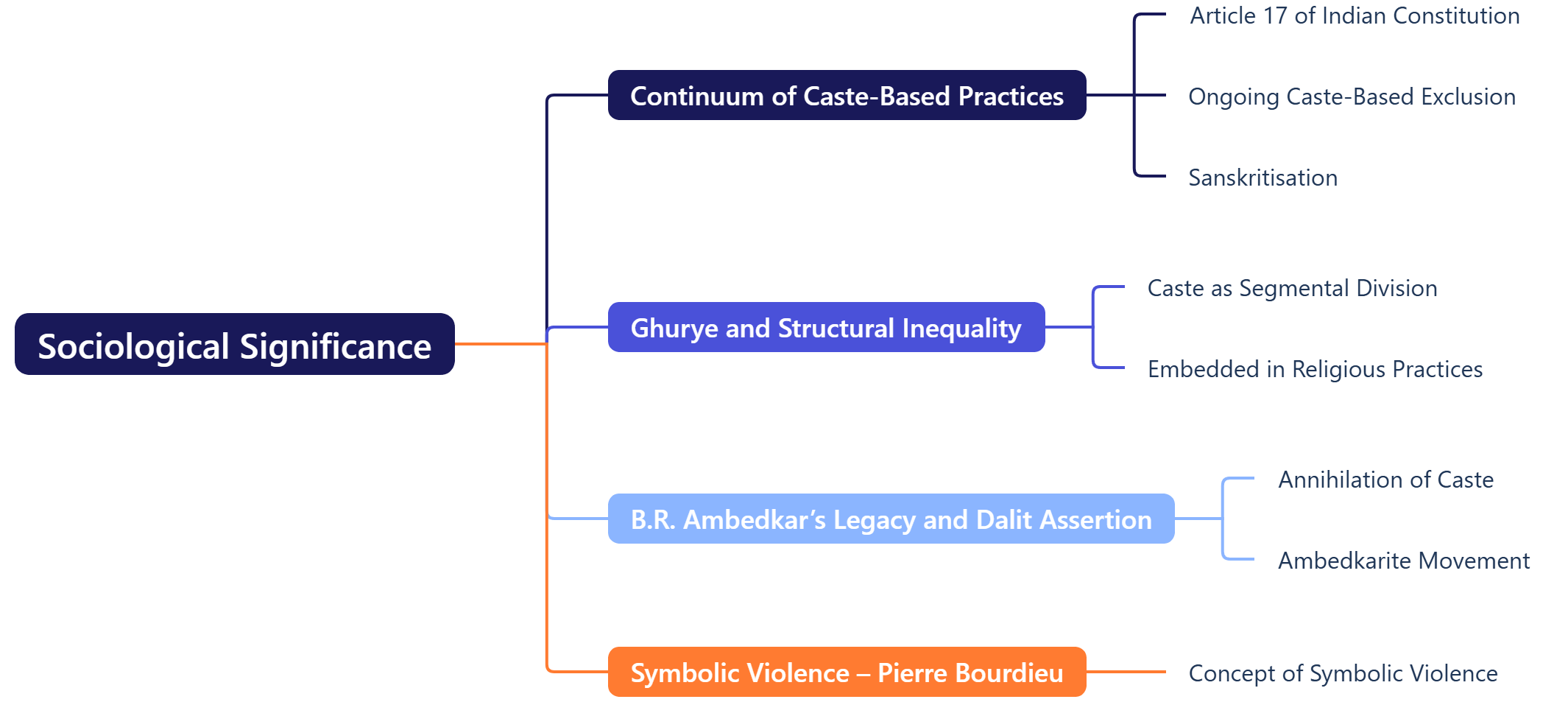
Sociological Significance
Continuum of Caste-Based Practices: Despite Article 17 of the Indian Constitutionabolishing untouchability, caste-based exclusion continues in symbolic, subtle, and institutional forms. Sociologist M.N. Srinivas describes this as a part of “sanskritisation”, where lower castes seek inclusion, but upper-caste practices remain exclusionary.
Ghurye and Structural Inequality: G.S. Ghurye viewed caste as a system of segmental division and hierarchical discrimination, deeply embedded in religious and social practices. Even rituals like temple donations become a means to reinforce social stratification.
B.R. Ambedkar’s Legacy and Dalit Assertion: This case resonates with Ambedkar’s vision of annihilating caste. The Ambedkarite movement aims to resist such subtle yet damaging forms of untouchability through legal and social means.
Symbolic Violence – Pierre Bourdieu: This scenario reflects Bourdieu’s concept of symbolic violence, where domination is imposed not through physical force but via everyday social practices—such as denial of rights in religious spaces.
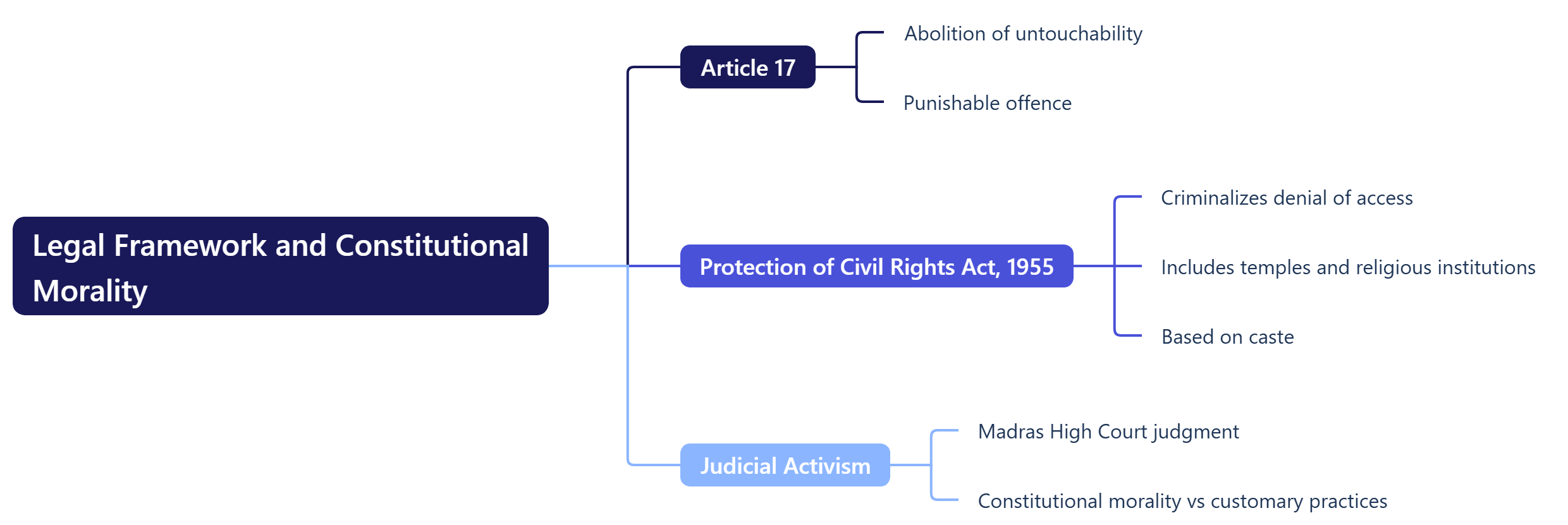
Legal Framework and Constitutional Morality
Article 17: Abolition of untouchability and making its practice a punishable offence.
Protection of Civil Rights Act, 1955: Criminalizes denial of access to temples and religious institutions based on caste.
Judicial Activism: This judgment by the Madras High Court affirms the importance of constitutional morality over customary practices.
Conclusion
The Madras High Court’s observations highlight the gap between legal abolition and social reality. While untouchability is illegal, its practical manifestations in religious, social, and cultural spheres continue. This underscores the need for grassroots social reform, legal enforcement, and educational interventions to dismantle caste prejudices from the roots.
PYQs
Paper I:
How far can caste be considered as a closed system of stratification? Evaluate with suitable examples. (2014)
Explain M.N. Srinivas’s concept of Sanskritization. How far is it relevant in understanding caste mobility? (2015)
Explain Louis Dumont’s concept of purity and pollution in the context of caste system in India. (2016)
What are the mechanisms through which caste continues to influence modern institutions in India? (2017)
How does caste operate as a form of social stratification in contemporary Indian society? (2018)
Discuss the interrelationship between caste and social mobility in the context of modern education. (2019)
Discuss the concept of social exclusion with special reference to caste. (2020)
How is symbolic violence manifested in caste-based interactions in India? Discuss with reference to Bourdieu’s theory. (2021)
Is caste discrimination a form of structural violence? Explain with examples. (2022)
Examine the role of rituals and religious practices in the perpetuation of caste inequality in Indian society. (2023)
Paper II:
How do Dalit movements challenge the traditional caste order in India? (2015)
Critically examine the role of caste in Indian democracy. (2016)
Explain how caste-based discrimination manifests in everyday interactions in urban India. (2017)
Examine the impact of religious institutions in perpetuating or reforming caste hierarchies in India. (2018)
Despite constitutional safeguards, untouchability continues in various forms. Discuss with examples. (2019)
Evaluate the success and limitations of laws aimed at eliminating caste discrimination in India. (2020)
Discuss the relevance of B.R. Ambedkar’s ideas on caste in contemporary Indian society. (2021)
Examine the intersection of caste and identity politics in shaping the discourse around social justice in India. (2021)
Discuss the role of civil society and grassroots movements in combating untouchability in India. (2022)
How does exclusion in religious spaces reflect the continuity of caste? Illustrate with examples. (2023)
To Read more topics like Untouchability in Modern Indiain Public Posts, visit: www.triumphias.com/blogs