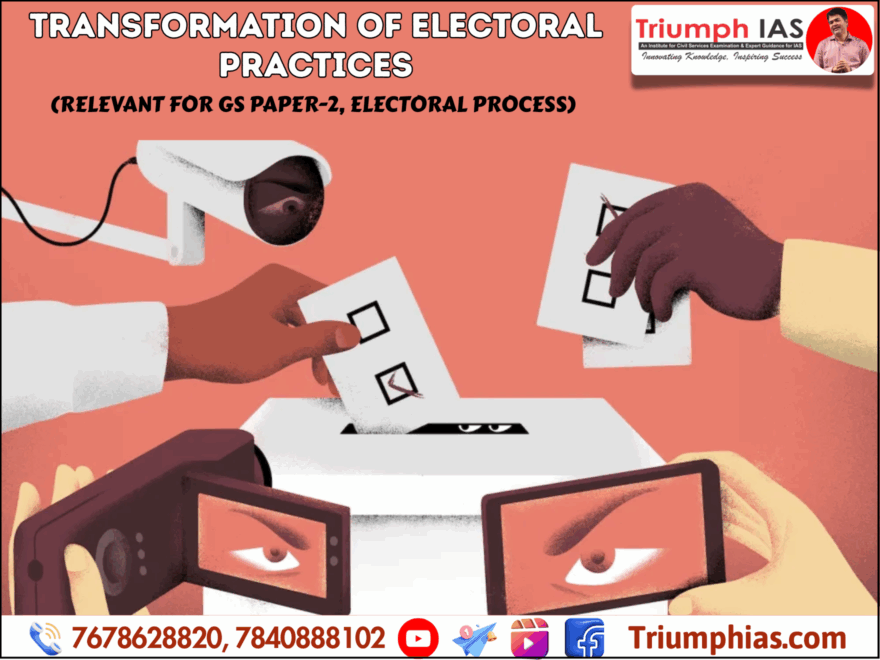
Transformation of Electoral Practices

Transformation of Electoral Practices

Transformation of Electoral Practices

(Relevant for GS paper-2, Electoral Process)

Electoral Practices

India’s electoral system, one of the world’s largest democracies, faces evolving challenges—from transparency and campaign financing to inclusivity and technological integration. Strengthening democratic processes requires continuous reforms that preserve electoral integrity, enhance public trust, and ensure that the constitutional principle of adult franchise is honored. Recent developments spotlight the Election Commission of India (ECI), judiciary, and civil society as active participants in driving systemic change.

Strengthening Voter Registration & Voter Rolls

A credible electoral process depends on accurate voter lists. Allegations of bogus and duplicate entries—especially during Maharashtra and Delhi roll revisions—have sparked concerns. In response, the ECI launched several reforms:

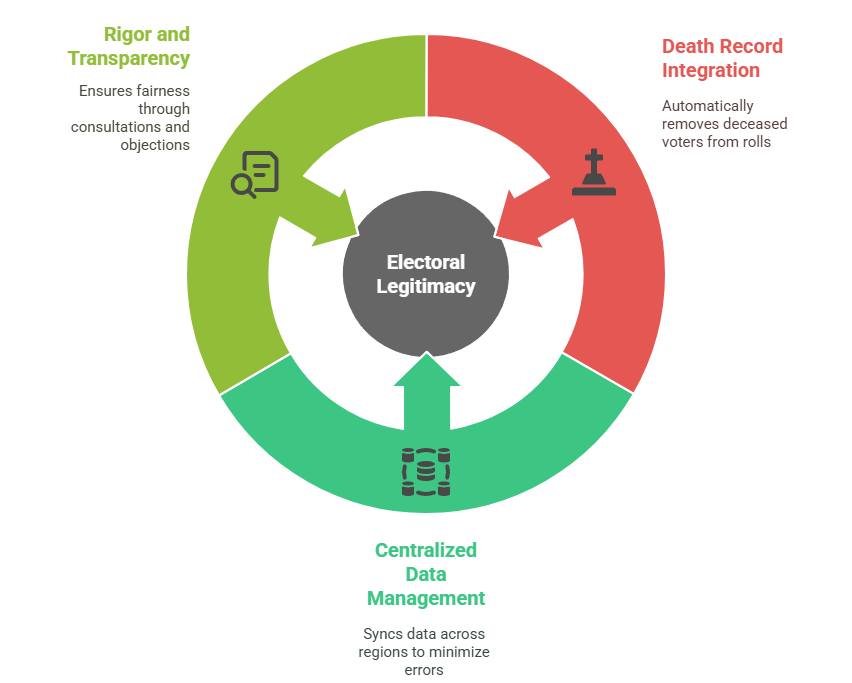
  • Integration of death records from the Civil Registration System, enabling automatic removal of deceased voters, verified by Booth Level Officers (BLOs).
  • Centralised electoral roll management (ERONET) syncs data across regions, minimizing duplication and errors.
  • The ECI’s Chief Election Commissioner (Gyanesh Kumar) reaffirmed the rigor and transparency of India’s roll compilation, noting decades of party consultations and objections as benchmarks These measures safeguard electoral legitimacy by reducing manipulation risks and building trust.

Enhanced Voter Facilitation & Participation

To enhance civic participation, especially among youth and women, the ECI continues to expand its SVEEP outreach—managing awareness campaigns, counsellor mobilization, and targeted interventions Concurrently:

  • Redesign of Voter Information Slips (VIS) has made polling details more legible.
  • Photo ID cards for BLOs promote transparency during house‑to‑house surveys Installation of mobile phone deposit zones near polling booths addresses concerns about misuse and promotes polling discipline

Such reforms reduce barriers to voting, particularly for first-time and marginalized voters.

Technological Interventions in Voting & Counting

India’s adoption of EVMs coupled with VVPATs in 2004 boosted efficiency and accuracy but also faced criticism over verifiability. To improve confidence, some allege full VVPAT matching should be mandated. While the Supreme Court declined full matching, it mandated enhanced sampling and new solutions like an AI‑powered VVPAT counter—a tech-led innovation that can scale verification without causing delays.

Emerging proposals—from blockchain voting to machine‑vision counters—signal a tech-driven path forward for electoral reforms.

Fairness in Campaign Finance & Expenditure

India’s campaign financing system still harbors opacity and malpractices:

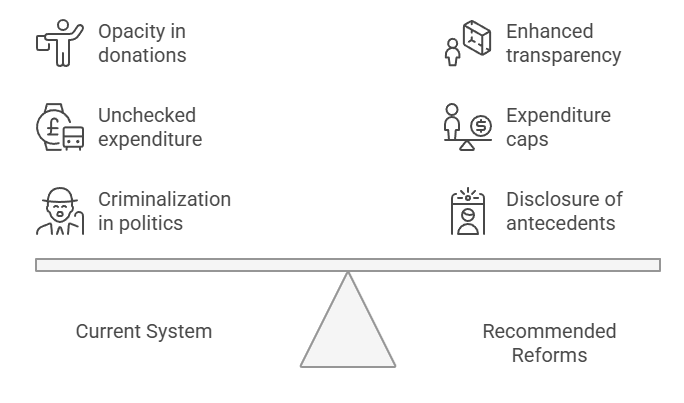
  • The now‑struck down Electoral Bonds scheme allowed anonymous political donations worth nearly ₹9,857 crore till April 2022. The Supreme Court invalidated it, citing lack of transparency.
  • No limit currently exists on party-level expenditure, leading to unchecked campaigning budgets; in 2024, expenditure by parties reached an estimated ₹100,000 crore.
  • Almost 46% of parliamentarians elected in 2024 have criminal cases, with 31% facing severe charges—indicating deep criminalization.

Key recommended reforms include:

  • introduction of party expenditure caps,
  • stronger Model Code of Conduct enforcement powers,
  • mandatory reporting of candidate criminal antecedents, and
  • enhanced disclosure of political funding—anonymity removed.

These align with Supreme Court and Law Commission recommendations on electoral integrity.

Electoral System & Structural Reforms

Several systemic proposals are in play:

  • The OCOC (One Candidate, One Constituency) principle seeks to curb “seat-hopping” and redundant bye-elections
  • The Supreme Court recently asked the government to consider setting a minimum vote threshold for uncontested candidates—underscoring deeper deliberations in the First-Past-The-Post (FPTP) model .
  • Discussion on One Nation, One Election continues: a constitutional amendment Bill introduced in Dec 2024 is awaiting review by a Joint Parliamentary Committee.

These widen the debate on federalism, constitutional design, efficiency, and democratic representation.

Strengthening the Election Commission

Effective reforms hinge on a credible institutional setup. Recommendations include:

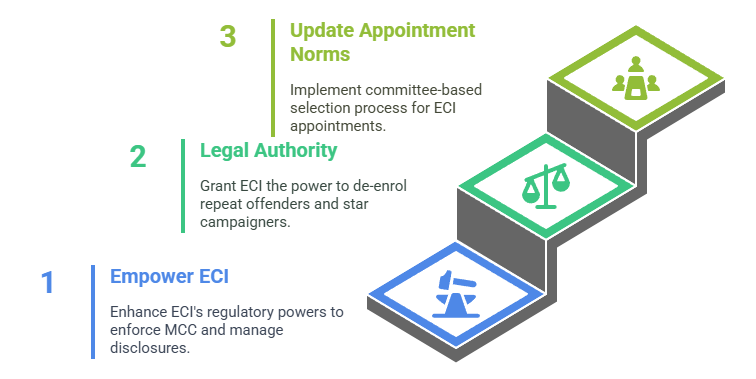
  • Empowering the ECI with greater regulatory authority to enforce MCC and manage candidate disclosures
  • Granting legal authority to de-enrol repeat offenders or star campaigners who violate norms.
  • Updating ECI appointment norms, as per ADR-led Supreme Court rulings mandating a committee-based selection process

These measures would bolster ECI’s institutional autonomy and operational integrity.

Civic Engagement & Electoral Literacy

Empowering voters is essential for meaningful reforms:

  • The NCERT introduced electoral literacy in 2024‑25, embedding content in school curriculums from 10th grade—supported by ECI & Ministry of Education efforts
  • Widespread SVEEP programs and polling station interventions encourage voter empowerment further .

Voter education promotes informed participation and strengthens democratic accountability.

 Way Forward

India’s electoral reforms aim to safeguard the foundational pillars of democracy—trust, transparency, and equal voice. Reforms must address:

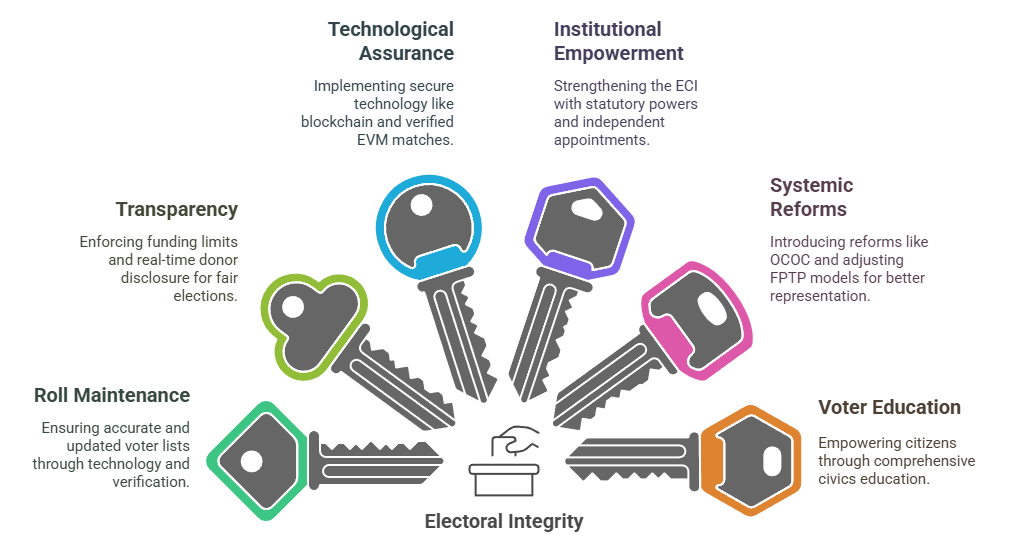
  1. Strengthened roll maintenance, including Aadhaar‑EPIC visits, automation with privacy safeguards.
  2. Election transparency via party-level funding limits and real‑time donor-publication norms.
  3. Technological assurance, including verified EVM‑VVPAT matches and secure blockchain exploration.
  4. Institutional empowerment of the ECI, with statutory powers and independent appointments.
  5. Systemic reforms like OCOC, minimum vote rules, and adjusted FPTP models.
  6. Voter education and center-stage civics education to empower next-gen citizens.

Conclusion

A vibrant democracy thrives on the credibility of its electoral processes. As India confronts evolving challenges—from roll accuracy to tech assurance, funding transparency, and institution-building—ambitious reforms are underway.

To Read more topicsvisit: www.triumphias.com/blogs

Read more Blogs:

Migration: an Opportunity or a Challenge? | Sociology Optional Coaching | Vikash Ranjan Classes | Triumph IAS | UPSC Sociology Optional

Legalizing MSP: Opportunities and Challenges | Sociology Optional Coaching | Vikash Ranjan Classes | Triumph IAS | UPSC Sociology Optional

One comment

Leave a Reply

Your email address will not be published. Required fields are marked *