(Relevant for Sociology Paper I: Robert K. Merton- Deviance; Social Change in Modern Society and Sociology Paper II: Challenges of Social Transformation)
Ragging often euphemized as “student bonding” or “initiation ritual”, continues to haunt Indian educational institutions. From elite engineering colleges to state-run universities, the menace of ragging manifests as psychological torture, physical assault, caste and gender discrimination, and in extreme cases, suicides. The tragic case of 19-year-old Faizan in Uttar Pradesh in 2024 brought the issue back into public discourse, highlighting how institutional apathy and normalized deviant behavior perpetuate such violence.
Sociological Analysis
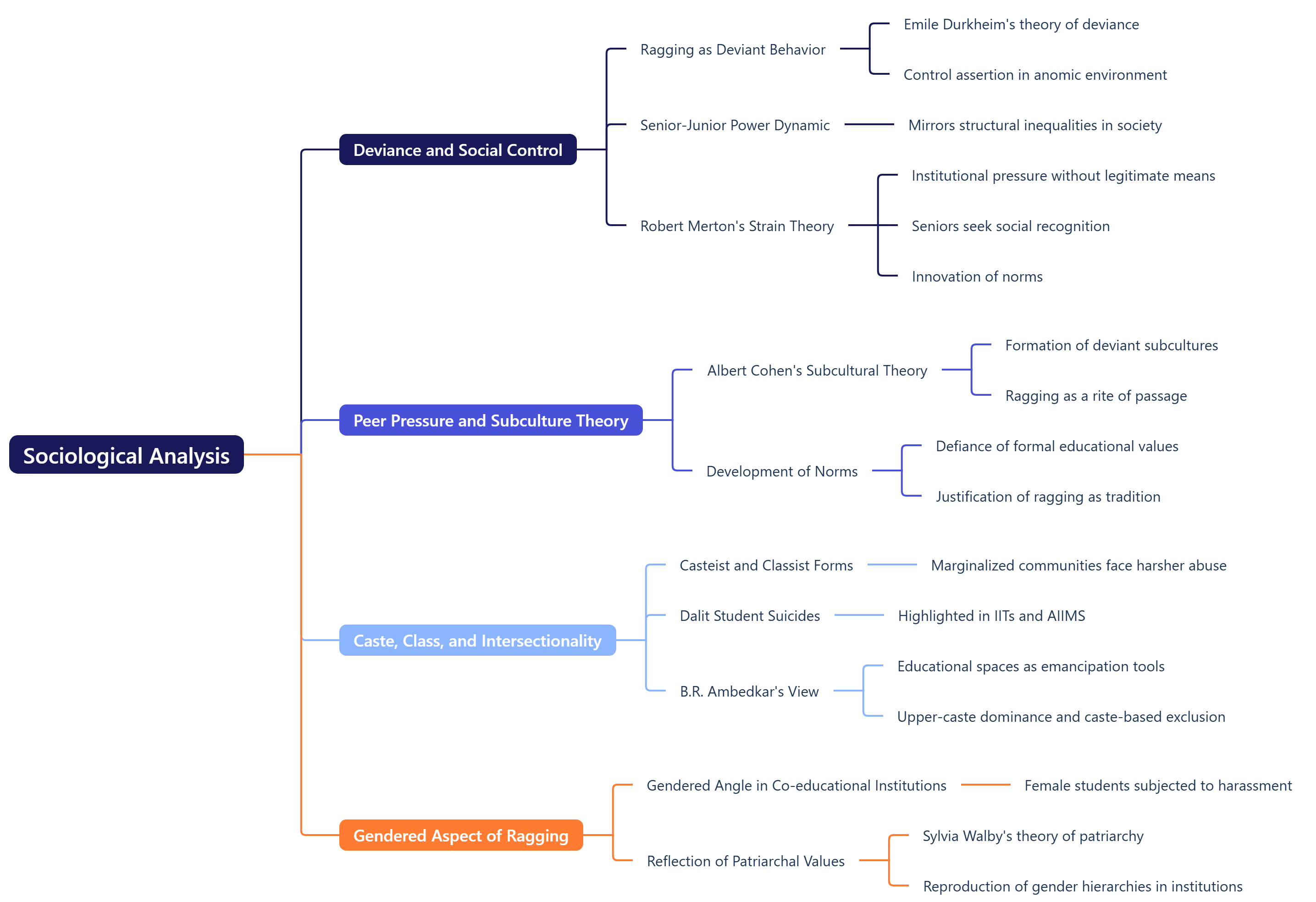
Deviance and Social Control: Ragging can be classified as deviant behavior in sociology. Using Emile Durkheim’s theory of deviance, it represents an attempt by students to assert control in a normless (anomic) environment. The senior-junior power dynamic mirrors structural inequalities in wider society. According to Robert Merton’s Strain Theory, ragging is a result of institutional pressure without legitimate means to assert status. Seniors resort to ragging to gain social recognition among peers—an innovation of norms gone awry.
Peer Pressure and Subculture Theory: Albert Cohen’s Subcultural Theory explains how students, especially in hostel environments, form deviant subcultures where ragging is seen as a rite of passage. These peer groups develop norms that defy formal educational values, often justifying ragging as a tradition.
Caste, Class, and Intersectionality: Ragging often takes a casteist and classist form, where students from marginalized communities face harsher abuse. The case of Dalit student suicides in premier institutions like IITs and AIIMS points to the intersection of caste and institutional bias.From B.R. Ambedkar’s standpoint, educational spaces are supposed to be tools of emancipation, but upper-caste dominance and caste-based exclusion recreate hierarchical patterns even within universities.
Gendered Aspect of Ragging: In co-educational institutions, ragging often has a gendered angle, where female students are subjected to sexual harassment, reflecting patriarchal values within educational spaces. This aligns with Sylvia Walby’s theory of patriarchy where institutional spaces reproduce gender hierarchies.
Failure of Institutions and State Mechanisms
Despite the UGC’s anti-ragging regulations (2009) and the establishment of the National Anti-Ragging Helpline, enforcement remains weak. Michel Foucault’s idea of surveillance and discipline is pertinent here—the absence of institutionalsurveillance and lack of punitive measures encourage impunity.
Way Forward
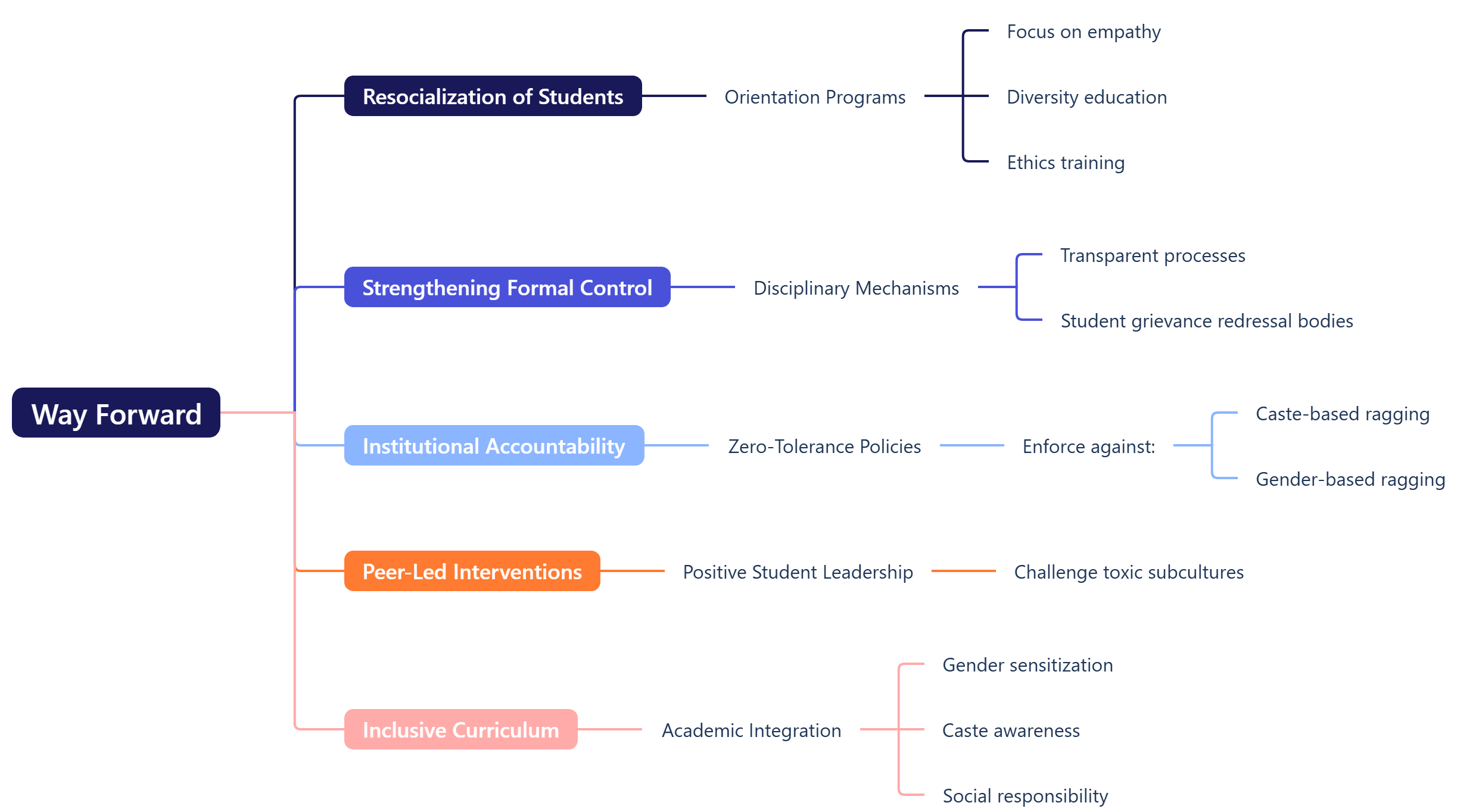
Resocialization of Students: Conducting orientation programs focused on empathy, diversity, and ethics.
Institutional Accountability: Enforcing zero-tolerance policies, especially in caste and gender-based ragging.
Peer-Led Interventions: Promote positive student leadership to challenge toxic subcultures.
Inclusive Curriculum: Include gender sensitization, caste awareness, and social responsibility as part of academic life.
Conclusion
Ragging is not an isolated act of student mischief—it is a sociological symptom of larger structural inequalities embedded within Indian society. It mirrors the hierarchies of caste, class, gender, and power, reproduced even in the most educated institutions. A truly progressive education system cannot coexist with practices that dehumanize, marginalize, and silence students under the guise of tradition or bonding. To eliminate ragging, India must move beyond token legal mechanisms toward transformative cultural change—where educational spaces become sites of equality, dignity, and empowerment, not intimidation. Sociological insight reminds us that change must begin with questioning normalized violence and holding institutions accountable. Only then can we reclaim our campuses as safe, inclusive, and nurturing environments that reflect the democratic ideals India aspires to.
Previous Year Questions
Paper I
Explain the role of informal mechanisms of social control in perpetuating deviance among youth. (2019)
Discuss how peer group and youth subcultures shape identity and behavior. (2020)
Examine the sociological significance of mental health issues in youth. (2021)
Paper II
Critically examine the limitations of state policies in curbing discrimination in higher education. (2018)
Discuss the manifestations of patriarchy in Indian educational institutions. (2021)
How does caste operate as a form of exclusion in educational spaces in contemporary India? (2023)
To Read more topics like Ragging in India: Institutionalized Violencein Public Posts, visit: www.triumphias.com/blogs