Menstrual Discrimination and Caste-Based Prejudice in Schools
(Relevant for Sociology Paper 1: Social Stratification, Gender and Society, Social Exclusion and Sociology Paper 2: Caste System, Education and Social Mobility, Marginalized Groups)
A shocking case from a private school near Coimbatore has stirred nationwide outrage. A Class 8 girl was forced to sit outside the classroom during her examination simply because she was menstruating. Even worse, she belongs to a Scheduled Caste (SC), raising serious concerns of caste-based discrimination intertwined with menstrual stigma. The video of her sitting on the school steps during the exam—recorded by her mother—went viral and exposed the deeply embedded intersectionality of caste, gender, and institutional apathy.
Violation of Rights: Legal and Ethical Dimensions
The school principal has been suspended under Section 17 of the Right to Education Act, 2009, which prohibits physical and mental harassment of children. Furthermore, FIRs have been lodged under Sections 3(1)(r) and 3(1)(za)(D) of the Scheduled Castes and Scheduled Tribes (Prevention of Atrocities) Act, 1989.
These actions highlight:
The systemic invisibility of Dalit girls in educational institutions.
Institutional failure to ensuredignity during menstruation, a natural biological process.
How menstruation is still seen as ‘impurity’, reflecting Brahmanical patriarchy embedded in social institutions.
Sociological Analysis: Intersectionality of Caste and Gender
This incident is not isolated. It reveals how schools, instead of being agents of social mobility, often become mechanisms for reproducing social hierarchies. The girl’s Scheduled Caste identity, combined with menstrual taboo, made her doubly vulnerable to exclusion.
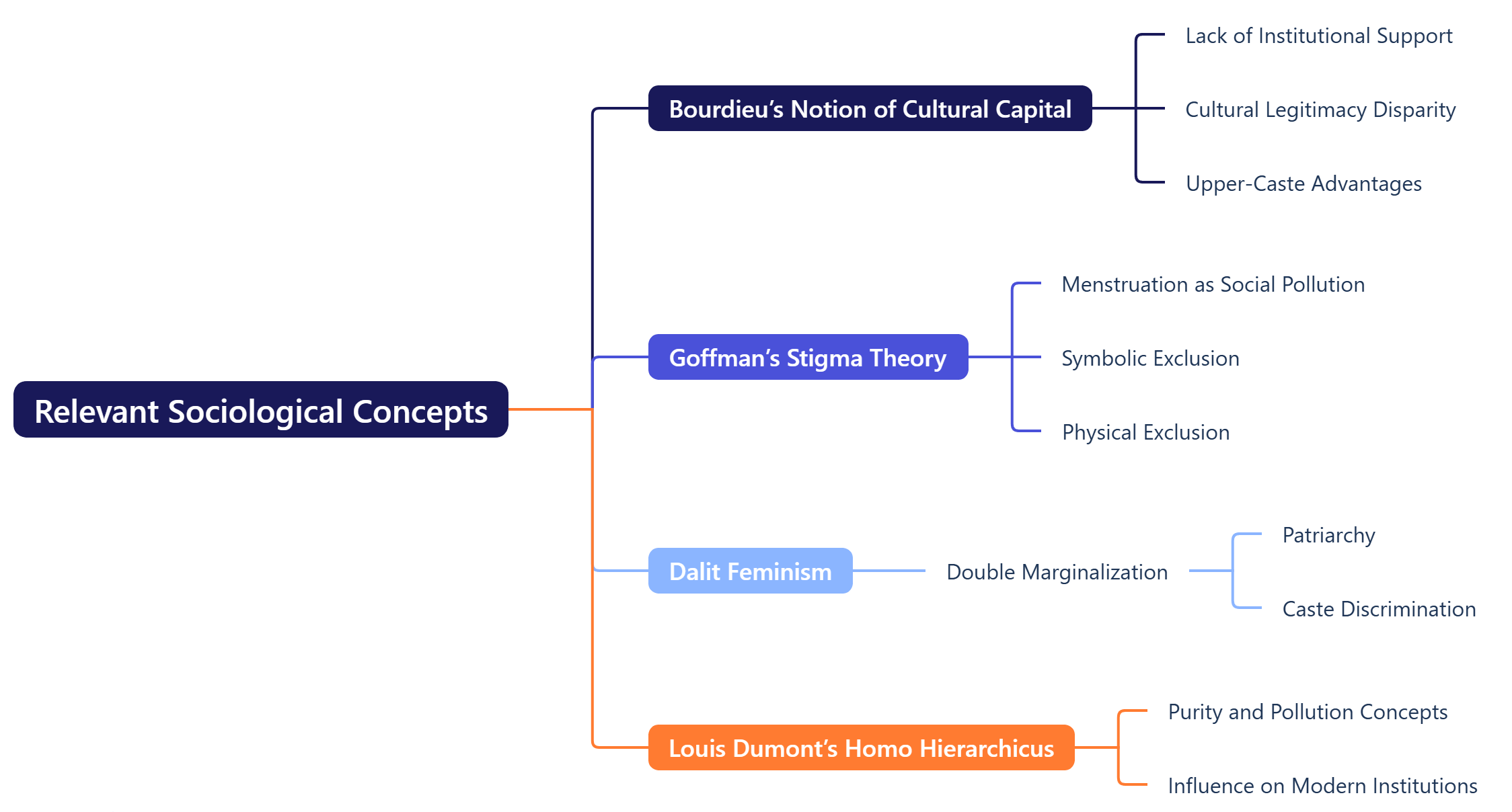
Relevant sociological concepts:
Bourdieu’s notion of cultural capital: The girl lacked institutional support and cultural legitimacy that upper-caste students might enjoy.
Goffman’s stigma theory: Menstruation becomes a marker of social pollution, leading to symbolic and physical exclusion.
Dalit Feminism: Highlights the double marginalization of Dalit women—through both patriarchy and caste.
Louis Dumont’s Homo Hierarchicus: Illustrates how notions of purity and pollution still dictate modern institutions.
Implications for Education Policy and Social Justice
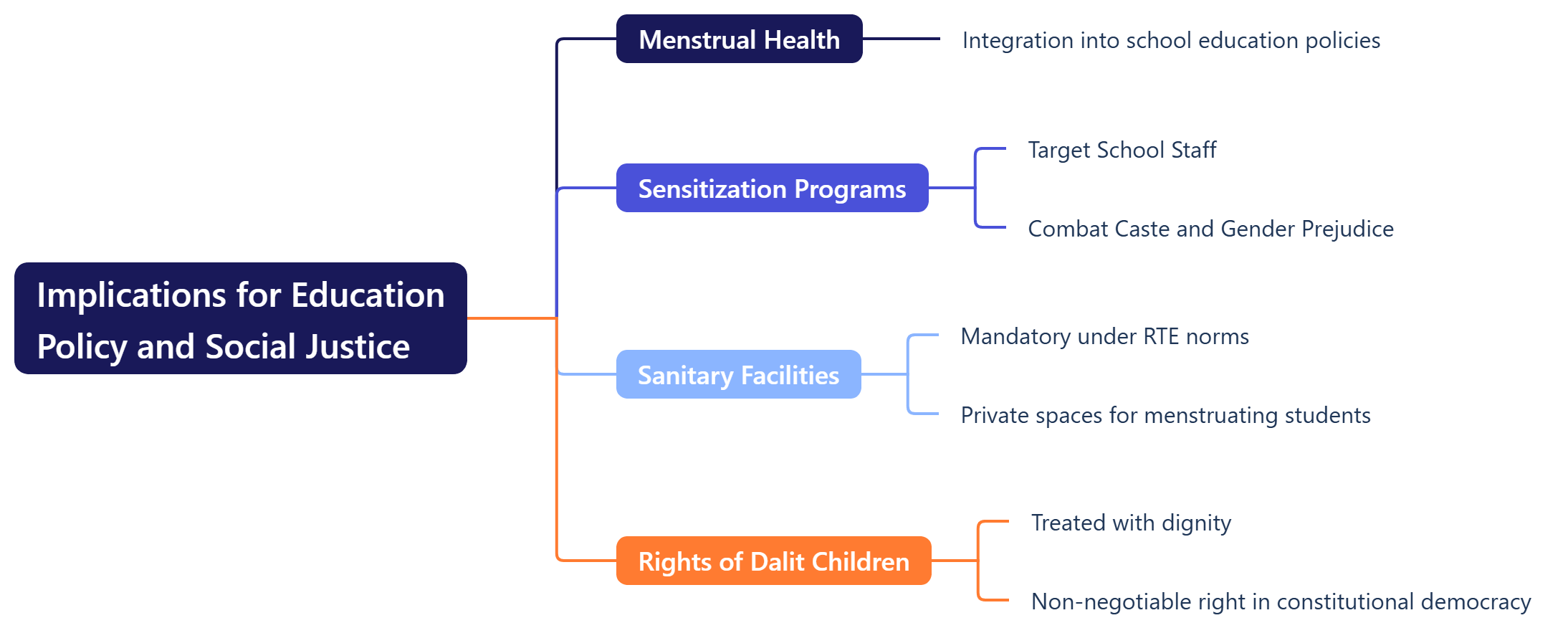
Menstrual health must be integrated into school education policies.
Sensitization programs for school staff are essential to combat caste and gender prejudice.
Sanitary facilities and private spaces for menstruating students should be mandatory under RTE norms.
More importantly, Dalit children must be treated with dignity—a non-negotiable right in a constitutional democracy.
Conclusion:
This case is a painful reminder that even today, being born a Dalit girl means fighting for dignity in every institution. Schools must evolve as inclusive spaces, not extensions of societal biases. Addressing menstrual stigma and caste discrimination is not just about law enforcement—it’s about changing the social consciousness of India.
PYQs
Paper I:
Explain the Marxian view of social stratification. (2015)
Is the Indian education system an agent of social change or social reproduction? (2016)
Discuss the role of hidden curriculum in perpetuating social stereotypes. (2017)
Explain Goffman’s concept of stigma. How does stigma operate in everyday social interactions? (2017)
Examine the role of the family and school in reinforcing gender stereotypes. (2018)
What is intersectionality? How does it help in understanding the marginalization of women in India? (2020)
How do social background and cultural capital affect access to education in India? (2020)
How does patriarchy shape the experience of gender in Indian society? (2021)
Examine the role of education in the reproduction of social inequality in India. (2022)
How do caste and class intersect in the structure of social inequality in India? (2022)
What are the various forms of gender inequalities present in society? How do they affect development? (2023)
Paper II:
What are the key challenges faced by Dalit women in accessing education and dignity? (2015)
Examine the role of caste in determining social mobility in India. (2015)
Analyze the role of religion and tradition in shaping taboos related to menstruation in Indian society. (2016)
Comment on the persistence of untouchability despite constitutional safeguards. (2017)
Explain how caste intersects with gender and class in rural and urban India. (2018)
How does school culture reflect larger social hierarchies in Indian society? (2019)
How far has the caste system transformed into a system of social stratification? (2019)
How far have state policies and legal measures been successful in addressing gender-based discrimination? (2020)
Examine the challenges faced by SC/ST students in accessing quality education. (2020)
Examine the structural and cultural factors behind the discrimination against women in India. (2022)
Discuss the changing nature of caste-based discrimination in contemporary India. (2023)
Evaluate the success of the Right to Education Act in democratizing access to education. (2023)
To Read more topics like Menstrual Discrimination and Caste-Based Prejudice in Schools in Indiain Public Posts, visit: www.triumphias.com/blogs








2 comments