


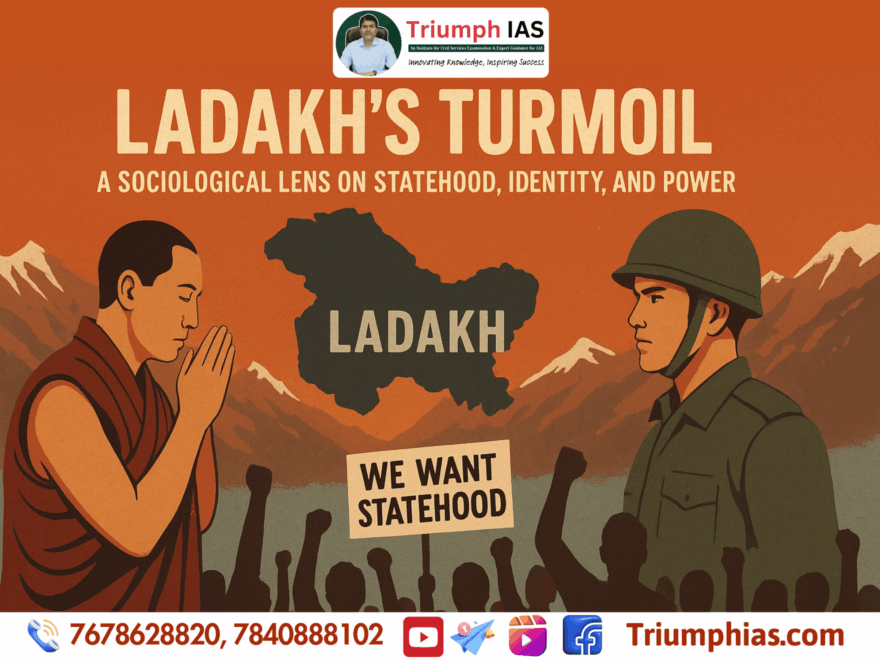
Ladakh Turmoil: A Sociological Lens on Statehood, Identity, and Power
(Relevant for Sociology Paper 2: Politics and Society)
Ladakh TurmoilThe recent unrest in Ladakh, marked by massive protests, hunger strikes, and calls for constitutional safeguards, is often discussed through the limited lens of political maneuvering or strategic necessity. Yet, this view risks missing the deeper undercurrents shaping the region’s collective cry for statehood and inclusion in the Sixth Schedule of the Indian Constitution. What if we understood Ladakh crisis not just as a political confrontation—but as a social phenomenon? What if we saw beyond protest slogans and policy decisions to recognize a community grappling with profound questions of identity, order, and power? Here, classical and contemporary sociological theory becomes indispensable. By drawing on thinkers such as Émile Durkheim, Karl Marx, and Max Weber, and extending into more modern perspectives—from internal colonialism to risk society—we can build a much richer understanding of Ladakh’s struggle. The Anomie of a Shattered Social Order – Émile DurkheimTo comprehend the anxiety and disorientation in Ladakh today, Émile Durkheim’s concept of anomie is illuminating. Anomie refers to a breakdown of social norms, where the old rules no longer apply, and new ones are yet to take hold. For decades, Ladakh functioned under a semi-autonomous structure within Jammu & Kashmir. The abrogation of Article 370 in 2019 was not just a constitutional change—it disrupted a long-standing social equilibrium. Norms surrounding land rights, political participation, and cultural preservation were dissolved almost overnight. Durkheim would see the protests as an attempt to reconstruct collective conscience—the shared beliefs and values that bind a community. The demand for the Sixth Schedule, then, is a plea not just for legal protection, but for the reconstitution of a shared social order. Material Interests and the Struggle for Control – Karl MarxIf Durkheim explains the social psychology, Karl Marx helps decode the economic and material underpinnings of the unrest. At its core, the Ladakhi protest is a fight over control of resources and production. The fear of demographic change, industrial overreach, and ecological damage reflects a concern over what Marx would call “primitive accumulation”—the process by which communal resources are appropriated for capitalist gains. The Sixth Schedule, in this light, is a legal mechanism to retain control over land, livelihoods, and local governance, resisting a model of development that could dispossess the very people it claims to uplift. Status, Power, and Legitimacy – Max WeberMax Weber enriches this picture by introducing the idea of status groups and legitimate authority. For Ladakhis, this is not just about economics—it’s about cultural survival. Their identity as tribal, Buddhist, and ecologically rooted people constitutes a status group. The demand for statehood and constitutional protection is a quest for legitimate power (Herrschaft)—the ability to self-govern and preserve their unique way of life. On the other hand, the Indian state’s use of mechanisms like the National Security Act (NSA) exemplifies Weber’s notion of the state’s monopoly on the legitimate use of coercion. The clash, then, is one of competing legitimacies. Sacred Spaces and Cultural Identity – Durkheim RevisitedDurkheim’s dichotomy of the sacred and the profane adds another layer. For the people of Ladakh, land, monasteries, and ecosystems are not merely functional—they are sacred elements of their collective life. Large-scale tourism, mining, or demographic shifts are perceived as the profane—threatening desecration of these sacred spaces. The demand for protective legal status is not merely administrative; it’s a ritualistic defense of what they hold as spiritually and culturally inviolable. Expanding the Lens: Contemporary Sociological PerspectivesWhile the classical theorists help establish foundational insights, Ladakh’s present-day struggle also demands more nuanced, contemporary sociological frameworks. The Leviathan and the Sovereign State – Thomas HobbesThough not a sociologist, Thomas Hobbes‘s concept of the Leviathan helps explain the central government’s approach. From Delhi’s perspective, Ladakh is not just a cultural region—it’s a geopolitical buffer, adjacent to both Pakistan and China. The direct rule via the Lieutenant Governor and the reluctance to grant legislative power reflects a sovereign logic: stability and control take precedence over local democracy in the name of national survival. This results in a fundamental narrative clash: self-determination vs. state security. Internal Colonialism – Michael HechterMichael Hechter‘s theory of internal colonialism is especially relevant here. Ladakh, though officially part of the nation, is treated as a resource-rich periphery. Tourism, infrastructure, and defense are prioritized for national gains, while local voices are marginalized. The fear of being overrun by outsiders and stripped of ecological and cultural autonomy mirrors the experience of colonized territories—only this time, within the borders of the nation-state. The Ladakhi movement is thus not just political; it’s a decolonial movement seeking to reverse internal domination. Competing Imagined Communities – Benedict AndersonBenedict Anderson described nations as “imagined communities”—built through shared narratives rather than face-to-face interaction. In Ladakh, two such imagined communities are colliding:
Through protests, hunger strikes, and symbols like local heroes, Ladakhis are reinforcing their imagined community, demanding recognition within—or perhaps apart from—the dominant national imagination. Risk Society and Environmental Fragility – Ulrich BeckThe concept of Risk Society, developed by Ulrich Beck, is a perfect fit for understanding Ladakh’s ecological anxiety. Modernization brings not just prosperity but new forms of man-made risks—climate change, glacier melting, industrial pollution. For Ladakhis, resisting certain development projects is not about being anti-progress; it’s about managing existential environmental risks in a fragile high-altitude ecosystem. In this sense, their fight aligns with global environmental justice movements. Protecting Ladakh is not just about cultural survival—it’s about climate resilience. Stigma and Marginal Identity – Erving GoffmanFinally, Erving Goffman’s work on stigma explains the fear of being politically and culturally sidelined. Ladakhis worry that, without safeguards, they will become a minority in their own land—disempowered, diluted, and dismissed. The protests are public performances of dignity and resistance, a collective refusal to accept political marginalization and cultural invisibility. Comparison Table: Thinkers & Their Interpretation of Ladakh
Conclusion: A Crisis of Many LayersWhat is happening in Ladakh is not one crisis, but many at once:
To respond only with law and order—or even economic aid—is to miss the point. Ladakh’s demands are not just technical. They are existential. The movement is a plea for dignity, autonomy, cultural survival, and ecological justice. If India is to remain a plural, democratic federation, it must develop the sociological imagination to not only hear Ladakh—but to understand it. |
To Read more topics, visit: www.triumphias.com/blogs
Read more Blogs:
Gyan Bharatam: Digitising the Soul of India’s Civilisational Wisdom
This blog makes a crucial point about the complexity of the Ladakh issue. Marx’s materialist perspective on power struggles really shines here. It’s not just about political control—it’s also about the economic and cultural resources at stake, especially for marginalized groups like the Ladakhi people.