


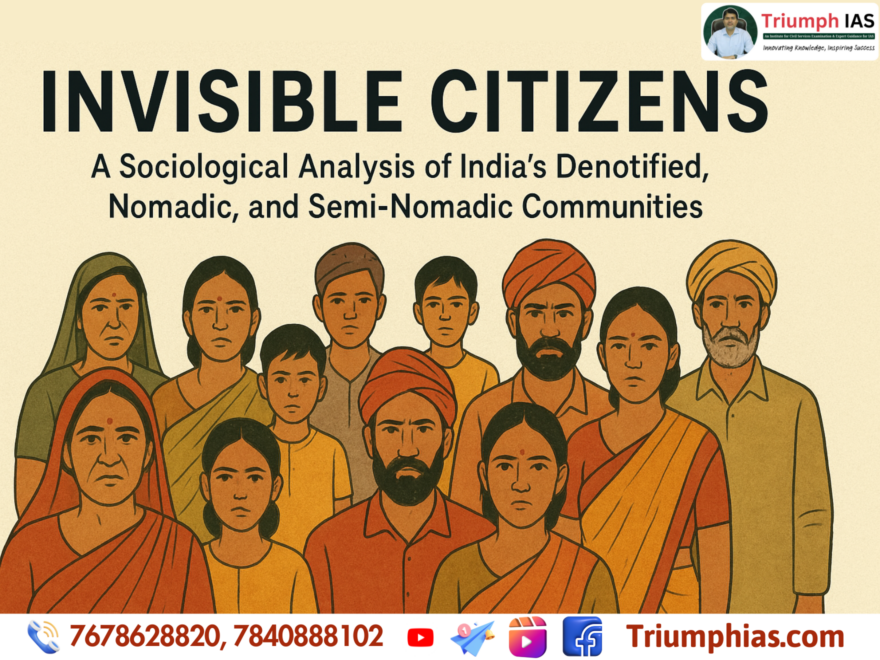
Invisible Citizens: A Sociological Analysis of India’s Denotified, Nomadic, and Semi-Nomadic Communities
(Relevant for Sociology Paper 2: Tribal Communities in India)
Invisible Citizens: A Sociological Analysis of India’s Denotified, Nomadic, and Semi-Nomadic CommunitiesRecently, the Indian government decided not to reclassify the 268 Denotified, Nomadic, and Semi-Nomadic communities (DNTs) into SC/ST/OBC categories, despite recommendations from the Anthropological Survey of India. This decision has serious socio-economic implications. Classification is not just bureaucratic—it determines access to welfare, education, livelihoods, and social recognition. For communities historically stigmatized, such as those branded “criminal tribes” during the British colonial era, the lack of formal recognition perpetuates structural marginalization. From a sociological perspective, the plight of DNTs reveals how state classifications, historical prejudice, and social structures intersect to maintain inequality. These communities, comprising roughly 10% of India’s population, have historically faced social exclusion, economic deprivation, and administrative neglect. Historical Context: Colonial Stigma and Social ExclusionThe story of DNTs begins with the Criminal Tribes Act of 1871, under which certain communities were labeled “born criminals.” This legal branding was a tool of colonial social control, embedding structural stigma into social institutions. Post-independence, India repealed the Act in 1952, denotifying these communities. Yet, social memory and bureaucratic inertia continued to marginalize them.
This colonial legacy is a classic example of what Pierre Bourdieu would term symbolic violence—a process where social hierarchies are imposed subtly through labels and classifications, legitimizing inequality and rendering marginal communities structurally powerless. Bourdieu: Social, Cultural, and Economic Capital DeficitsBourdieu’s framework helps us understand how DNTs’ marginalization is maintained across generations:
Without recognition in the SC/ST/OBC frameworks, DNTs face compounded disadvantage, unable to convert cultural and social resources into economic gains. Foucault: Governance, Classification, and Population ManagementMichel Foucault emphasized how the state exercises power through knowledge and classification. The refusal to reclassify DNTs illustrates the politics of recognition:
Foucault would interpret this as an ongoing exercise of disciplinary power, where the state’s “knowledge about populations” regulates who counts as a citizen deserving rights. Sen: Capability Deprivation and Social JusticeAmartya Sen’s Capability Approach reframes social justice in terms of freedom and functionings. DNTs’ lack of recognition restricts their fundamental capabilities:
From a Senian perspective, the failure to integrate DNTs into recognized welfare categories directly diminishes human development and equality. Weber: Bureaucracy and Institutional NeglectMax Weber highlighted the dual nature of bureaucracy: rational, efficient governance on one hand, and rigid, depersonalized administration on the other. The DNT situation illustrates Weber’s “irrationality of rationality”:
Weber would argue that the bureaucracy’s inability to adapt to these communities’ realities transforms the machinery of governance into an instrument of exclusion. Ambedkarian Perspective: Structural Discrimination and Social EmpowermentDr. B.R. Ambedkar’s framework on social justice is central here. He emphasized state intervention to correct historical injustices, recognizing that caste-based discrimination requires affirmative measures. DNTs, historically criminalized and socially marginalized, fit Ambedkar’s conception of groups needing targeted social empowerment:
Contemporary Challenges: Marginalization in Modern IndiaDespite legal abolition of the Criminal Tribes Act, DNTs face ongoing disadvantages:
These challenges reveal that social stigma can persist even when legal frameworks nominally change, illustrating the resilience of structural inequality. Policy Implications and Sociological Lessons
Conclusion: Counting, Recognizing, and Empowering the InvisibleThe denial of DNT reclassification is more than an administrative decision—it is a continuation of historical marginalization, leaving vulnerable communities trapped in cycles of poverty, social exclusion, and bureaucratic invisibility. Sociology teaches us that classification, recognition, and empowerment are deeply interlinked. Without inclusive policies, these communities remain invisible in India’s developmental narrative. By integrating Bourdieu, Foucault, Sen, Weber, and Ambedkar, we see that the challenges faced by DNTs are not accidental—they are structural, historical, and political. Addressing their marginalization requires more than welfare schemes; it demands systemic recognition, social justice, and institutional flexibility. Only then can India ensure that its most vulnerable citizens are truly counted, recognized, and empowered. |
To Read more topics, visit: www.triumphias.com/blogs
Read more Blogs:
Health Security and National Security: A Sociological Reading of the 2025 Cess Bill
When Genetics Meets Governance: Thalassemia, Contaminated Blood, and Social Inequalities in India
One comment