


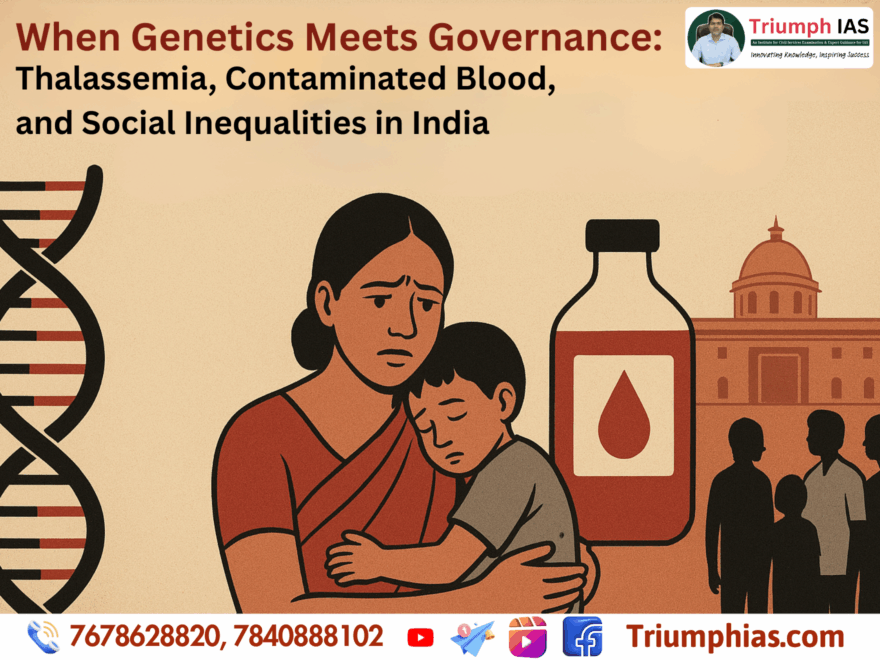
When Genetics Meets Governance: Thalassemia, Contaminated Blood, and Social Inequalities in India
(Relevant for Sociology Paper 2: Politics and Society and Population Dynamics)
| Recently, news emerged from Jharkhand where five children with thalassemia tested positive for HIV after receiving contaminated blood transfusions. This tragic incident is not just a medical failure, but also a social, ethical, and governance challenge, raising questions about healthcare infrastructure, vulnerability, and inequality in India.
To understand the significance, it is crucial to examine the medical condition, systemic gaps, and sociological dimensions that intersect in this crisis. Thalassemia: The Genetic BurdenThalassemia is an inherited disorder affecting hemoglobin production, leading to anemia and reduced oxygen transport in the body. It is classified into several types:
In India, thalassemia is a major public health challenge, with 150,000 patients and 12,000 new cases annually. About 3–4% of the population are carriers, with tribal communities accounting for a significant portion. Recognizing its chronic impact, India classifies thalassemia as a disability under the RPwD Act, 2016, enabling patients to access certain welfare measures. Treatment requires regular blood transfusions, iron chelation therapy, and sometimes bone marrow transplants. This dependence on healthcare infrastructure exposes patients to systemic failures, as seen in Jharkhand. Healthcare Infrastructure and Systemic GapsThe Jharkhand incident highlights critical governance and health system deficiencies:
From a Max Weberian perspective, bureaucracy—intended to rationalize healthcare delivery—sometimes becomes rigid, impersonal, and fails to account for local vulnerabilities, leading to inefficiencies with real human costs. Sociological Perspectives on Vulnerability
Children with thalassemia in Jharkhand represent structurally vulnerable populations:
Pierre Bourdieu’s theory of social and economic capital can illuminate these disparities: families with fewer resources lack the economic capital to access private healthcare, the cultural capital to navigate complex medical systems, and the social capital to demand accountability from state institutions.
The governance of thalassemia care illustrates Foucault’s concept of biopolitics: the state’s role in managing populations’ health. Blood safety protocols, disease registries, and CSR-driven initiatives like Thalassemia Bal Sewa Yojana (TBSY) reflect attempts to regulate biological life. However, failure in execution—as in the contaminated transfusions—reveals biopolitical neglect, where the state’s obligation to protect vulnerable populations is unevenly applied. Marginalized groups, such as tribal children in Jharkhand, bear the brunt of such oversight gaps.
Sen’s framework emphasizes freedom and real opportunities to lead healthy lives. Thalassemia patients’ capabilities are constrained by:
Contaminated transfusions are not just a medical lapse—they deprive children of fundamental capabilities, exacerbating social inequities.
Thalassemia is recognized as a disability, yet societal stigma persists:
Erving Goffman’s theory of stigma applies here: patients experience “spoiled identities”, where biological difference intersects with societal prejudice. Adding HIV infection compounds stigma, further marginalizing affected children and families. Policy Measures and Social ImplicationsIndia has several interventions to address thalassemia:
However, gaps in implementation, awareness, and rural accessibility persist. From a sociological lens, these gaps reflect structural inequality, bureaucratic inertia, and uneven distribution of social capital, disproportionately affecting marginalized communities. Ethical and Governance DimensionsThe Jharkhand case also raises bioethical concerns:
Sociologically, this reflects institutional betrayal, where governance structures fail to protect the most vulnerable, reinforcing cycles of exclusion and mistrust. Conclusion: Towards Equity in HealthThe intersection of thalassemia, HIV risk, and systemic failure in Jharkhand highlights urgent sociological lessons:
This incident underscores that medical crises are not only biomedical issues but social crises, reflecting the interplay of inequality, governance, and marginalization. Only by combining policy rigor with sociological insight can India ensure that vulnerable children with thalassemia are not exposed to preventable risks, and can live healthy, dignified lives. |
To Read more topics, visit: www.triumphias.com/blogs
Read more Blogs:
Choosing Death, Negotiating Life: A Sociological Inquiry into Euthanasia in India
Manual Scavenging in India: Caste, Labour, and the Sociology of State Failure
One comment