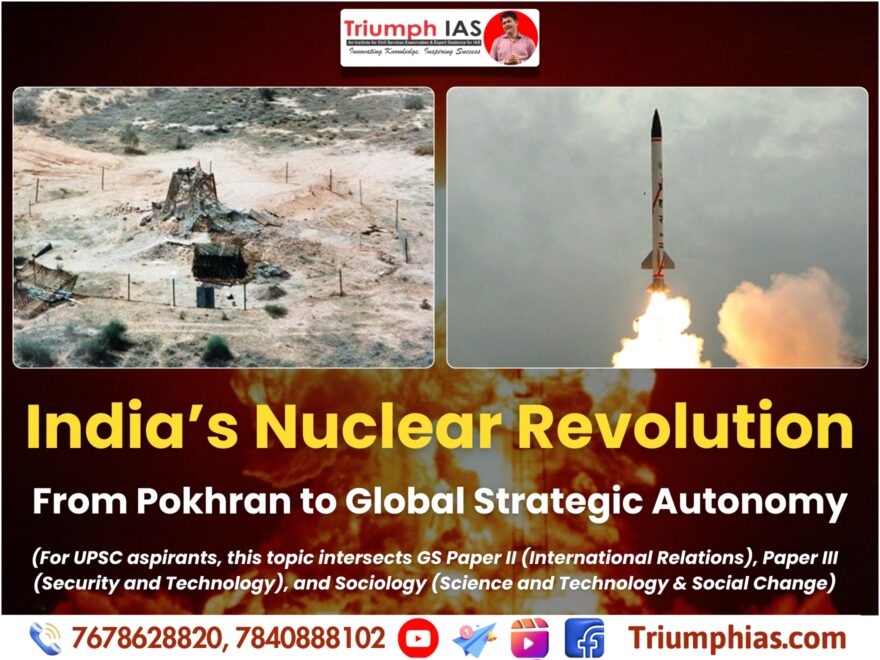
India’s Nuclear Revolution: From Pokhran to Global Strategic Autonomy

India’s Nuclear Revolution: From Pokhran to Global Strategic Autonomy

India’s Nuclear Revolution
From Pokhran to Global Strategic Autonomy

(For UPSC aspirants, this topic intersects GS Paper II (International Relations), Paper III (Security and Technology), and Sociology (Science and Technology & Social Change)

Introduction:

India’s nuclear revolution is not just about warheads or uranium—it is the story of a nation’s transformation through science, security, and self-reliance. Born out of the vision of pioneers like Homi Bhabha and institutionalized through bold leadership, India’s nuclear evolution reflects its deeper quest for strategic autonomy, technological advancement, and energy security.

Historical Timeline of India’s Nuclear Evolution

  • 1948 – Atomic Energy Act: Jawaharlal Nehru emphasized peaceful uses of nuclear energy.
  • 1974 – Pokhran-I (“Smiling Buddha”): India conducted its first nuclear test, officially for peaceful purposes.
  • 1998 – Pokhran-II: Under Atal Bihari Vajpayee, India became a de facto nuclear weapons state.
  • 2003 – Nuclear Doctrine: India adopted a No First Use (NFU) policy and developed a credible minimum deterrent.
  • 2008 – Indo-US Civil Nuclear Deal: Marked India’s integration into the global nuclear order without signing the NPT.

Key Features of India’s Nuclear Doctrine

  • No First Use (NFU): India will only use nuclear weapons in retaliation.
  • Credible Minimum Deterrence: Avoids arms race, but ensures sufficient capability.
  • Nuclear Triad: Land-based missiles (Agni series), air-delivered bombs, and submarine-launched missiles (INS Arihant).

Civilian Use of Nuclear Power

India’s nuclear program is not just about bombs:

  • India operates 22 nuclear reactors and is expanding civilian capacity.
  • Thorium reserves in Kerala make it a potential future leader in sustainable nuclear energy.
  • Energy equity aims to ensure clean power for all without over-reliance on fossil fuels.

Impact on Global and Domestic Fronts

  • Strategic Autonomy: India now participates in forums like NSG (although not a full member), MTCR, and Wassenaar Arrangement, asserting its sovereignty in global security.
  • Technological Advancement: India’s DRDO, BARC, and ISRO collaborations have enhanced indigenous capabilities in missile systems, nuclear reactors, and space programs.
  • Regional Deterrence: Nuclear capability balances threats from China and Pakistan, acting as a stabilizer in South Asia.

Challenges Ahead

  • Nuclear Waste Management: Still underdeveloped in India.
  • Safety Concerns: Post-Fukushima, India faces pressure to upgrade plant safety.
  • Global Entry Barriers: Despite progress, India still awaits full NSG membership.
  • Balancing Civil & Military Use: Ensuring peaceful application remains a priority.

Conclusion:

India’s nuclear revolution reflects the country’s ability to navigate complex challengestechnical, diplomatic, and ethical. From building reactors to asserting deterrence, from signing global treaties to resisting coercion, India has carved a unique nuclear path—rooted in peace, powered by science, and driven by strategic foresight. As India moves toward becoming a global power, its nuclear journey will remain central to its identity as a modern, responsible, and sovereign republic.

To Read more topics like Artificial Intelligence and Human Development in HDR 2025 in Public Posts, visit: www.triumphias.com/blogs

Read more Blogs:

GDP @ 70: Does GDP Methodology of Calculating Growth Requires a Serious Shift? | Ethics for UPSC Civil Services Examination | Triumph IAS

Code of Conduct for Civil Servants | Ethics for UPSC Civil Services Examination | Triumph IAS

One comment

Leave a Reply

Your email address will not be published. Required fields are marked *