Historical materialism is propounded by Karl Marx. Historical materialism forms the backbone of Marxist sociology. It explains how material conditions and economic structures shape society, politics, and culture. This theory is not only a theoretical foundation but also a lens to analyze contemporary issues like inequality, capitalism, caste-class dynamics, agrarian distress, and globalization in India.
In simple terms, historical materialism is the idea that history is driven by material conditions, not ideas alone. Unlike idealist thinkers who believed that religion, culture, or philosophy drive history, Marx argued that the economic base of society (mode of production) determines the superstructure (law, politics, ideology, culture).
Core Principles of Historical Materialism
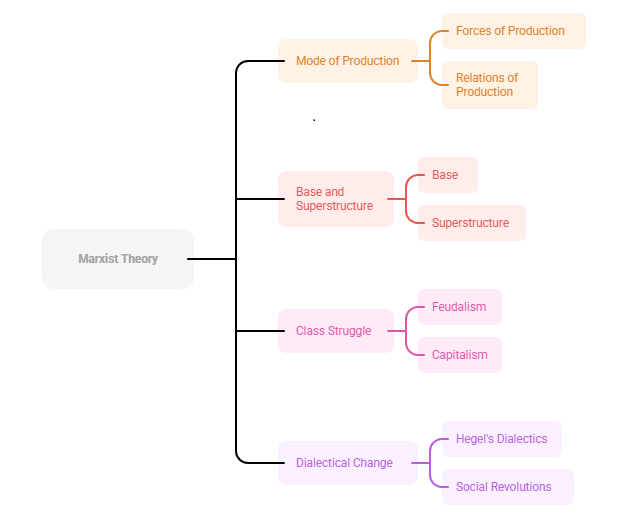
Mode of Production: The foundation of society lies in how people produce goods. This includes:
Forces of production: technology, tools, labor power.
Relations of production: property relations between classes (e.g., landlord–tenant, capitalist–worker).
Base and Superstructure:
Base (economic structure): forces + relations of production.
Superstructure: politics, religion, morality, laws, culture. Marx argued that the base determines the superstructure, though the superstructure can also reinforce the base.
Class Struggle: History is the story of conflict between classes. In feudalism, it was lords vs serfs; in capitalism, it is bourgeoisie vs proletariat. Class struggle pushes societies from one stage of development to another.
Dialectical Change: Borrowing from Hegel’s dialectics, Marx explained that contradictions within a mode of production lead to social revolutions. For example, capitalism creates enormous wealth but also inequality, leading to conditions for socialism.
Historical Materialism and Stages of Social Development
Marx outlined five broad stages of human history:
Primitive Communism – communal ownership, no private property.
Slavery – emergence of class exploitation.
Feudalism – lords and serfs, land as main productive force.
Ancient tribal communities in India reflect primitive communism.
The zamindari system represents feudalism.
Post-1991 reforms accelerated capitalism and globalization in India.
Sociological Analysis
Strengths
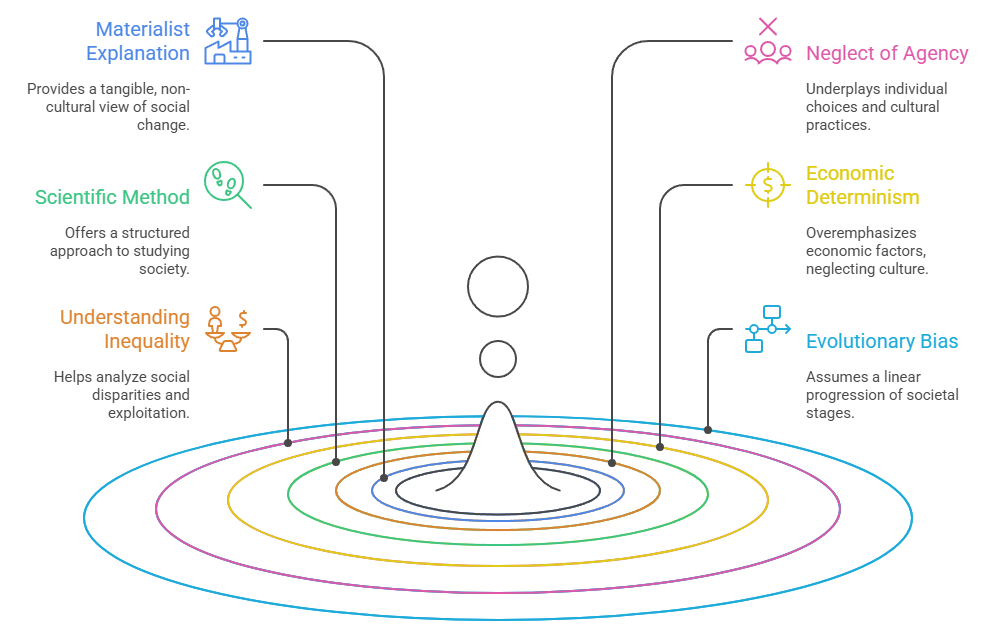
Provides a materialist explanation of social change, avoiding vague cultural or religious explanations.
Helps understand inequality, poverty, and class exploitation in contemporary India.
Offers a scientific method to study society (as Marx claimed).
Criticisms
Economic determinism: Critics argue Marx overemphasized economy and ignored culture, religion, and values (Max Weber highlighted this with hisProtestant Ethic thesis).
Neglect of agency: Individuals’ choices and cultural practices are often underplayed.
Evolutionary bias: Not all societies pass through the stages Marx described.
Thinkers like Antonio Gramsci extended Marx’s ideas by introducing cultural hegemony, showing how ideology also shapes power. Althusser refined the base-superstructure model with the idea of ideological state apparatuses.
Historical Materialism and Indian Society
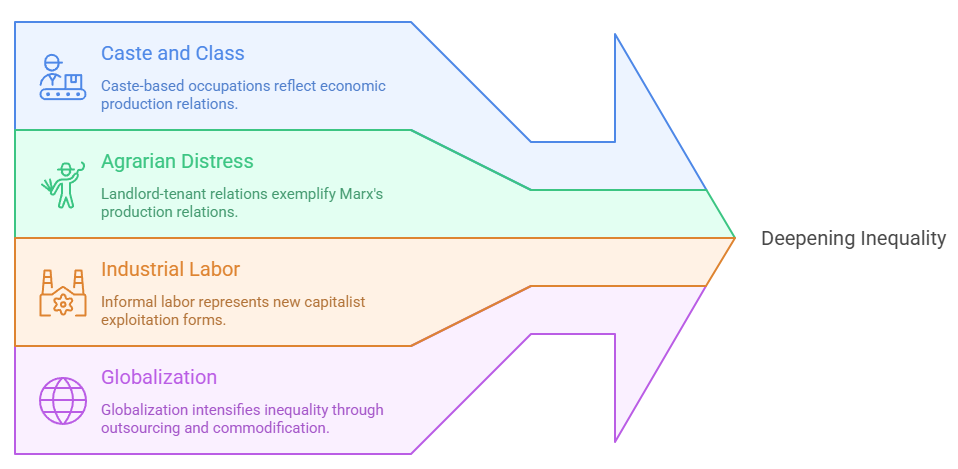
Caste and Class: Marxists like D. Kosambi argued that caste should be studied as linked to material conditions of production. For instance, caste-based occupations in villages reflect economic relations.
Agrarian Distress: The relationship between landlords, tenants, and agricultural laborers is a classic case of Marx’s relations of production.
Industrial Labor: The rise of the informal sector, gig work, and contract labor in India can be analyzed as new forms of capitalist exploitation.
Globalization: Outsourcing, platform work, and commodification of culture show how capitalism evolves but also deepen inequality.
Current Relevance
Historical materialism is not just theory; it helps decode current social issues:
Farmers’ protests → conflict between agrarian producers and corporatized agriculture.
Platformization of labor (gig economy) → modern proletariat facing precarity without security.
Inequality reports (Oxfam, World Inequality Report) → widening gap between rich and poor, validating Marx’s prediction.
Privatization and neoliberal reforms → show how capitalism restructures class relations.
Conclusion
Historical materialism is not just Marx’s theory; it is a method of analysis. It gives a powerful framework to connect theory with practice, history with present, and structure with change. As Marx famously wrote, “The philosophers have only interpreted the world, in various ways. The point, however, is to change it.”
Historical materialism is a reminder: understanding society is not enough; you must also see the forces of change shaping it.
PYQs
Paper I –
“Analyse the salient features of historical materialism.”(2013)
“Analyse Marxian conception of historical materialism as a critique of Hegelian dialectics.”(2017)
“What is historical materialism? Examine its relevance in understanding contemporary societies.”(2023)
Highlight the main features of historical materialism as propounded by Marx. How far is this theory relevant in understanding contemporary societies? Explain. (2025)