Slums as Manifestations of Industrialization and Urbanization in India | Sociology Optional Coaching | Vikash Ranjan Classes | Triumph IAS 2026-27 | UPSC Sociology Optional
Slums are often the most visible and controversial indicators of urbanization in India. Characterized by overcrowding, inadequate housing, lack of basic amenities, insecure tenure, and poor sanitation, slums reveal deep-seated socio-economic inequalities. While industrialization and urbanization are engines of economic growth and social transformation, they have also generated structural dislocations, rural-urban migration, and spatial segregation, leading to the proliferation of slums.
Sociologically, slums can be seen as both consequences and critiques of industrial and urban development, offering insights into class stratification, social exclusion, policy shortcomings, and governance challenges. The rise of slums raises questions about sustainable urban development, equity, and the human cost of modernization.
Industrialization and Urbanization in India: Context
Industrialization
Post-independence industrial policies (Five-Year Plans, Liberalization in 1991) promoted rapid industrial growth in urban centers, particularly in Mumbai, Kolkata, Delhi, Bengaluru, and Hyderabad.
Industrialization created job opportunities, attracting migrants from rural areas seeking higher wages.
The economic benefits were unevenly distributed, concentrating wealth in industrial hubs while low-skilled workers remained marginalized.
Urbanization
Urban population in India has grown from 17% in 1951 to over 35% in 2021, reflecting rural-urban migration driven by industrial opportunities.
Cities expanded faster than infrastructure and housing development, creating informal settlements.
Urbanization intensified land pressure, housing shortages, and informal economic activities, laying the foundation for slums.
Linkage: Industrialization and urbanization are interlinked processes. Industrialization generates employment and income disparities, while urbanization concentrates people in cities where housing and social services are inadequate, producing slums.
Slums as Manifestations of Industrialization and Urbanization
Economic Dimension
Slums house low-wage industrial workers, informal laborers, and migrants who cannot afford formal housing.
The dual economy framework (Lewis, 1954) explains the coexistence of high-productivity industrial sectors and low-productivity informal labor markets.
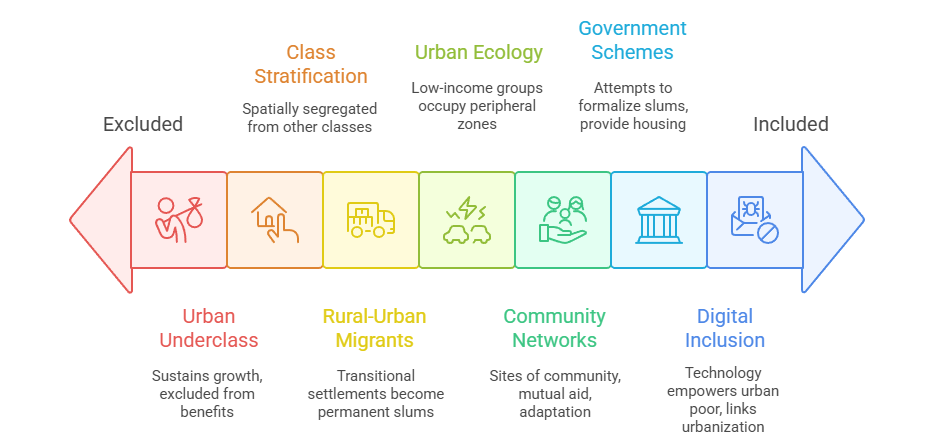
Slums represent the urban underclass that sustains industrial and service sector growth yet remains economically excluded from its benefits.
Sociological Dimension – Stratification and Exclusion
Slums reflect class stratification: the poor are spatially segregated from middle- and upper-class neighborhoods.
Bourdieu’s concept of economic, social, and cultural capital is applicable: slum dwellers lack capital to access quality housing, education, or formal jobs.
Marxian perspective: Slums exemplify urban proletariat living conditions, highlighting exploitation and unequal distribution of resources under capitalist industrialization.
Weberian lens: Social status and life chances of slum dwellers are restricted by ascribed and acquired factors, including caste, education, and occupation.
Demographic and Migration Dimension
Slums are primarily composed of rural-urban migrants.
Push factors: agrarian distress, unemployment, lack of irrigation, and rural poverty.
Pull factors: industrial jobs, urban amenities, and the perception of upward mobility.
Zelinsky’s mobility and migration theory can be applied: transitional migration leads to temporary settlements that become permanent slums.
Spatial Dimension – Urban Ecology and Segregation
The Chicago School’s urban ecology model (Burgess, 1925) explains slums as a product of concentric zone urban expansion, where low-income groups occupy peripheral or transitional zones.
In India, slums often emerge near industrial zones, railway stations, or city outskirts—reflecting functional and economic proximity to employment.
Modern urban planning failures have perpetuated spatial segregation, reinforcing social hierarchies in cities.
Cultural and Social Life in Slums
Slums are not merely spaces of deprivation; they are sites of community networks, mutual aid, and cultural adaptation.
Giddens’ structuration theory: while slums are shaped by social structures (urban policies, labor markets), they also enable agency, with residents forming informal economies and social organizations.
Community initiatives in Mumbai, Bengaluru, and Delhi show grassroots resilience—e.g., cooperatives, microfinance, and local education programs.
Policy and Governance Dimension
Government schemes such as Rajiv Awas Yojana (RAY), Pradhan Mantri Awas Yojana (PMAY), and Slum Rehabilitation Authorities (SRA) attempt to formalize slums or provide housing.
Challenges: inadequate funding, bureaucratic inefficiency, political interference, and informal property rights.
Slums persist because industrialization and urbanization continue to outpace housing and social infrastructure development.
Contemporary Linkages
COVID-19 pandemic highlighted vulnerability of slum dwellers: crowded housing, lack of sanitation, and limited access to health care exacerbated risks.
Digital inclusion: projects like Aadi Vaani and local e-governance initiatives show how technology can empower urban poor, linking with broader debates on inclusive urbanization.
Theoretical Synthesis
Perspective
Explanation of Slums
Thinkers / Theories
Marxian
Slums as outcomes of capitalist industrialization and exploitation
Karl Marx, Marxist urban theory
Weberian
Social status, life chances, and bureaucratic exclusion affect slum existence
Max Weber
Bourdieu
Lack of cultural, social, and economic capital reproduces urban inequality
Pierre Bourdieu
Chicago School
Urban ecological model; slums in transitional/peripheral zones
Burgess, Park
Giddens
Agency within structural constraints; slum communities adapt
Slums in India are direct manifestations of industrialization and urbanization, reflecting economic inequalities, social stratification, migration pressures, and urban planning failures. Yet, they also demonstrate agency, resilience, and cultural adaptation among marginalized urban populations.




3 comments