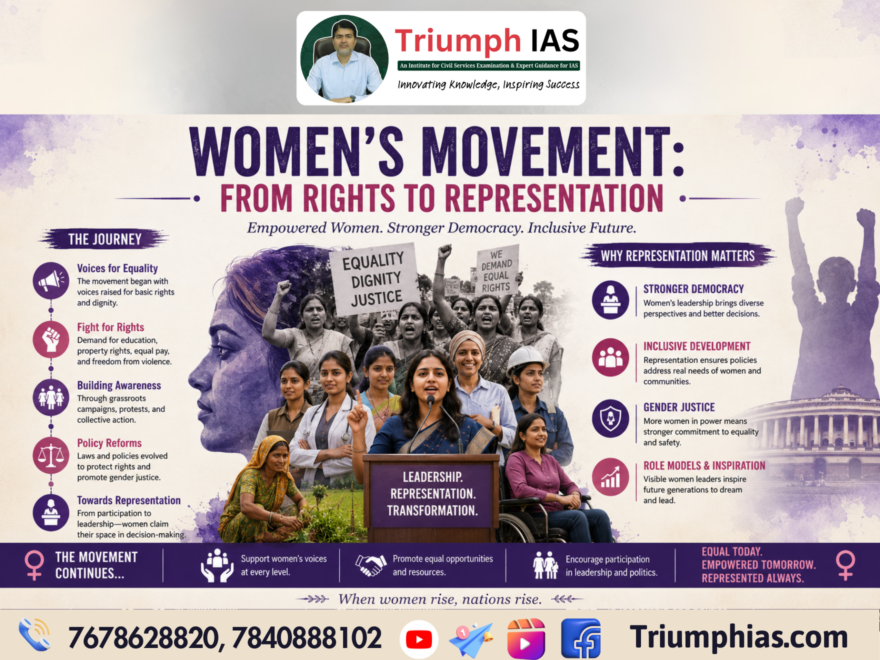
Womens Movement: From Rights to Representation

Womens Movement: From Rights to Representation

Relevant for Sociology Optional Paper 1, Paper 2, and GS Paper I (Indian Society)

Introduction

The women’s movement has been one of the most transformative social movements in modern history. While its early phases primarily focused on securing legal and political rights for women, contemporary struggles increasingly emphasize representation, participation, and empowerment in various spheres of society. The transition from demanding rights to seeking meaningful representation reflects the evolving nature of gender justice in a democratic and globalized world.

Historically, women across societies faced systemic discrimination rooted in patriarchal social structures. They were denied access to education, property ownership, political participation, and economic opportunities. The first wave of the women’s movement emerged in the nineteenth and early twentieth centuries, focusing on civil and political rights, particularly the right to vote. Feminist thinkers and activists challenged the exclusion of women from public life and demanded equality before the law.

The second wave, which gained momentum during the 1960s and 1970s, expanded the agenda beyond legal equality. It addressed issues such as workplace discrimination, reproductive rights, domestic violence, and unequal gender roles. Feminist scholars highlighted how social institutions perpetuated gender inequalities even when formal rights had been granted. The famous slogan “the personal is political” reflected the understanding that gender oppression extended into family, culture, and everyday life.

Contemporary women’s movements have moved further toward the question of representation. The concern is no longer limited to whether women possess rights but whether they are adequately represented in political institutions, corporate leadership, academia, media, and governance structures. Representation is significant because it influences decision-making, policy priorities, and resource allocation. Without representation, formal equality often fails to translate into substantive equality.

Sociologists view this transition through multiple theoretical lenses. Liberal feminists emphasize equal opportunities and institutional reforms to ensure women’s participation in public life. Radical feminists focus on dismantling patriarchal power structures that continue to marginalize women. Socialist feminists examine how gender inequality intersects with economic exploitation, while intersectional feminists highlight the experiences of women differentiated by caste, class, ethnicity, religion, and region.

In the Indian context, the women’s movement has evolved through distinct phases. Social reform movements in the nineteenth century challenged practices such as sati, child marriage, and restrictions on women’s education. Post-independence constitutional provisions guaranteed equality and non-discrimination. However, persistent gender disparities in literacy, employment, political participation, and access to resources revealed the limitations of legal rights alone.

Recent developments have focused on increasing women’s representation in governance and public institutions. Reservation policies in Panchayati Raj Institutions have significantly enhanced women’s participation in local governance. The growing demand for greater representation in legislative bodies reflects the recognition that women must not merely be subjects of policy but active participants in shaping it. Movements addressing workplace harassment, gender-based violence, and digital safety further demonstrate the expanding scope of women’s collective action.

The rise of social media has added a new dimension to women’s movements. Campaigns such as #MeToo have enabled women to challenge entrenched power structures and bring issues of gender violence into public discourse. Digital activism has amplified marginalized voices and fostered global solidarity, although concerns regarding online harassment and digital exclusion remain significant.

The journey from rights to representation highlights the changing aspirations of women’s movements. Legal rights remain essential, but genuine empowerment requires equitable participation in decision-making processes and social institutions. The future of gender justice lies in creating inclusive structures where women are not merely beneficiaries of rights but equal stakeholders in shaping society. Such a transformation is indispensable for achieving substantive democracy, social justice, and inclusive development.

UPSC Civil Services (Mains) Question

Q. “The contemporary women’s movement has shifted its focus from securing rights to ensuring representation and participation in decision-making structures.” Critically examine this statement with suitable sociological perspectives. (20 Marks)

To Read more topicsvisit: www.triumphias.com/blogs

Read more Blogs:

Management of Indian border disputes- a complex task – Triumph IAS & Vikash Ranjan Sir

Farmers Movements and Agrarian Distress

🔥 YOUR FINAL UPSC RANK CAN BE DECIDED BY JUST TWO PAPERS — ESSAY & OPTIONAL!

Most aspirants study hard.
But very few know how to convert knowledge into MARKS.

That’s where Triumph IAS creates the difference. 🚀

✍️ EMTS – Essay Mentorship & Test Series (CSE Mains 2026–27)

Under the mentorship of Vikash Ranjan Sir, master the art of writing structured, philosophical, multidimensional, and topper-level essays.

Scientific Essay Writing Approach
Knowledge Matrix Framework
5 Exclusive Essay Approach Classes
2 Thematic Tests + 4 UPSC Mock Tests
Detailed Model Essay Hints
Flexible Writing & Discussion Sessions
Personal 1-to-1 Mentorship

🏆 Trusted by UPSC Essay Toppers
━━━━━━━━━━━━━━━━━━

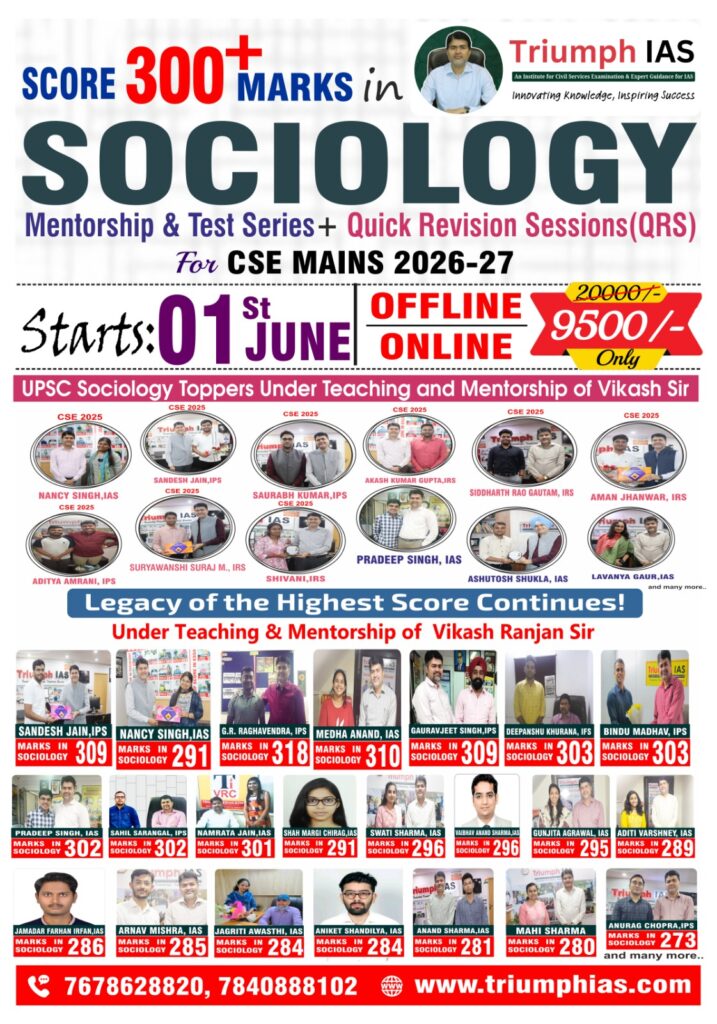
📚 SMTS – Sociology Mentorship & Test Series + Quick Revision Session (QRS)

🎯 SCORE 300+ MARKS IN SOCIOLOGY OPTIONAL

A structured, analytical, and result-oriented mentorship program designed to maximize your Sociology score under the guidance of Vikash Ranjan Sir.

Program Highlights:

26 Full-Length Tests with Detailed Evaluation
PYQ–NYQ Trend Analysis
Quick Revision Sessions on Unconventional Questions
Brainstorming & Concept Enrichment Sessions
1-to-1 Personal Mentorship Discussions
Topic-wise Answer Writing Practice
Current Social Issues Compilation
Home-based Practice Tests with Model Hints
Thinkers Integration & Value Addition Notes
Essay & GS Enrichment through Sociology

  • 🏆 Legacy of High Scores Continues:
  • 🌟 G.R. Raghavendra, IPS – 318
  • 🌟 Medha Anand, IAS – 310
  • 🌟 Sandesh Jain, IPS – 309
  • 🌟 Gauravjeet Singh, IPS – 309
  • 🌟 Deepanshu Khurana, IFS – 303
  • 🌟 Pradeep Singh, IAS – 302
  • 🌟 Swati Sharma, IAS – 296
  • 🌟 Gunjita Agarwal, IAS – 295

…and many more successful aspirants.

━━━━━━━━━━━━━━━━━

Batch Starts: 01 June

  • 📍 Available in OFFLINE & ONLINE Mode
  • 📞 Call/WhatsApp: 7678628820 | 7840888102
  • 🌐 triumphias.com
  • 📍 Triumph IAS
  • 23-B, 3rd Floor, Pusa Road
  • Near Karol Bagh Metro Pillar No. 114, New Delhi
One comment

Leave a Reply

Your email address will not be published. Required fields are marked *