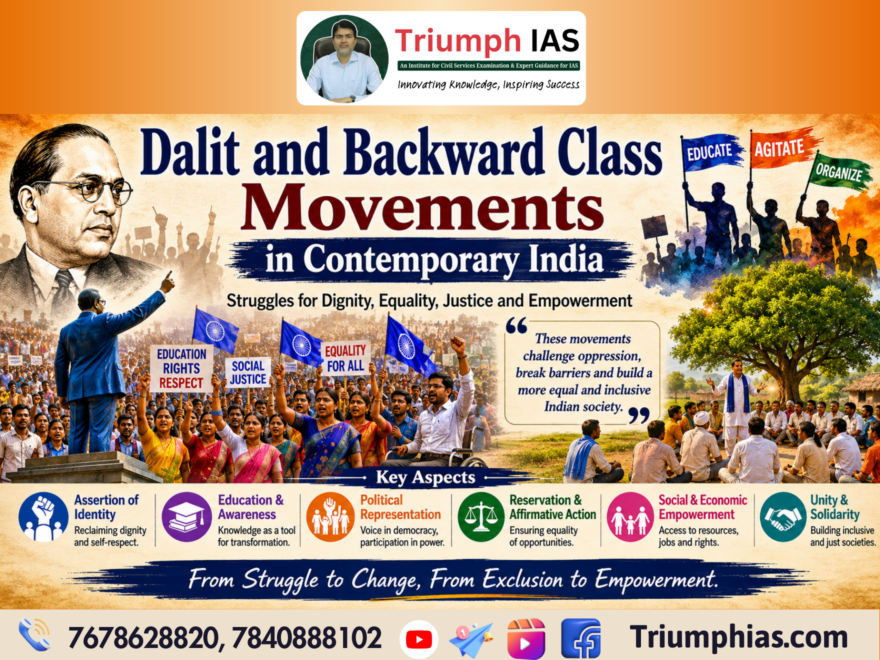
Dalit and Backward Class Movements in Contemporary India

Dalit and Backward Class Movements in Contemporary India

Relevant for Sociology Optional Paper 1, Paper 2, and GS Paper I (Indian Society)

Introduction

India’s social structure has historically been shaped by the institution of caste, which created hierarchies of privilege and exclusion. Among the most significant social movements in modern India are the Dalit and Backward Class movements, which have challenged caste-based discrimination and demanded dignity, equality, representation, and social justice. These movements have transformed the political, social, and cultural landscape of contemporary India and continue to influence debates on democracy, identity, and development.

From a sociological perspective, Dalit and Backward Class movements represent collective efforts by marginalized groups to challenge structural inequalities embedded in society. They are examples of social movements that seek not merely policy changes but a reconfiguration of social relations and power structures.

The Dalit movement traces its roots to the struggles against untouchability and caste oppression. Reformers such as Jyotirao Phule, Savitribai Phule, and most notably B. R. Ambedkar played crucial roles in mobilizing oppressed communities. Ambedkar emphasized education, organization, and political participation as instruments of emancipation. His vision continues to inspire Dalit movements that seek social equality, constitutional rights, and freedom from caste-based discrimination.

In contemporary India, Dalit movements have expanded beyond traditional demands for legal protection. They increasingly focus on issues such as educational access, employment opportunities, land rights, social dignity, and representation in institutions. The rise of Dalit literature, digital activism, and cultural assertion has enabled marginalized voices to challenge dominant narratives and create new spaces for resistance. Incidents of caste violence and discrimination continue to generate mobilization, reflecting the persistence of caste inequalities despite constitutional safeguards.

Parallel to the Dalit movement, Backward Class movements emerged from demands for social and educational advancement among Other Backward Classes (OBCs). These movements gained momentum during the twentieth century, particularly in southern India, where non-Brahmin movements challenged upper-caste dominance in education and public employment. The implementation of the recommendations of the Mandal Commission marked a turning point in Indian politics by expanding reservations for OBCs and strengthening their political representation.

The sociological significance of the Backward Class movement lies in its challenge to traditional power structures. It facilitated the emergence of new political elites from historically marginalized communities and democratized access to state resources. Regional political parties representing backward classes played a crucial role in reshaping electoral politics and broadening participation in governance.

Contemporary Dalit and Backward Class movements increasingly intersect with issues of gender, education, employment, urbanization, and globalization. Dalit women, for example, experience multiple forms of marginalization based on caste and gender, leading to distinct forms of activism. Similarly, young members of backward classes are utilizing digital platforms to articulate demands for equal opportunities and social recognition.

However, these movements also face challenges. Internal divisions, identity fragmentation, economic inequalities within communities, and debates over reservation policies often complicate collective mobilization. Globalization and neoliberal economic reforms have created new opportunities for social mobility but have also generated fresh forms of exclusion. As a result, movements today must address both traditional caste hierarchies and emerging socioeconomic disparities.

Conclusion

In conclusion, Dalit and Backward Class movements remain central to India’s democratic transformation. They have expanded the meaning of citizenship, strengthened social justice discourse, and challenged entrenched inequalities. While significant progress has been achieved, the persistence of caste-based discrimination underscores the continuing relevance of these movements. Their struggle reflects the broader sociological quest for equality, dignity, and inclusive development in a diverse and democratic society.

UPSC Civil Services (Mains) Question

Q. “Dalit and Backward Class movements have transformed the nature of social justice and democratic participation in India.” Critically examine the sociological significance of these movements in contemporary India. (250 Words)

To Read more topicsvisit: www.triumphias.com/blogs

Read more Blogs:

Alternative technologies for a climate change resilient India – Triumph IAS & Vikash Ranjan Sir

Womens Movement: From Rights to Representation

🔥 YOUR FINAL UPSC RANK CAN BE DECIDED BY JUST TWO PAPERS — ESSAY & OPTIONAL!

Most aspirants study hard.
But very few know how to convert knowledge into MARKS.

That’s where Triumph IAS creates the difference. 🚀

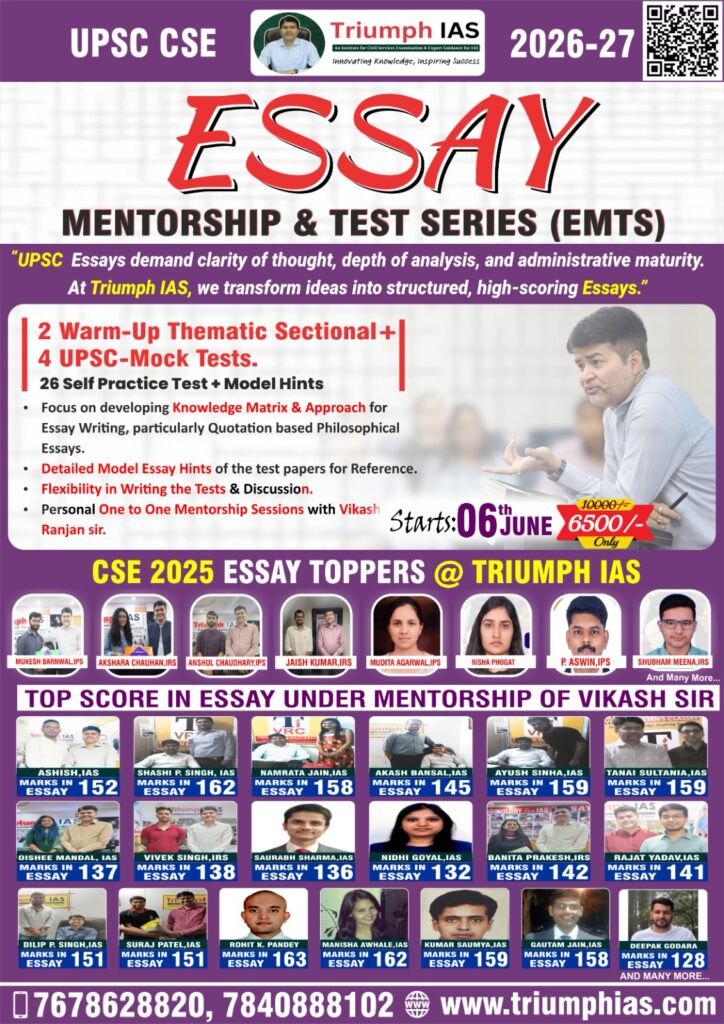
✍️ EMTS – Essay Mentorship & Test Series (CSE Mains 2026–27)

Under the mentorship of Vikash Ranjan Sir, master the art of writing structured, philosophical, multidimensional, and topper-level essays.

Scientific Essay Writing Approach
Knowledge Matrix Framework
5 Exclusive Essay Approach Classes
2 Thematic Tests + 4 UPSC Mock Tests
Detailed Model Essay Hints
Flexible Writing & Discussion Sessions
Personal 1-to-1 Mentorship

🏆 Trusted by UPSC Essay Toppers
━━━━━━━━━━━━━━━━━━

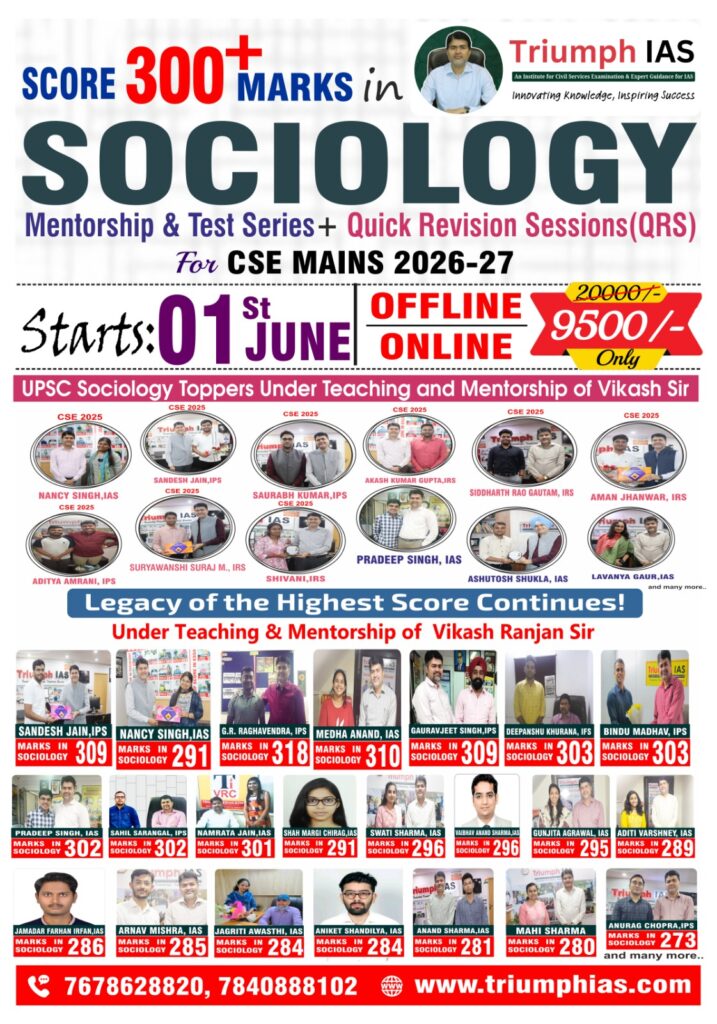
📚 SMTS – Sociology Mentorship & Test Series + Quick Revision Session (QRS)

🎯 SCORE 300+ MARKS IN SOCIOLOGY OPTIONAL

A structured, analytical, and result-oriented mentorship program designed to maximize your Sociology score under the guidance of Vikash Ranjan Sir.

Program Highlights:

26 Full-Length Tests with Detailed Evaluation
PYQ–NYQ Trend Analysis
Quick Revision Sessions on Unconventional Questions
Brainstorming & Concept Enrichment Sessions
1-to-1 Personal Mentorship Discussions
Topic-wise Answer Writing Practice
Current Social Issues Compilation
Home-based Practice Tests with Model Hints
Thinkers Integration & Value Addition Notes
Essay & GS Enrichment through Sociology

  • 🏆 Legacy of High Scores Continues:
  • 🌟 G.R. Raghavendra, IPS – 318
  • 🌟 Medha Anand, IAS – 310
  • 🌟 Sandesh Jain, IPS – 309
  • 🌟 Gauravjeet Singh, IPS – 309
  • 🌟 Deepanshu Khurana, IFS – 303
  • 🌟 Pradeep Singh, IAS – 302
  • 🌟 Swati Sharma, IAS – 296
  • 🌟 Gunjita Agarwal, IAS – 295

…and many more successful aspirants.

━━━━━━━━━━━━━━━━━

Batch Starts: 01 June

  • 📍 Available in OFFLINE & ONLINE Mode
  • 📞 Call/WhatsApp: 7678628820 | 7840888102
  • 🌐 triumphias.com
  • 📍 Triumph IAS
  • 23-B, 3rd Floor, Pusa Road
  • Near Karol Bagh Metro Pillar No. 114, New Delhi
One comment

Leave a Reply

Your email address will not be published. Required fields are marked *