Development-Induced Displacement and Environmental Crisis

Development-Induced Displacement and Environmental Crisis

Relevant for Sociology Optional Paper 1, Paper 2, and GS Paper I (Indian Society)

Introduction

Development-Induced Displacement and Environmental Crisis:- Development has long been considered a pathway toward economic progress, technological advancement, and improved standards of living. Large-scale infrastructure projects such as dams, mining activities, industrial corridors, urban expansion, and transportation networks are often justified as essential for national development. However, from a sociological perspective, development is not a value-neutral process. It often produces unequal outcomes, particularly in the form of development-induced displacement (DID) and environmental degradation.

Development-induced displacement refers to the forced movement of individuals and communities from their ancestral lands due to development projects. These processes raise critical questions regarding social justice, environmental sustainability, and the rights of marginalized communities.

Main body:

Development-Induced Displacement: A Crisis of Livelihood and Identity

Displacement caused by development projects affects millions of people worldwide. In India, large dams, mining projects, industries, wildlife conservation initiatives, and urban renewal programs have resulted in the displacement of tribal communities, farmers, and economically weaker groups.

Sociologically, displacement is not merely a physical relocation but a process involving the loss of livelihood, cultural identity, social networks, and community cohesion. Indigenous and tribal populations are particularly vulnerable because their relationship with land extends beyond economic dependence to cultural traditions, religious practices, and collective identity.

The concept of developmental refugees highlights communities that are compelled to sacrifice their homes and resources for projects that primarily benefit other sections of society. The unequal distribution of the costs and benefits of development reflects broader structures of social stratification and power relations.


Sociological Perspectives on Development and Displacement

The conflict perspective, influenced by the ideas of Karl Marx, views displacement as a consequence of unequal control over resources, where powerful economic and political groups benefit at the expense of marginalized communities. Development projects may therefore reproduce existing inequalities.

Dependency theorists argue that development models focused solely on industrial growth often ignore local communities and ecological sustainability. Similarly, the concept of environmental justice emphasizes that the environmental burdens of development are disproportionately borne by disadvantaged social groups.

The sociologist Michael Cernea’s Impoverishment Risks and Reconstruction (IRR) Model identifies major risks associated with displacement, including landlessness, joblessness, homelessness, food insecurity, social disintegration, and loss of access to common resources.


Environmental Crisis and the Consequences of Unsustainable Development

Rapid industrialization, excessive extraction of natural resources, deforestation, pollution, and unplanned urbanization have intensified the global environmental crisis. Climate change, biodiversity loss, water scarcity, and ecological degradation demonstrate the limitations of development models based purely on economic growth.

Environmental sociologists argue that ecological problems are deeply connected with social structures, consumption patterns, and economic systems. The ecological modernization perspective suggests that technological innovation and environmentally responsible policies can reconcile economic development with ecological protection.

Environmental degradation affects all sections of society, but its consequences are more severe for vulnerable communities that rely directly on natural resources for survival.


Development, Environment, and Social Movements

The negative consequences of displacement and environmental destruction have led to various social movements advocating sustainable and participatory development. Movements such as struggles against destructive development projects emphasize community rights, environmental protection, and democratic decision-making.

The concept of sustainable development, popularized through global environmental discourse, advocates meeting present developmental needs without compromising the ability of future generations to fulfill their own needs. It emphasizes balancing economic growth, social equity, and ecological conservation.

Conclusion:

Development-induced displacement and environmental crises reveal the contradictions of modern development. While economic growth remains necessary, a development model that ignores human rights, cultural identity, and ecological balance creates new forms of inequality and social conflict.

A sociological approach highlights that genuine development must be inclusive, participatory, and environmentally sustainable. The challenge before contemporary societies is not merely to achieve development, but to ensure that development is equitable, humane, and respectful of nature.

UPSC Civil Services (Mains) Question

Q. “Development projects often create environmental degradation and social displacement, exposing the unequal distribution of the costs and benefits of development.” Critically examine the statement using sociological perspectives. (250 Words)

To Read more topicsvisit: www.triumphias.com/blogs

Read more Blogs:

Ageing, Sex Ratio Imbalance, and Reproductive Health

Joy is the simplest form of gratitude – Triumph IAS & Vikash Ranjan Sir

🔥 YOUR FINAL UPSC RANK CAN BE DECIDED BY JUST TWO PAPERS — ESSAY & OPTIONAL!

Most aspirants study hard.
But very few know how to convert knowledge into MARKS.

That’s where Triumph IAS creates the difference. 🚀

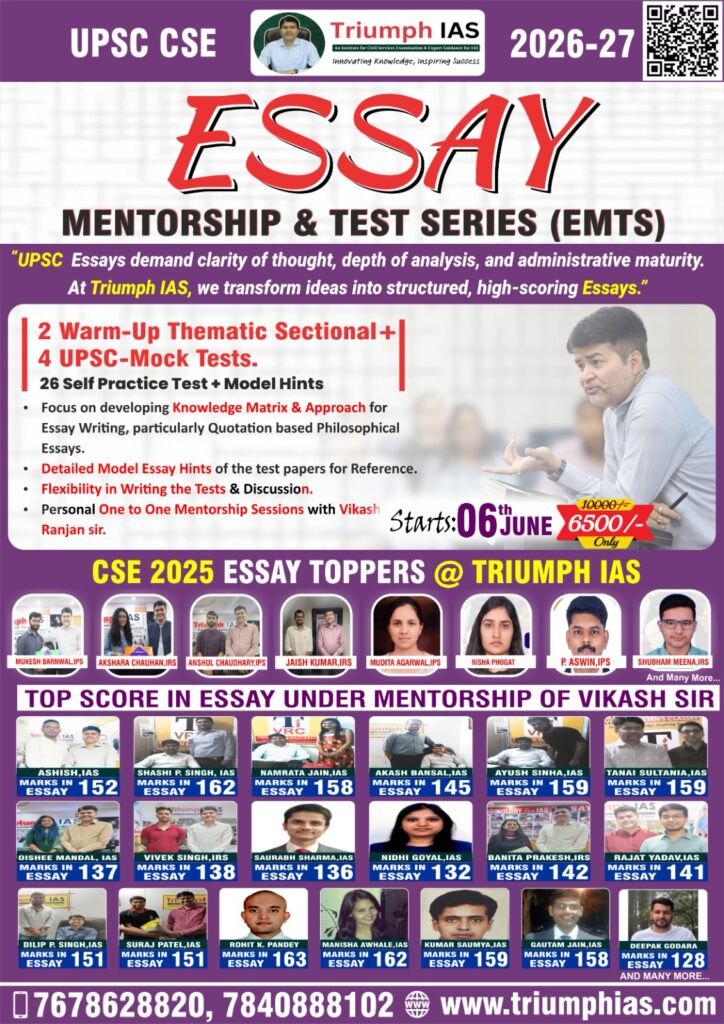
✍️ EMTS – Essay Mentorship & Test Series (CSE Mains 2026–27)

Under the mentorship of Vikash Ranjan Sir, master the art of writing structured, philosophical, multidimensional, and topper-level essays.

Scientific Essay Writing Approach
Knowledge Matrix Framework
5 Exclusive Essay Approach Classes
2 Thematic Tests + 4 UPSC Mock Tests
Detailed Model Essay Hints
Flexible Writing & Discussion Sessions
Personal 1-to-1 Mentorship

🏆 Trusted by UPSC Essay Toppers
━━━━━━━━━━━━━━━━━━

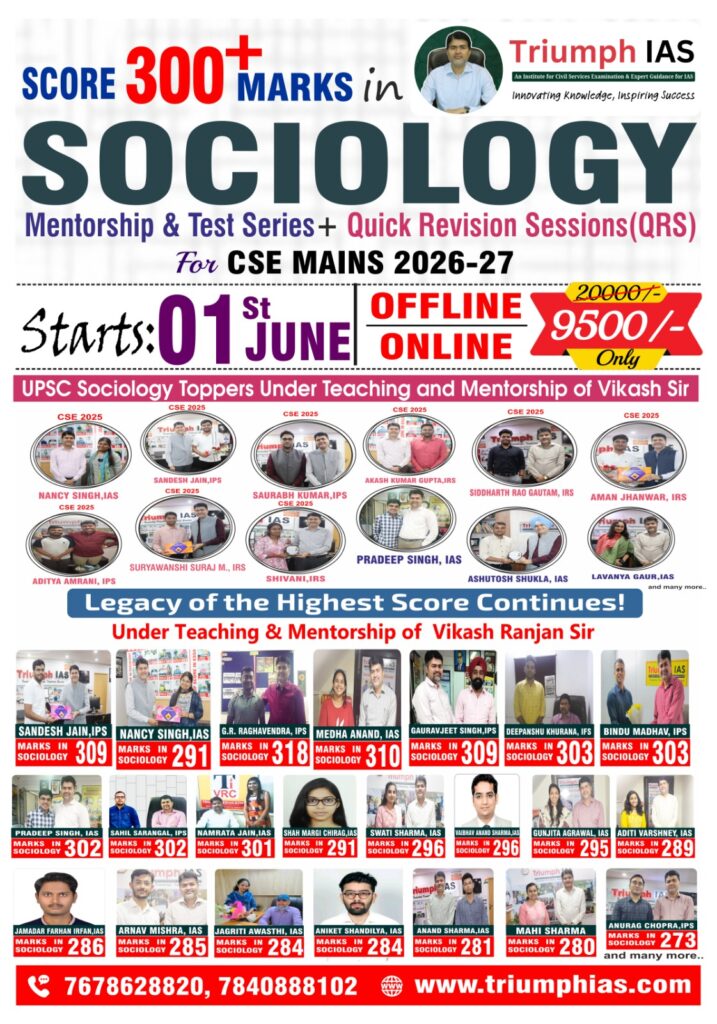
📚 SMTS – Sociology Mentorship & Test Series + Quick Revision Session (QRS)

🎯 SCORE 300+ MARKS IN SOCIOLOGY OPTIONAL

A structured, analytical, and result-oriented mentorship program designed to maximize your Sociology score under the guidance of Vikash Ranjan Sir.

Program Highlights:

26 Full-Length Tests with Detailed Evaluation
PYQ–NYQ Trend Analysis
Quick Revision Sessions on Unconventional Questions
Brainstorming & Concept Enrichment Sessions
1-to-1 Personal Mentorship Discussions
Topic-wise Answer Writing Practice
Current Social Issues Compilation
Home-based Practice Tests with Model Hints
Thinkers Integration & Value Addition Notes
Essay & GS Enrichment through Sociology

  • 🏆 Legacy of High Scores Continues:
  • 🌟 G.R. Raghavendra, IPS – 318
  • 🌟 Medha Anand, IAS – 310
  • 🌟 Sandesh Jain, IPS – 309
  • 🌟 Gauravjeet Singh, IPS – 309
  • 🌟 Deepanshu Khurana, IFS – 303
  • 🌟 Pradeep Singh, IAS – 302
  • 🌟 Swati Sharma, IAS – 296
  • 🌟 Gunjita Agarwal, IAS – 295

…and many more successful aspirants.

━━━━━━━━━━━━━━━━━

Batch Starts: 01 June

  • 📍 Available in OFFLINE & ONLINE Mode
  • 📞 Call/WhatsApp: 7678628820 | 7840888102
  • 🌐 triumphias.com
  • 📍 Triumph IAS
  • 23-B, 3rd Floor, Pusa Road
  • Near Karol Bagh Metro Pillar No. 114, New Delhi
 

Leave a Reply

Your email address will not be published. Required fields are marked *