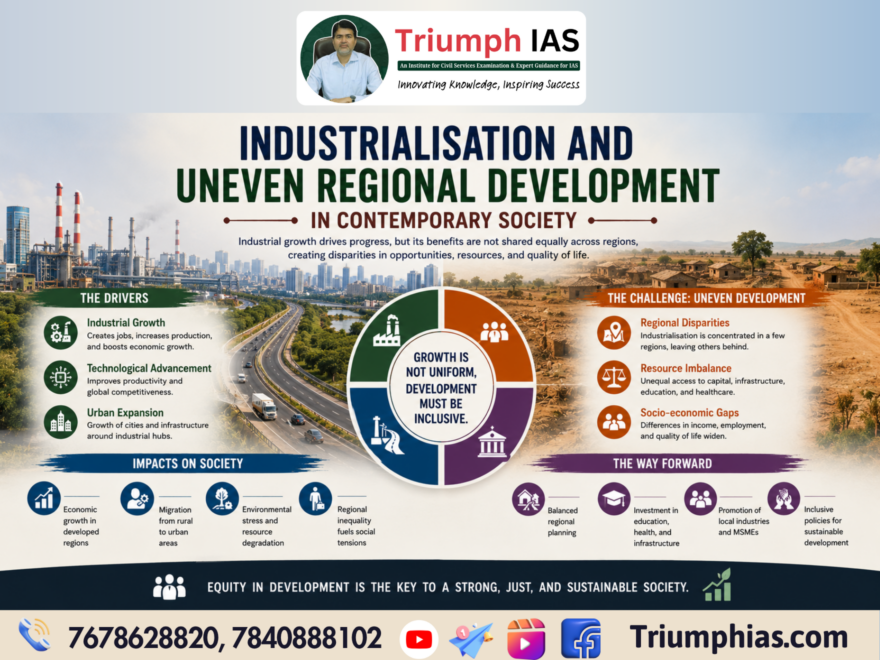
Industrialisation has long been regarded as a driving force of economic growth, modernization, and social transformation. It creates employment opportunities, enhances productivity, promotes urbanization, and contributes significantly to national development. However, the benefits of industrialisation are rarely distributed equally across regions. In contemporary society, industrial growth often remains concentrated in specific geographical areas, leading to uneven regional development and widening socio-economic disparities. From a sociological perspective, this phenomenon raises important questions about social justice, inequality, migration, and the role of the state in balanced development.
Dimension
Understanding Industrialisation and Regional Development
Industrialisation refers to the process through which economies shift from predominantly agrarian production to manufacturing and industrial activities. This transformation reshapes social structures, occupational patterns, and patterns of settlement. Regional development, on the other hand, concerns the economic and social progress of different geographical areas within a country.
Ideally, industrialisation should promote balanced growth across regions. However, in practice, industries tend to cluster in locations that offer advantages such as infrastructure, skilled labour, transportation networks, access to markets, and investment-friendly policies. Consequently, some regions emerge as industrial hubs while others remain economically stagnant.
Causes of Uneven Regional Development
Historical and Structural Factors
Many industrial regions enjoy historical advantages inherited from colonial investments, resource concentration, and early industrial establishments. Sociologists argue that development often follows a path-dependent trajectory where initial advantages continue to attract further investments, reinforcing regional inequalities.
Infrastructure and Investment Concentration
Regions with better transportation, communication facilities, educational institutions, and financial networks attract more industrial investments. Areas lacking these facilities struggle to compete, creating a cycle of underdevelopment. Gunnar Myrdal’s concept of “cumulative causation” explains how developed regions continue to grow while less developed regions fall further behind.
Globalisation and Market Forces
Contemporary industrialisation is strongly influenced by global capital flows. Multinational corporations prefer locations with higher profitability and lower production costs. This selective investment pattern often strengthens already developed regions while bypassing peripheral areas, contributing to spatial inequality.
Policy and Governance Disparities
Differences in state policies, administrative efficiency, and political influence also affect industrial growth. Regions with effective governance and proactive industrial policies are more successful in attracting investments than regions facing institutional weaknesses.
Sociological Consequences of Uneven Development
Migration and Urban Expansion
Uneven industrialisation encourages large-scale migration from less developed regions to industrial centres. Rural populations move in search of employment and better living standards. While migration offers opportunities, it also places pressure on urban infrastructure, leading to overcrowding, housing shortages, and the growth of informal settlements.
Social Inequality and Exclusion
Industrial concentration generates disparities in income, education, healthcare, and employment opportunities. Peripheral regions often experience poverty, unemployment, and social marginalization. Such inequalities can deepen existing divisions based on class, caste, ethnicity, and region.
Regional Identity and Social Movements
Persistent regional disparities frequently give rise to demands for greater autonomy, resource allocation, and political recognition. Sociologists observe that feelings of relative deprivation can fuel regional movements and identity-based mobilization. Ted Robert Gurr’s theory of relative deprivation helps explain why communities perceive inequality as a source of social and political unrest.
Environmental and Social Costs
Industrial hubs often face environmental degradation, pollution, and resource depletion. Meanwhile, less industrialized regions may experience resource extraction without corresponding economic benefits. This unequal distribution of costs and benefits raises concerns regarding sustainable development and environmental justice.
Towards Balanced Regional Development
Addressing uneven regional development requires comprehensive policy interventions. Governments must invest in infrastructure, education, healthcare, and skill development in lagging regions. Decentralized industrial policies, regional planning, and incentives for industries to locate in backward areas can help reduce disparities. Strengthening local governance and promoting inclusive growth are equally important.
The concept of balanced regional development aligns with the broader sociological objective of achieving social equity and reducing structural inequalities. Sustainable industrialisation should not merely increase economic output but also ensure that development benefits diverse regions and social groups.
Conclusion
Industrialisation remains a powerful engine of social and economic transformation. However, when industrial growth is geographically concentrated, it creates uneven regional development and deepens social inequalities. Contemporary societies face the challenge of ensuring that industrial progress contributes to inclusive and balanced development. A sociological understanding of regional disparities highlights the need for equitable policies that promote both economic efficiency and social justice, thereby fostering a more integrated and cohesive society.







One comment