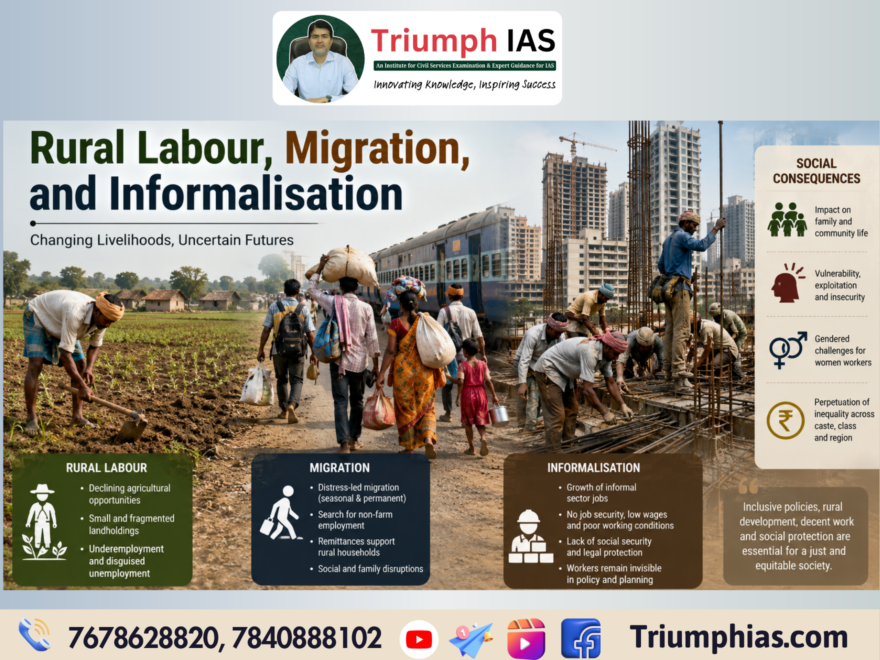
Rural Labour, Migration, and Informalisation in India | Sociology Optional UPSC

Rural Labour, Migration, and Informalisation

Relevant for Sociology Optional Paper 1, Paper 2, and GS Paper I (Indian Society)

Introduction

India’s rural society has undergone profound transformation in recent decades due to economic liberalisation, urbanisation, technological change, and agrarian distress. Among the most significant sociological developments are the increasing migration of rural labour and the growing informalisation of work. These processes have altered traditional social structures, livelihood patterns, and class relations in rural India.

Traditionally, rural labour in India was closely linked to agriculture. Landless labourers, marginal farmers, and artisan communities depended heavily on seasonal agricultural employment. However, declining profitability in agriculture, fragmentation of landholdings, mechanisation, and climate-related uncertainties have weakened the absorptive capacity of the rural economy. As a result, millions of rural workers migrate to urban centres in search of livelihood opportunities.

Migration in India is both seasonal and permanent. Seasonal migration is particularly common among workers from states such as Bihar, Uttar Pradesh, Jharkhand, Odisha, and Rajasthan. Labourers often move temporarily to cities for construction work, factory labour, domestic work, transport services, and informal sector employment. Sociologists describe this as “distress migration” because it is driven less by opportunity and more by economic compulsion.

Migration has multiple social consequences. On one hand, remittances sent by migrant workers improve household incomes, support education, healthcare, and consumption in villages. Migration can also weaken rigid caste hierarchies by exposing individuals to urban environments and diverse social interactions. On the other hand, migration disrupts family structures, creates emotional insecurities, and often leads to exploitation due to poor working conditions and absence of legal protection.

The phenomenon of informalisation is closely connected with migration. Informalisation refers to the expansion of employment without job security, fixed wages, social security benefits, or legal safeguards. Even within the organised sector, contractual and temporary employment has increased significantly. Migrant workers are disproportionately concentrated in the informal economy where labour laws are weakly enforced.

From a sociological perspective, informalisation reflects the unequal nature of capitalist development in India. Scholars such as Jan Breman have highlighted how migrant labourers remain trapped in cycles of poverty and vulnerability despite participating in economic growth. Informal workers often lack identity documents, union representation, healthcare access, and housing security. Women migrant workers face additional challenges of gender discrimination, wage inequality, and unsafe working conditions.

The COVID-19 pandemic exposed the precarious condition of migrant labour in India. During the nationwide lockdown, millions of migrant workers were forced to return to villages due to sudden unemployment and lack of social protection. This humanitarian crisis demonstrated the structural invisibility of informal labour in policymaking and governance.

Government initiatives such as MGNREGA, rural skill development programmes, and labour code reforms attempt to address some of these challenges. MGNREGA, in particular, has provided rural employment opportunities and reduced distress migration to some extent. However, implementation gaps, delayed payments, and inadequate wages continue to limit its effectiveness.

Sociologically, the issues of rural labour, migration, and informalisation reveal the intersection of class, caste, gender, and regional inequalities. Dalits, Adivasis, and backward caste communities are disproportionately represented among migrant labourers and informal workers. Therefore, these processes cannot be understood merely as economic phenomena; they are deeply embedded in India’s social structure.

Conclusion

In conclusion, rural labour migration and informalisation represent major transformations in contemporary Indian society. While migration creates opportunities for survival and social mobility, informalisation perpetuates insecurity and inequality. A balanced policy approach focusing on rural development, labour rights, social security, and inclusive growth is essential for ensuring dignity and justice for India’s working population.

UPSC Civil Services (Mains) Question

Q. “Discuss the relationship between rural migration and informalisation of labour in contemporary India. Analyse its social consequences.” (250 Words)

To Read more topicsvisit: www.triumphias.com/blogs

Read more Blogs:

Changing Modes of Agricultural Production

Wisdom finds truth – Triumph IAS & Vikash Ranjan Sir


🔥 YOUR FINAL UPSC RANK CAN BE DECIDED BY JUST TWO PAPERS — ESSAY & OPTIONAL!

Most aspirants study hard.
But very few know how to convert knowledge into MARKS.

That’s where **Triumph IAS** creates the difference. 🚀

✍️ EMTS – Essay Mentorship & Test Series (CSE Mains 2026–27)

Under the mentorship of **Vikash Ranjan Sir**, master the art of writing structured, philosophical, multidimensional, and topper-level essays.

Scientific Essay Writing Approach
Knowledge Matrix Framework
5 Exclusive Essay Approach Classes
2 Thematic Tests + 4 UPSC Mock Tests
Detailed Model Essay Hints
Flexible Writing & Discussion Sessions
Personal 1-to-1 Mentorship

🏆 Trusted by UPSC Essay Toppers
━━━━━━━━━━━━━━━━━━

📚 SMTS – Sociology Mentorship & Test Series + Quick Revision Session (QRS)

🎯 SCORE 300+ MARKS IN SOCIOLOGY OPTIONAL

A structured, analytical, and result-oriented mentorship program designed to maximize your Sociology score under the guidance of **Vikash Ranjan Sir**.

Program Highlights:

26 Full-Length Tests with Detailed Evaluation
PYQ–NYQ Trend Analysis
Quick Revision Sessions on Unconventional Questions
Brainstorming & Concept Enrichment Sessions
1-to-1 Personal Mentorship Discussions
Topic-wise Answer Writing Practice
Current Social Issues Compilation
Home-based Practice Tests with Model Hints
Thinkers Integration & Value Addition Notes
Essay & GS Enrichment through Sociology

  • 🏆 Legacy of High Scores Continues:
  • 🌟 G.R. Raghavendra, IPS – 318
  • 🌟 Medha Anand, IAS – 310
  • 🌟 Sandesh Jain, IPS – 309
  • 🌟 Gauravjeet Singh, IPS – 309
  • 🌟 Deepanshu Khurana, IFS – 303
  • 🌟 Pradeep Singh, IAS – 302
  • 🌟 Swati Sharma, IAS – 296
  • 🌟 Gunjita Agarwal, IAS – 295

…and many more successful aspirants.

━━━━━━━━━━━━━━━━━

  • *Batch Starts: 01 June*
  • 📍 Available in OFFLINE & ONLINE Mode
  • 📞 Call/WhatsApp: 7678628820 | 7840888102
  • 🌐 triumphias.com
  • 📍 Triumph IAS
  • 23-B, 3rd Floor, Pusa Road
  • Near Karol Bagh Metro Pillar No. 114, New Delhi

Leave a Reply

Your email address will not be published. Required fields are marked *