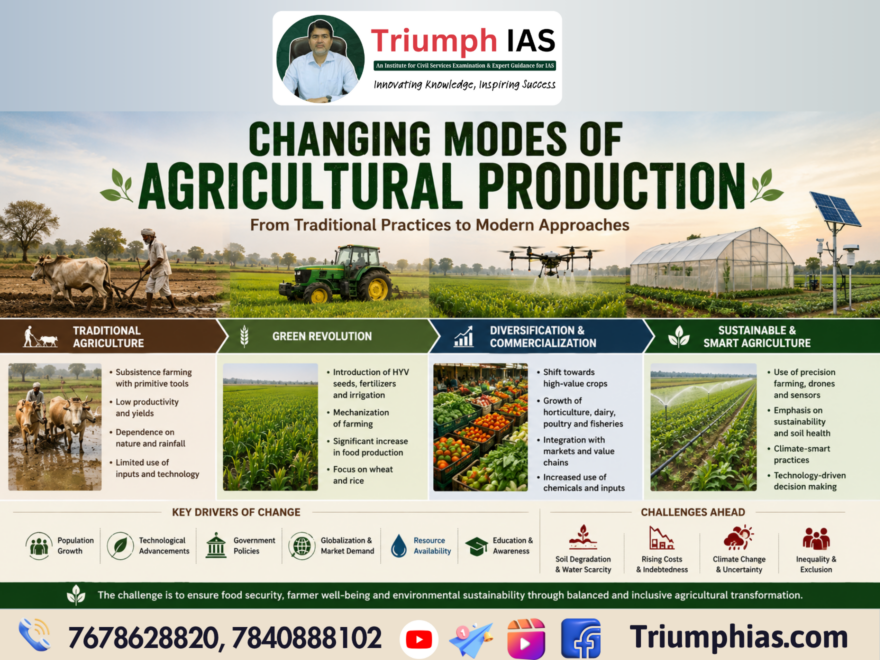
Changing Modes of Agricultural Production

Changing Modes of Agricultural Production

Relevant for Sociology Optional Paper 1, Paper 2, and GS Paper I (Indian Society)

Introduction

Agriculture has historically been the backbone of Indian society, shaping social relations, economic structures, and cultural practices. However, the modes of agricultural production have undergone significant transformation due to technological advancement, market expansion, state intervention, and globalization. Sociology examines these changes not merely as economic shifts but as processes that alter class relations, caste dynamics, labour structures, and rural life.

Karl Marx viewed the mode of production as the combination of productive forces and relations of production. In agriculture, this includes land ownership, labour organization, technology, and patterns of surplus extraction. In India, agricultural production has evolved from subsistence farming to commercial and capitalist agriculture, leading to profound social consequences.

Traditionally, Indian agriculture was characterized by feudal and semi-feudal relations. Landlords controlled land while peasants and agricultural labourers depended on them for livelihood. Caste hierarchy reinforced these economic inequalities. Upper castes generally owned land, whereas lower castes worked as tenants or labourers. Production was largely subsistence-oriented, with limited market integration.

The Green Revolution in the 1960s marked a major transformation in agricultural production. The introduction of high-yielding variety seeds, irrigation facilities, chemical fertilizers, and mechanization increased productivity significantly. States like Punjab, Haryana, and Western Uttar Pradesh became centres of intensive agriculture. Sociologists such as A.R. Desai and Daniel Thorner observed that these technological changes also strengthened capitalist tendencies in agriculture.

The changing mode of production led to differentiation within the peasantry. Rich farmers with access to capital and irrigation benefited disproportionately, while small and marginal farmers often became indebted. This created new agrarian classes such as capitalist farmers, rural bourgeoisie, and wage labourers. The commercialization of agriculture increased dependence on markets, credit institutions, and agribusiness corporations.

Mechanization has also altered labour relations in rural India. Tractors, harvesters, and modern equipment reduced the demand for manual labour, particularly affecting landless labourers. Seasonal migration from villages to urban centres increased as rural employment opportunities declined. Women agricultural labourers were often the worst affected due to gender discrimination in wages and employment.

Globalization further transformed agriculture by linking farmers to global markets. Contract farming, export-oriented cultivation, and corporate entry into agriculture changed traditional cropping patterns. Farmers increasingly shifted towards cash crops such as cotton, sugarcane, and horticulture products. While globalization created opportunities for some farmers, it also exposed them to price fluctuations, market uncertainties, and indebtedness.

Environmental concerns have emerged as another sociological issue associated with changing agricultural production. Excessive use of chemical fertilizers and groundwater exploitation has led to ecological degradation. Sociologists highlight how environmental crises disproportionately affect vulnerable rural communities. Sustainable agriculture and organic farming are now being promoted as alternatives to intensive capitalist agriculture.

The agrarian crisis in contemporary India reflects contradictions within changing production systems. Farmer suicides, rural indebtedness, land fragmentation, and unemployment indicate that agricultural transformation has not benefited all sections equally. Social movements led by farmers have emerged demanding better prices, loan waivers, and protection from corporate exploitation.

From a sociological perspective, changing modes of agricultural production demonstrate the interaction between economy, technology, power, and social inequality. Agriculture is not merely a sector of economic activity; it is deeply connected with caste, class, gender, and state policies. Understanding these transformations is essential for addressing rural distress and ensuring inclusive development.

Conclusion:

In conclusion, the transition from traditional to capitalist and globalized agriculture has reshaped Indian rural society. While technological advancement increased productivity, it also widened inequalities and created new social challenges. Sociology helps in understanding these structural changes and their impact on rural communities, making it an important area of study for civil services aspirants and scholars alike.

UPSC Civil Services (Mains) Question

Q. “Changing modes of agricultural production have transformed rural class relations and intensified social inequalities in India.” Discuss sociologically.

To Read more topicsvisit: www.triumphias.com/blogs

Read more Blogs:

Green Revolution: Growth with Inequality

Biased media is a real threat to Indian Democracy – Triumph IAS & Vikash Ranjan Sir


🔥 YOUR FINAL UPSC RANK CAN BE DECIDED BY JUST TWO PAPERS — ESSAY & OPTIONAL!

Most aspirants study hard.
But very few know how to convert knowledge into MARKS.

That’s where **Triumph IAS** creates the difference. 🚀

✍️ EMTS – Essay Mentorship & Test Series (CSE Mains 2026–27)

Under the mentorship of **Vikash Ranjan Sir**, master the art of writing structured, philosophical, multidimensional, and topper-level essays.

Scientific Essay Writing Approach
Knowledge Matrix Framework
5 Exclusive Essay Approach Classes
2 Thematic Tests + 4 UPSC Mock Tests
Detailed Model Essay Hints
Flexible Writing & Discussion Sessions
Personal 1-to-1 Mentorship

🏆 Trusted by UPSC Essay Toppers
━━━━━━━━━━━━━━━━━━

📚 SMTS – Sociology Mentorship & Test Series + Quick Revision Session (QRS)

🎯 SCORE 300+ MARKS IN SOCIOLOGY OPTIONAL

A structured, analytical, and result-oriented mentorship program designed to maximize your Sociology score under the guidance of **Vikash Ranjan Sir**.

Program Highlights:

26 Full-Length Tests with Detailed Evaluation
PYQ–NYQ Trend Analysis
Quick Revision Sessions on Unconventional Questions
Brainstorming & Concept Enrichment Sessions
1-to-1 Personal Mentorship Discussions
Topic-wise Answer Writing Practice
Current Social Issues Compilation
Home-based Practice Tests with Model Hints
Thinkers Integration & Value Addition Notes
Essay & GS Enrichment through Sociology

  • 🏆 Legacy of High Scores Continues:
  • 🌟 G.R. Raghavendra, IPS – 318
  • 🌟 Medha Anand, IAS – 310
  • 🌟 Sandesh Jain, IPS – 309
  • 🌟 Gauravjeet Singh, IPS – 309
  • 🌟 Deepanshu Khurana, IFS – 303
  • 🌟 Pradeep Singh, IAS – 302
  • 🌟 Swati Sharma, IAS – 296
  • 🌟 Gunjita Agarwal, IAS – 295

…and many more successful aspirants.

━━━━━━━━━━━━━━━━━

  • *Batch Starts: 01 June*
  • 📍 Available in OFFLINE & ONLINE Mode
  • 📞 Call/WhatsApp: 7678628820 | 7840888102
  • 🌐 triumphias.com
  • 📍 Triumph IAS
  • 23-B, 3rd Floor, Pusa Road
  • Near Karol Bagh Metro Pillar No. 114, New Delhi

One comment

Leave a Reply

Your email address will not be published. Required fields are marked *