Education has always been a key driver of social change in India. From Macaulay’s colonial education policy to the Kothari Commission’s recommendations, every shift in education has shaped the way Indian society functions. In 2020, the Government of India approved the New Education Policy (NEP 2020), replacing the 34-year-old National Policy on Education (1986). It promises to transform learning by focusing on holistic, flexible, and multidisciplinary approaches aligned with the needs of the 21st century.
NEP 2020 is not just a policy but a window into how education interacts with social structure, culture, economy, and state policy.
Key Salient Features of NEP 2020
School Education Reform
5+3+3+4 Structure: Replacing the old 10+2 system, NEP introduces a new curricular structure corresponding to ages 3–18 (Foundational, Preparatory, Middle, Secondary).
Early Childhood Care and Education (ECCE): Integration of Anganwadi and pre-school learning into mainstream schooling.
Holistic and Experiential Learning: Emphasis on critical thinking, creativity, and reducing rote memorization.
Mother Tongue as Medium of Instruction: Until at least Grade 5, preferably Grade 8, to promote cognitive development.
Higher Education Transformation
Multidisciplinary Education: Flexible curricula, multiple entry-exit points, and an Academic Bank of Credit.
Gross Enrollment Ratio (GER) Target: Increase GER to 50% by 2035.
National Research Foundation (NRF): Boosting research culture.
Phasing Out Affiliated Colleges: Granting autonomy to higher institutions.
Vocational Education and Skills
Skill development will start from school level, integrating coding, internships, and vocational exposure by Grade 6.
Teacher Development
Four-year integrated B.Ed. degree: As a minimum qualification for teachers by 2030.
Continuous Professional Development (CPD): Annual training to improve teaching quality.
Technology in Education
Focus on Digital Learning, E-content, and Online Platforms like SWAYAM, DIKSHA, and use of AI.
Emphasis on bridging the Digital Divide to ensure equitable access.
Equity and Inclusion
Special attention to Socially and Economically Disadvantaged Groups (SEDGs) including SCs, STs, OBCs, minorities, and girls.
Gender Inclusion Fund and Special Education Zones for aspirational districts.
Sociological Analysis
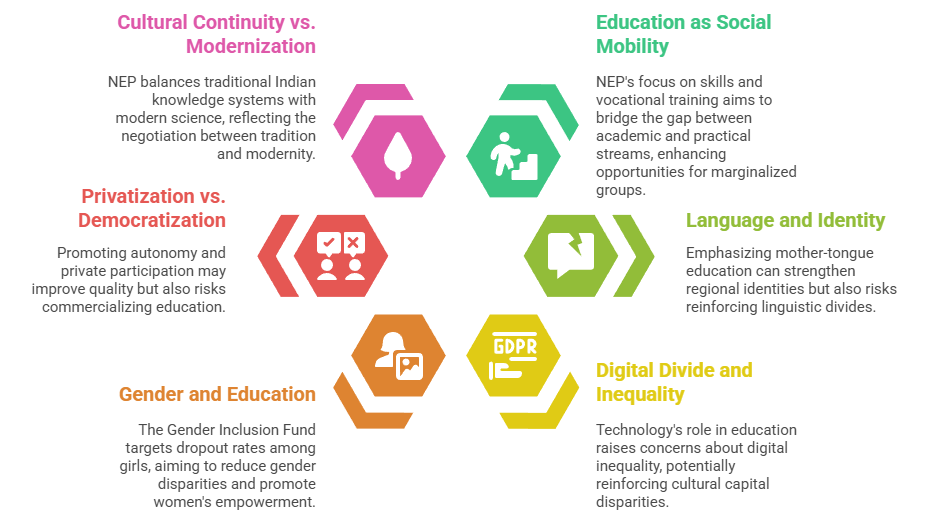
Education as Social Mobility: Education is an agency of social mobility (Parsons). NEP’s emphasis on skills, vocational training, and multidisciplinary courses can weaken the traditional divide between “academic” and “practical” streams, offering students from marginalized groups more opportunities for upward mobility.
Language and Identity: The stress on mother-tongue education revives debates on language and cultural identity. Sociologists like Anderson argue that language builds “imagined communities.” Teaching in local languages can strengthen regional identities but also risks reinforcing linguistic divides.
Digital Divide and Inequality: While technology enables access, it also raises concerns about digital inequality. According to recent surveys, rural areas face limited internet penetration. If not addressed, NEP’s tech-based approach may reinforce Bourdieu’s idea of cultural capital, where privileged groups gain disproportionate advantage.
Gender and Education: The Gender Inclusion Fund is significant. Feminist sociologists argue that education is central to dismantling patriarchy. By targeting dropout rates among girls, especially in rural areas, NEP can reduce gender disparities and promote women’s empowerment.
Privatization vs. Democratization: NEP promotes autonomy of institutions and private participation, which may improve quality but also risk commercialization of education. Marxist perspectives see this as aligning education with capitalist interests, where education becomes a commodity rather than a public good.
Cultural Continuity vs. Modernization: NEP balances Indian knowledge systems (like Ayurveda, classical arts) with modern science. This duality reflects M.N. Srinivas’s concept of Sanskritization and Westernization, showing how Indian society negotiates tradition and modernity.
Implications of NEP 2020
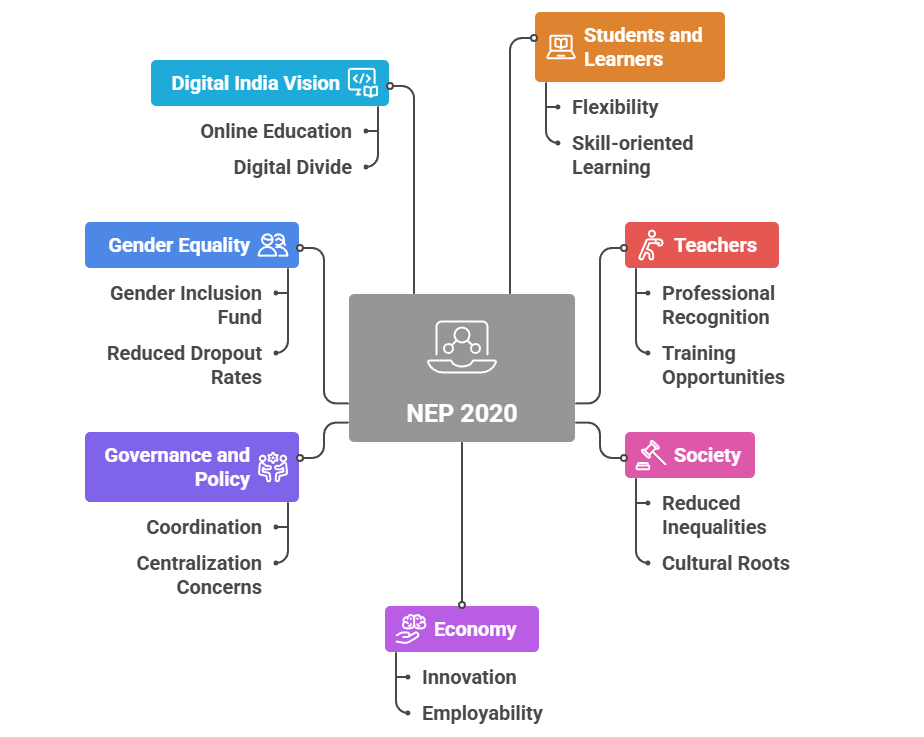
For Students and Learners: NEP provides flexibility, skill-oriented learning, and reduced exam pressure. It makes education more student-centric and prepares learners for future job markets.
For Teachers: Teachers will gain professional recognition and better training opportunities. However, the challenge lies in implementing continuous professional development across rural and urban areas.
For Society: By focusing on equity and inclusion, NEP can reduce inequalities in education. Mother tongue instruction may strengthen cultural roots but could also pose challenges in national-level mobility.
For Economy: Skill development, vocational training, and research promotion can boost innovation, productivity, and employability. It aligns education with India’s demographic dividend.
For Governance and Policy: The policy emphasizes cooperative federalism in education but also raises concerns about centralization. Its implementation requires strong coordination between centre and states.
For Gender Equality: The Gender Inclusion Fund and focus on reducing dropout rates among girls can empower women and narrow the gender gap in education.
For Digital India Vision: NEP’s emphasis on online education complements Digital India. However, unequal access to devices and internet connectivity risks widening the digital divide.
Challenges Ahead
Implementation Gap: India has a history of ambitious policies falling short in execution.
Funding: NEP recommends spending 6% of GDP on education, but actual expenditure hovers around 3%.
Teacher Quality: Ensuring trained teachers in remote areas is difficult.
Balancing Equity and Autonomy: Striking a balance between inclusive access and global-level competition will be tricky.
Conclusion
The New Education Policy 2020 is a landmark reform with the potential to reshape India’s knowledge society. It emphasizes holistic, inclusive, and skill-based learning, while keeping Indian values at the core. Yet, its success will depend on how well India bridges gaps of inequality, digital access, and funding.
NEP is more than an education policy—it is a mirror reflecting India’s aspirations of becoming a knowledge economy, while grappling with its realities of social diversity, inequality, and cultural plurality. It offers a goldmine of examples to connect theory with current affairs.
PYQs
Paper I
Explain the sociological significance of the New Education Policy and its thrust on vocationalization and skill development. (2021)
To what extent can education and skill development be an agent of social change? Critically analyze. (2025)
Paper II
“Education is often viewed as an agency of social change. However in reality, it could also reinforce inequalities and conservatism.” Discuss. (2014)
“Education helps in perpetuating social and economic inequalities.” Critically examine. (2015)
“Education is a major source of social mobility in contemporary society.” Explain. (2016)
Discuss the issues of access and exclusion in higher education in India. (2019)
“Technology has accelerated the process of development and dependency.” Discuss. (2020)
How does the New Education Policy, 2020 aim to eradicate disparities in the system of education in India? (2020)
“According to Durkheim, ‘the major function of education is the transmission of society’s norms and values.’” Discuss. (2020)
Are traditional social institutions getting weakened as agents of social change in contemporary society? Substantiate. (2022)
“Instead of promoting equality in society, the present system of education itself has contributed to increased socio-economic disparities.” Critically comment. (2022)
“Educational development is the only Panacea for country’s all ills and evils.” Critically examine the above statement with reference to NEP-2020. (2025)






3 comments