Introduction: Harmonising Development and Conservation in Andaman and Nicobar
The Andaman and Nicobar Islands (ANI), a union territory of India, are strategically located in the Bay of Bengal and play a crucial role in India’s maritime security, ecology, and regional geopolitics. With a population of around 4 lakh (Census 2011), the islands are home to diverse indigenous communities, rich biodiversity, and significant ecological heritage. In recent years, development initiatives in ANI have gained momentum, especially under India’s Act East Policy and strategic focus on the Indo-Pacific region. However, the need to balance development with ecological preservation and tribal rights is more critical than ever.
Geographical and Strategic Importance
Location: ANI comprises 572 islands, of which around 37 are inhabited, lying approximately 1,200 km from mainland India.
Geopolitical Value: ANI is close to the Malacca Strait, one of the world’s busiest shipping lanes, giving India a strategic maritime advantage.
Security Perspective: The islands host key military installations such as INS Baaz and INS Kohassa, contributing to India’s maritime surveillance in the Eastern Indian Ocean.
Current Development Initiatives
Great Nicobar Island Mega Project
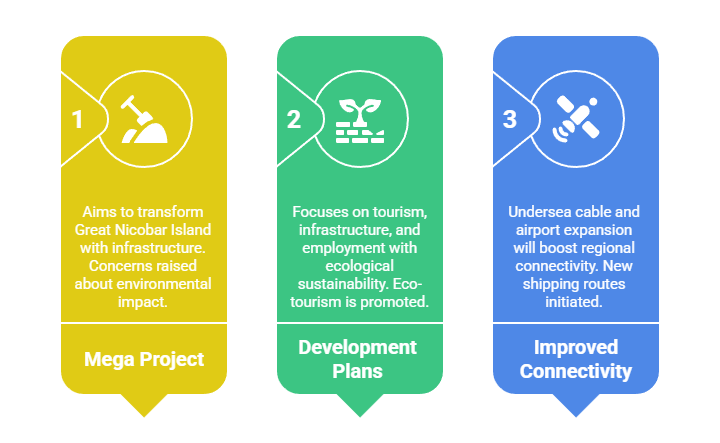
Objective: A ₹72,000 crore project is underway to transform Great Nicobar Island with an international transhipment port, a Greenfield airport, township, and power plants.
Capacity: The port is expected to handle 16 million TEUs by 2050, rivalling ports in Singapore and Colombo.
Controversy: Environmentalists have raised concerns over deforestation, impact on wildlife like leatherback turtles, and displacement of the Shompen tribe.
Holistic Development Plans
NITI Aayog’s Vision: The government has proposed a ‘Holistic Development Plan’ focusing on tourism, infrastructure, and employment while ensuring ecological sustainability.
Eco-tourism Initiatives: Sustainable tourism is being promoted in destinations like Havelock, Neil, and Long Island, with efforts to cap tourist inflow to protect fragile ecosystems.
Improved Connectivity
Undersea Cable: The inauguration of the Chennai-Port Blair undersea optical fibre cable (2020) improved internet connectivity.
Air Connectivity: Expansion of the Veer Savarkar International Airport in Port Blair and upcoming airports on other islands will boost regional connectivity.
Shipping: New shipping routes between the islands and the mainland have been initiated to ease transportation of goods and passengers.
Environmental Concerns
Biodiversity Hotspot
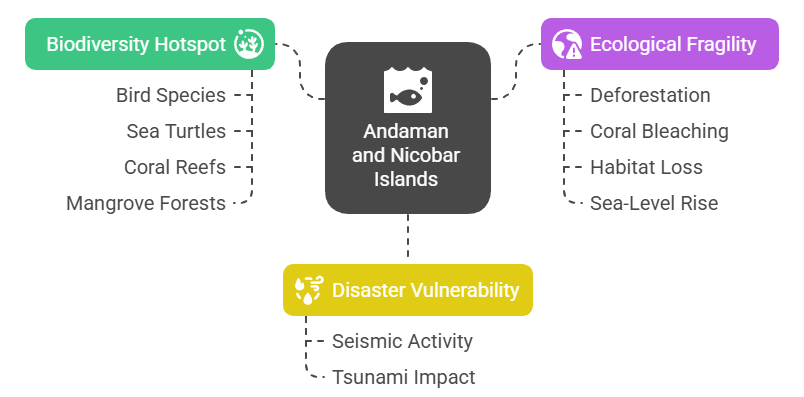
ANI forms part of the Indo-Burma biodiversity hotspot with high endemism. The islands are home to:
270 bird species (including Narcondam hornbill).
4 species of sea turtles, including the critically endangered Leatherback turtle.
Rich coral reefs and mangrove forests.
Ecological Fragility
Unregulated development leads to deforestation, coral bleaching, and habitat loss.
Climate change-induced sea-level rise poses a long-term threat to low-lying islands.
Disaster Vulnerability
ANI is located in a seismically active zone. The 2004 tsunami caused massive devastation, highlighting the vulnerability of the islands.
Tribal Rights and Cultural Sensitivity
Tribal Population: ANI is home to six major tribes—Great Andamanese, Onge, Jarawa, Sentinelese, Shompen, and Nicobarese.
PVTGs: Except for Nicobarese, the rest are classified as Particularly Vulnerable Tribal Groups (PVTGs), whose lifestyle depends on isolation and traditional subsistence methods.
Legal Protections:
The Andaman and Nicobar Islands (Protection of Aboriginal Tribes) Regulation, 1956 protects tribal habitats.
Recent development projects have attracted criticism for potentially infringing on tribal territories.
Sentinelese Protection: The government maintains a ‘hands-off’ policy towards the Sentinelese, prohibiting any contact.
Government Balancing Acts
Environmental Safeguards: The Environment Ministry mandates strict Environmental Impact Assessments (EIA) for development projects.
Tribal Safeguards: Tribal reserves remain protected by law, and most development is planned outside these areas.
Sustainable Development Goals (SDGs): Projects are being aligned with India’s SDG commitments, especially on climate action (SDG 13) and life below water (SDG 14).
Recent Data and Reports
State of Forest Report 2021: ANI recorded a slight decline in forest cover, mainly due to natural disasters and developmental pressures.
Global Coral Reef Monitoring Network Report 2022: Noted coral bleaching incidents in ANI due to rising sea temperatures.
National Census Update: The upcoming 2026–27 Census will undertake a special enumeration of tribal groups to better inform policy decisions.
Way Forward: Sustainable Pathways
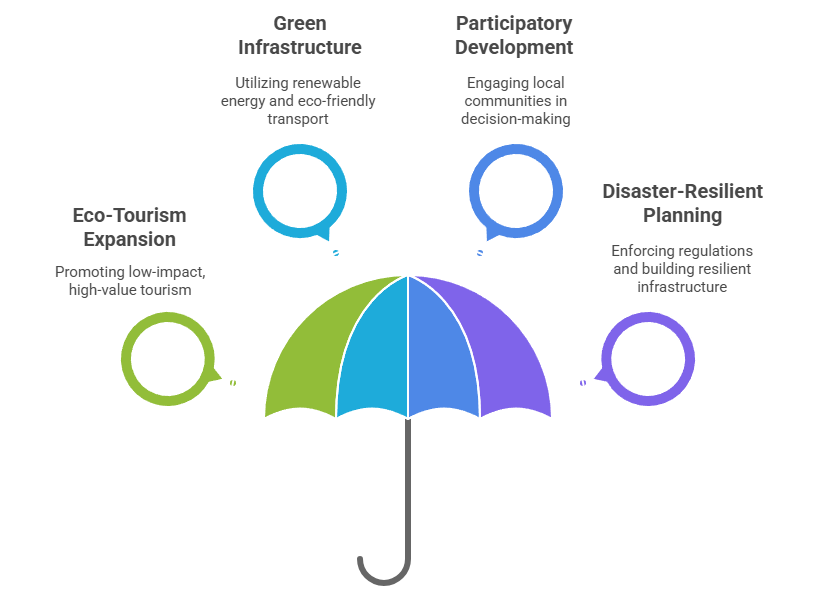
Eco-Tourism Expansion
Promote low-footprint, high-value tourism.
Limit tourist numbers on ecologically sensitive islands like Jolly Buoy and Red Skin.
Green Infrastructure
Use renewable energy (solar and wind) to reduce diesel dependence.
Develop green ports and eco-friendly transport solutions.
Participatory Development
Engage local communities, especially Nicobarese and settlers, in decision-making.
Respect tribal autonomy while offering voluntary welfare interventions.
Disaster-Resilient Planning
Strict enforcement of Coastal Regulation Zones (CRZ) norms.
Build disaster-resilient housing and infrastructure, especially in tsunami-prone zones.
Conclusion
The Andaman and Nicobar Islands are a microcosm of India’s larger developmental challenges—balancing progress with sustainability. While India’s strategic interests and connectivity needs are valid, the preservation of the islands’ unique ecology and indigenous cultures must be paramount. Responsible development, rooted in environmental prudence and social inclusivity, holds the key to truly sustainable progress in this invaluable part of India.









2 comments