(Relevant for Sociology Paper I: Sociological Thinkers- Emile Durkheim Stratification and Mobility; Works and Economic Life and sociology Paper II: Social Classes in India; Challenges of Social Transformation)
Agriculture distress and farmer suicides remain a critical social issue in India, with far-reaching implications across the domains of rural sociology, poverty, social inequality, structural violence, and policy failure. For UPSC Sociology aspirants, this topic intersects core themes like nature of society, social change, structural-functionalism, and social exclusion.
Recent Data & Incidents
According to NCRB data,11,290 persons involved in farming (5,207 farmers + 6,083 agricultural labourers) died by suicide in 2022—about 6 % of all suicides in India.
From 2014–2022, 100,474 farmers and agricultural labourers committed suicide.
In early 2025, Maharashtra recorded 767farmer suicides from Jan–Mar—an average of one suicide every three hours.
Marathwada saw 269farmer suicides (Jan–Mar 2025), a 32% increase over 204 in the same period in 2024. Up to June 26, 2025, Marathwada recorded520 suicides, up 20% from 430 cases in Jan–Jun 2024.
Nationwide, State reports show 2,635 suicides in 2024 and 2,851 in 2023.
These figures highlight a worsening agrarian crisis fueled by debt, crop failure, price volatility, climate change, and policy gaps.
Root Causes:
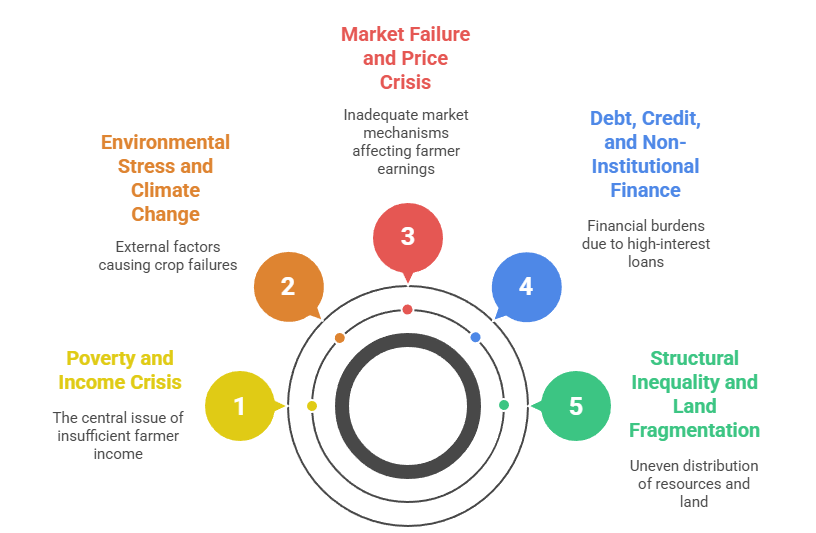
Structural Inequality and Land Fragmentation: India’s agrarian sector is marred by land fragmentation, with average holdings shrinking below 1.08 hectares. This results in uneconomic farming, especially for marginalized communities like Scheduled Castes and Tribes, limiting access to institutional credit and modern technology. This structural inequality perpetuates rural poverty and exclusion.
Debt, Credit, and Non-Institutional Finance: Due to weak institutional lending, many farmers depend on moneylenders and NBFCs, often at exorbitant interest rates. With low yields and mounting costs, loan repayment becomes difficult, creating a cycle of indebtedness. The absence of a comprehensive loan waiver policy adds to psychological stress and desperation.
Market Failure and Price Crisis: Market fluctuations, inadequate procurement mechanisms, and the absence of a legal guarantee for Minimum Support Price (MSP) leave farmers vulnerable. Although the government declares MSP, many crops are sold below it due to lack of procurement infrastructure, further eroding farmer incomes.
Environmental Stress and Climate Change: Unpredictable weather patterns, droughts, and unseasonal rains—particularly in drought-prone regions like Marathwada and Vidarbha—have intensified agrarian distress. These environmental changes combined with poor irrigation and outdated cropping practices, lead to frequent crop failures.
Poverty and Income Crisis: According to recent estimates, the average monthly income of a farm household is ₹10,218—barely sufficient for subsistence. Agriculture alone is no longer a viable livelihood, leading to intergenerational poverty and pushing many farmers into informal labor or distress migration to urban areas.
Sociological Analysis
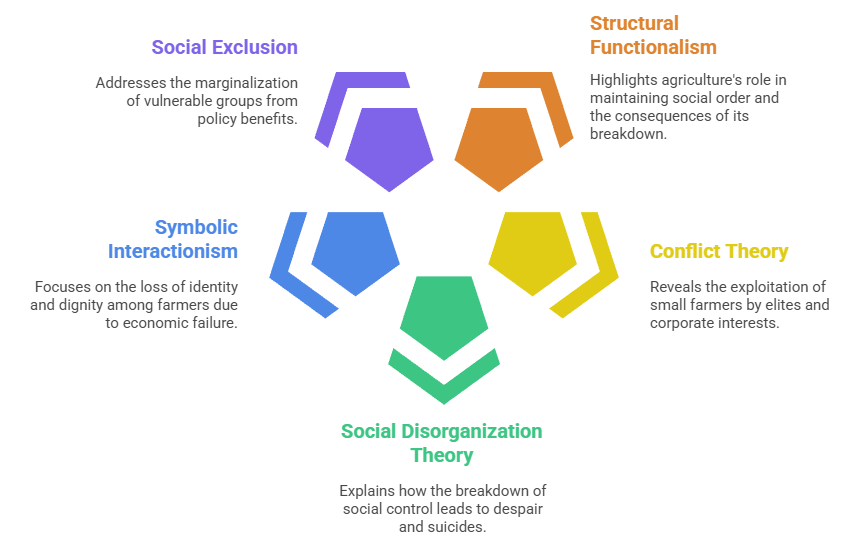
Structural Functionalism:: This perspective highlights agriculture as a key institution holding rural society together. Its breakdown due to policy neglect and environmental degradation disrupts social order, resulting in dysfunctions such as suicides, mental health crises, and community breakdown.
Conflict Theory: Class-based analysis reveals that land-owning elites and corporate interests benefit disproportionately from agricultural reforms, while small and marginal farmers bear the brunt of market volatility, debt, and policy apathy. This illustrates systemic exploitation within agrarian capitalism.
Social Disorganization Theory: Suicides can be interpreted as a breakdown of rural social control and cohesion. The weakening of panchayats, kinship ties, and community support systems amid agrarian stress contributes to alienation, despair, and increasing suicide rates.
Symbolic Interactionism: Farming is more than an occupation—it is an identity. Repeated failure and mounting debt impact self-worth. Farmers see suicide not just as an economic failure but as a response to the loss of dignity, honor, and societal respect.
Social Exclusion & Marginalization: Marginalized groups like tenant farmers, women, and SC/ST cultivators are often excluded from policy benefits like insurance, subsidies, or compensation schemes. Their invisibility in databases and lack of land titles worsen their vulnerability in the face of agrarian collapse.
Recent Incidents & Social Responses
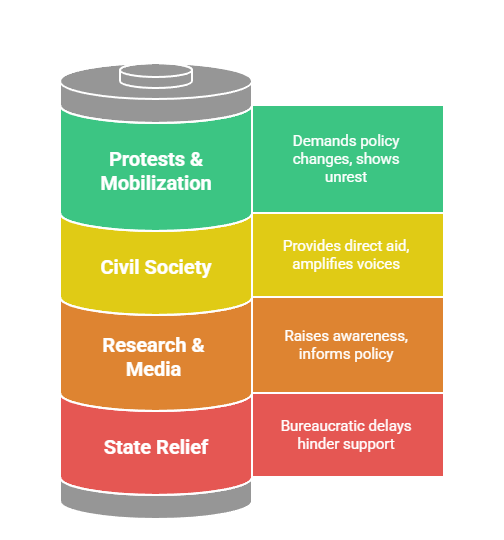
Protests and Mobilization: The 2024–25 farmers’ protests reignited demands for a legal MSP, implementation of the Swaminathan Committee’s recommendations, and loan waivers. Movements in Punjab, Haryana, and Maharashtra demonstrated collective rural unrest against perceived policy neglect.
State Relief Measures: The Maharashtra government allocated ₹20 crore to compensate families of farmers who died by suicide. However, activists claim many families are declared ineligible due to stringent norms, highlighting bureaucratic apathy and delays in disbursal.
Civil Society Interventions: Activists like Raju Shetti and Bacchu Kadu undertook hunger strikes and protest marches, amplifying voices of distressed farmers. Civil society organizations also started helplines, distributed pesticide-free kits, and organized awareness drives to prevent suicides.
Research and Media Reports: Studies have shown rising suicides among cotton growers and in drought-hit regions. Reports from Marathwada indicate a 32% rise in suicides in Q1 of 2025. The media and parliamentary debates have placed these issues in the public and political spotlight.
Policy Gaps & Recommendations
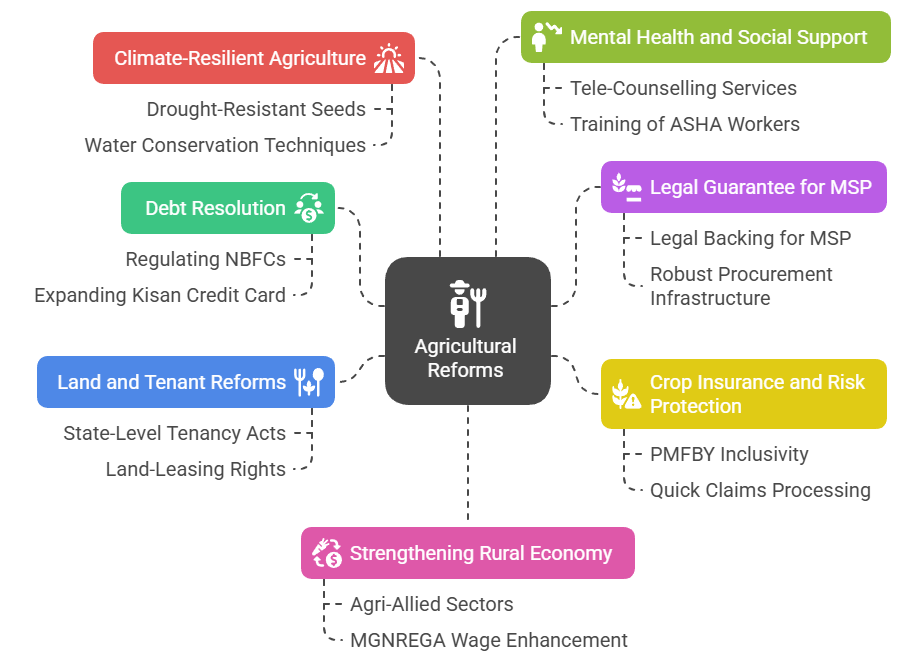
Debt Resolution: Strengthen institutional credit by regulating NBFCs, expanding Kisan Credit Card coverage, and simplifying crop loan procedures. Implementing interest-free loans and targeted waivers for distressed farmers is crucial.
Legal Guarantee for MSP: A legal backing for MSP across all crops, as demanded in farmer protests, can ensure fair pricing. This must be supported with robust procurement infrastructure at local levels to prevent exploitation by middlemen.
Crop Insurance and Risk Protection: Schemes like PMFBY must be made more inclusive and accessible. Claims should be processed quickly, with transparency in data collection and compensation, especially in climate-affected zones.
Land and Tenant Reforms: Revive and implement state-level tenancy acts that legally recognize tenant farmers. Provide land-leasing rights and identification to ensure they can access subsidies, insurance, and compensation.
Climate-Resilient Agriculture: Encourage drought-resistant seeds, water conservation techniques, and solar-powered irrigation. Promote agroforestry and district-wise adaptation plans to build resilience in vulnerable regions like Vidarbha and Marathwada.
Mental Health and Social Support: Launch targeted suicide-prevention programs in rural areas. Scale up tele-counselling services like KIRAN and integrate them into block-level health missions, along with training of ASHA and social workers.
Strengthening Rural Economy: Diversify the rural economy by investing in agri-allied sectors like dairy, poultry, and MSMEs. Enhance MGNREGA wages and link employment schemes to agriculture-related work during off-seasons.
Conclusion
Farmer suicides and agricultural distress signify deeper structural defects in our rural society. Through sociological analysis—drawing on inequality, structural violence, environmental change, and policy failure—we understand the systemic nature of this crisis. SOS is needed: from legal MSPs and debt resolution to mental-health support, climate adaptation, and empowering agricultural communities.
Previous Year Questions
Paper I:
How do structural inequalities lead to social problems in rural India? Illustrate with examples. (2020)
Discuss Emile Durkheim’s theory of suicide with reference to agrarian suicides in India. (2018)
Paper II:
Examine the agrarian distress in India with a sociological lens. (2022)
Write a note on indebtedness and farmers’ suicides. (2016)










One comment