Fundamentalism refers to a rigid adherence to basic religious or ideological principles, often in opposition to modern, secular, or liberal worldviews. While commonly associated with religious extremism, fundamentalism can manifest in politics, nationalism, and even secular ideologies.
In recent decades, it has emerged as a global socio-political phenomenon—impacting democratic values, human rights, gender equality, and intergroup harmony. In India, the rise of religious, linguistic, and ethnic fundamentalism poses serious challenges to pluralism and social cohesion.
Fundamentalism vs. Communalism
Fundamentalism and communalism, while often intertwined, differ in their core nature and objectives. Fundamentalism is primarily ideological, rooted in rigid adherence to religious or doctrinal principles, often rejecting modernity and pluralism. It seeks to impose a singular moral or religious worldview. In contrast, communalism is political and identity-based, where religion or ethnicity is used as a tool to mobilize communities for political gain, often resulting in intergroup hostility. While fundamentalism fuels the belief system, communalism exploits it for electoral or territorial power, making it a more strategic and conflict-prone phenomenon in plural societies like India.
Core Features of Fundamentalism
Literal interpretation of texts (religious or ideological)
Rejection of modernity, pluralism, and secularism
Gender regressive beliefs
Often anti-intellectual and anti-science
Seeks moral uniformity through coercion or law
Uses violence or threats to enforce beliefs
Examples of Fundamentalism in India
Religious: Hindutva mobilization, Islamic fundamentalist groups
Ethnic: ULFA in Assam, Khalistani revivalism
Linguistic: Anti-Hindi agitations, linguistic pride movements
Cultural: Moral policing by vigilante groups, bans on art or literature
Causes of Rise in Fundamentalism
Crisis of modernity and alienation
Globalization and cultural invasion anxieties
Identity politics in multi-ethnic societies
Perceived threat to tradition or religion
Political patronage and vote-bank politics
Educational gaps and lack of critical thinking
Media polarization and misinformation
Sociological Analysis
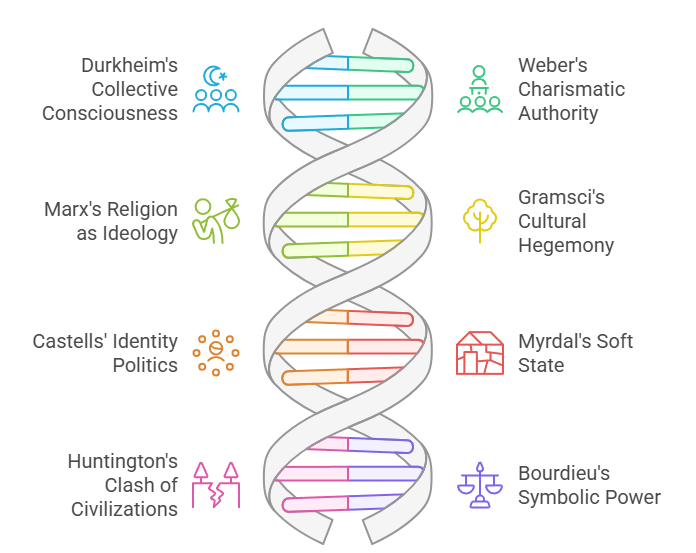
Durkheim and Collective Consciousness: According to Emile Durkheim, religion is a source of collective conscience. However, when societies undergo rapid change, this shared morality may become rigid. Fundamentalism arises when people cling to religion to regain a lost sense of order and moral community.
Weber and Religious Authority: Max Weber’sconcept of charismaticauthority helps explain how fundamentalist leaders gain followers by portraying themselves as divinely guided. Such leaders often emerge during times of social disruption, offering certainty and purpose to anxious populations.
Religion as Ideology: Marx viewed religion as the “opium of the people”—a tool used by ruling classes to suppress dissent. Fundamentalism, in this lens, serves reactionary class interests, preventing the poor from challenging their material exploitation by focusing on religious salvation.
Cultural Hegemony: Antonio Gramsci’s idea ofcultural hegemony shows how dominant ideologies, like fundamentalism, maintain power by shaping the moral and intellectual life of a society. In India, right-wing cultural nationalism has tried to define patriotism in religious terms, marginalizing dissent.
Identity Politics: In an age of globalization, Manuel Castells argues that people seek identity in closed groups—be it religion, caste, or region. Fundamentalism offers a sense of belonging in a rapidly changing world where traditional values feel threatened.
Soft State: Gunnar Myrdal’s idea of a “soft state” explains how India’s weak enforcement of secular principles allows religious extremists to operate with impunity. The lack of consistent state action fuels the growth of parallel moralities and vigilante groups.
Clash of Civilizations: Samuel Huntington predicted that post–Cold War conflicts would be driven by civilizational identities, especially religion. The global rise in Islamic and Christian fundamentalism and India’s own communal tensions reflect this shift from ideological to cultural conflict.
Symbolic Power: Pierre Bourdieu’s idea of symbolic capital shows how religious symbols and rituals are politicized. For example, wearing specific clothing, chanting slogans, or temple visits become markers of loyalty, and those who differ are labeled anti-national or unfaithful.
Implications of Fundamentalism
Threat to Democracy: Fundamentalism undermines pluralism, suppresses dissent, and fuels majoritarianism, weakening democratic institutions.
Gender Repression: It often promotes patriarchal values and curbs women’s rights, from education to mobility and reproductive freedom.
Rise in Violence and Polarization: Hate crimes, mob lynchings, and riots become tools to impose moral or religious dominance.
Collapse of Secular Ethos: Fundamentalism erodes the constitutional ideal of secularism, replacing civic identity with religious identity.
Hindrance to Education and Science: It opposes rational thought, promoting dogma and often pressuring educational institutions to revise textbooks or syllabi based on faith-based narratives.
Policy Recommendations and Way Forward
Strengthen secular education that fosters critical thinking and constitutional values.
De-link religion from politics through strict implementation of electoral laws.
Promote inter-faith dialogue and community-based peacebuilding.
Empower civil society to resist hate speech and religious dogma.
Reform religious institutions to promote inclusivity, especially for women and minorities.
Utilize media literacy programs to counter radical narratives online.
Conclusion
Fundamentalism is not just a religious or political challenge—it is a sociological crisis of modernity, identity, and coexistence. In a plural society like India, unchecked fundamentalism can hollow out democratic institutions and fracture civil society. A sociological understanding, rooted in empathy, rationality, and inclusiveness, is essential to counter the divisive narratives that fundamentalism thrives on. Aspirants must appreciate the complex interplay of culture, power, and belief systems, and work toward building an India that respects both diversity and constitutional unity.
PYQs
Paper 1 –
“Is religion losing its relevance in the modern world? Discuss.”– 2015
“Examine the role of collective consciousness in the development of religious movements.”– 2016
“What is the role of religion in contemporary society? Evaluate with reference to increasing religious fundamentalism.”– 2018
“Explain Emile Durkheim’s theory of religion. How does it help in understanding religious life in modern societies?”– 2019,
“Discuss the contribution of Max Weber in understanding the relationship between religion and economy.”– 2020
“Discuss how religious pluralism can contribute to both social cohesion and social conflict.”– 2021
“Explain the characteristics of social movements. How do they differ from religious revivals?”– 2023
Paper 2 –
“Discuss the role of state policies in addressing communal conflicts in India.”– 2015
“What are the major challenges to secularism in contemporary India?”– 2016
“Examine the causes and consequences of communal violence in India.”– 2018
“Analyze the impact of religious fundamentalism on Indian society.”– 2019
“Discuss the role of communalism in undermining the secular fabric of Indian society.”– 2020
“Discuss the challenges posed by religious extremism to national integration in India.”– 2020
“Discuss the resurgence of identity politics in the context of religion and ethnicity in India.”– 2021
“How do religious minorities in India negotiate their identity within a majoritarian context?”– 2022
“Critically examine the intersection of caste and religion in contemporary social movements.”– 2017
The blog provides a comprehensive overview of fundamentalism and its implications in modern society, particularl isn’t limited to religion—it can seep into politics and even secular ideologies, which is often overlooked. The sociological lens applied here really helps unpack its roots and implications in the Indian context. I’d be curious to hear more on how digital media is accelerating the spread of fundamentalist narratives in recent years.







The blog provides a comprehensive overview of fundamentalism and its implications in modern society, particularl isn’t limited to religion—it can seep into politics and even secular ideologies, which is often overlooked. The sociological lens applied here really helps unpack its roots and implications in the Indian context. I’d be curious to hear more on how digital media is accelerating the spread of fundamentalist narratives in recent years.