


Paving the Path to Gender Balance in India
(Relevant for GS paper-1, Gender Equality)

Gender balance in IndiaGender parity in India is both a social goal and an economic imperative. While India has made notable strides in education, political representation, and workforce participation, deep-rooted disparities remain. The journey toward gender equality is intertwined with constitutional reforms, safety infrastructure, economic policies, and societal change—making. Education: Boys and Girls Learning Side by SideIndia has achieved near-equal enrolment rates across school levels: 46–48% girls in pre-primary to higher secondary education. Importantly, girls now fill 28.5% of tertiary seats—slightly above their male counterparts at 28.3%. A powerful example of shifting norms: over 28 lakh girls passed Class 12 in science in 2024, compared to 23.3 lakh in 2022. While the foundation of gender parity in education is laid, challenges such as secondary school dropouts, vocational training gaps, and safety concerns remain. Policies like Udaan, Beti Bachao Beti Padhao, and investments in sanitation and transport are vital. Political Representation: Reserved Seats and Structural ChangeA landmark achievement is the passage of the Women’s Reservation Bill in 2023, constitutionally guaranteeing 1/3 of seats in Lok Sabha and state assemblies to women from the 2029 elections This move builds on the success of Panchayati Raj reservations since 1994, where women hold up to 50% of local governance seats. While these measures promise inclusivity and political empowerment, their effective rollout hinges on delimitation processes, sustained political will, and gender-sensitive institutional cultures.. Workforce & Economic Empowerment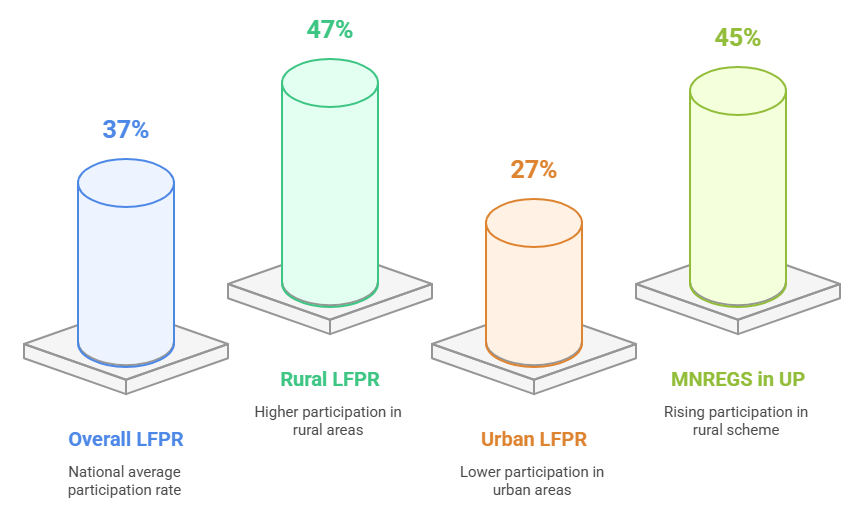 Despite educational gains, women’s labour force participation (LFPR) remains weak—approximately 37% as per PLFS 2022–23. Rural participation (~47%) significantly outpaces urban levels (~27%), largely propelled by informal agricultural and family work. Urban women face hurdles, including gendered wage gaps (33%), disproportionate unpaid care work (9.8x that of men), safety issues, and mobility constraints. Government initiatives—such as PM Mudra Yojana (with 69% female loan recipients), Mahila e-Haat, skill centres, and fiscal support like working women hostels and crèches in the Budget 2025–26—seek to activate women’s economic role. On the ground, rural schemes like MNREGS in UP show rising female participation (45% in 2025 Q1). Yet deep structural issues—low pay, informality, poor social protection, and gendered responsibilities—continue to suppress LFPR and economic freedom. Safety & Legal Reforms
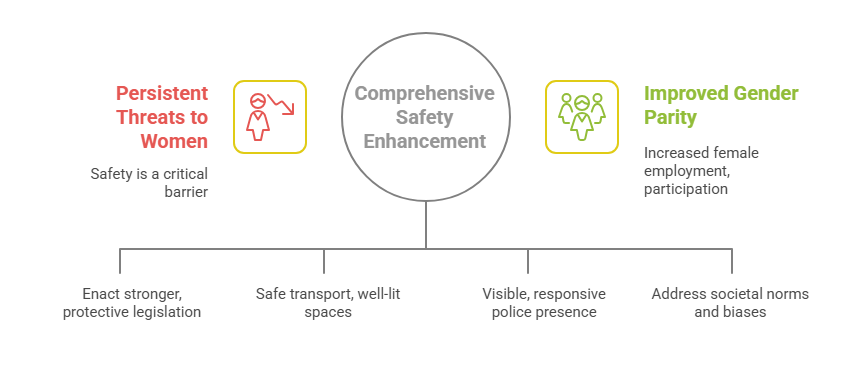
Safety and security are foundational to girls’ and women’s empowerment. Tragic incidents like the rape of a trainee doctor in Kolkata in 2024—sparking nationwide protests—reveal persistent threats to women’s mobility and workplace engagement. Data shows a rape occurs every 16 minutes, reinforcing that safety is a critical barrier to female employment and social participation. India ranks 131st out of 148 on the 2025 Global Gender Gap Index, with a parity score of just 64.4%. Despite marginal score improvements, India slipped from 129th rank in 2024 due to greater progress elsewhere. Enhancing women’s safety requires legal reforms, public infrastructure (safe transport, well-lit public spaces), effective police presence, and attitudinal change—not merely new laws. Care Economy: Support with Systemic ChangeA key unlocker of gender parity is the care economy—childcare, eldercare, and healthcare—that bears disproportionate burdens on women. IMF data suggests investing just 2% of GDP in the care sector could generate 11 million jobs and raise GDP by 27%. Yet these sectors remain underdeveloped in public policy, forcing women to downsize careers or exit the workforce. Governmental gender-budgeting has reached 8.9% of total expenditure—an all-time high for 2025–26—but much allocation remains non-gender-specific. Financial empowerment is also growing: women now hold 39% of bank accounts and new Demat account growth quadrupled from 6.7 to 27.7 million between 2021 and 2024. Still, labor transition depends on aligning care policies, skill development, financial inclusion, and social safeguards. Entrepreneurship & LeadershipWomen-led start-ups and enterprises are gaining momentum. Start-ups featuring women directors grew from 1,943 in 2021 to 17,405 in 2024. Programs like Stand-Up India, PMEGP, and Mudra provide access to credit and support. However, systemic hurdles remain in leadership pipelines. Women occupy only ~18% of corporate board seats (against global average 23%), and female leadership at the ministerial level stands below 10% . Way Ahead: A Comprehensive Approach
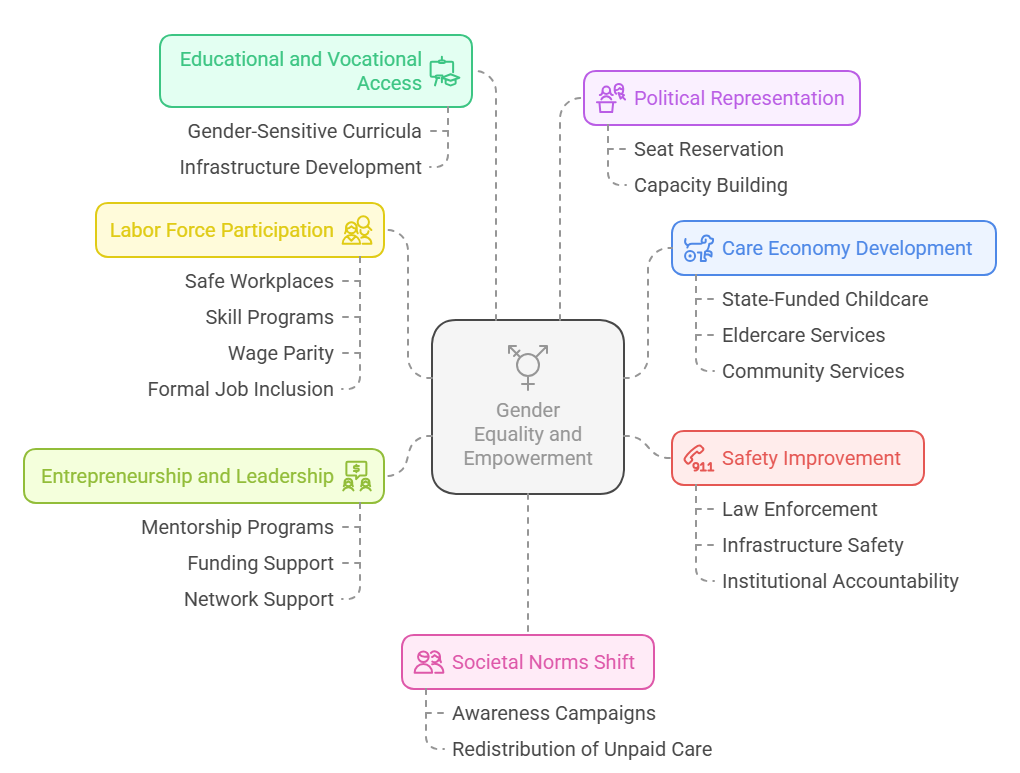
To achieve substantive gender parity, India needs intersectional reforms across multiple domains:
ConclusionIndia’s journey toward gender parity reveals promise and gaps—education at near parity contrasts sharply with political, economic, and safety deficits. Landmark policies and rising grassroots trends co-exist with regressive societal structures and security concerns. The synthesis of political representation, care economy investment, economic empowerment, and cultural transformation offers a nuanced pathway ahead. For UPSC aspirants, this theme integrates core domains—Constitutional design, democratic deepening, sustainable growth, social equity, and ethical governance—making “India’s Road to Gender Parity” an essential policy narrative with global ambitions. |





To Read more topics, visit: www.triumphias.com/blogs