(Relevant for Sociology Paper 1: Social Change in Modern Society and Sociology Paper 2:Systems of Kinship in India; Challenges of Social Transformation)
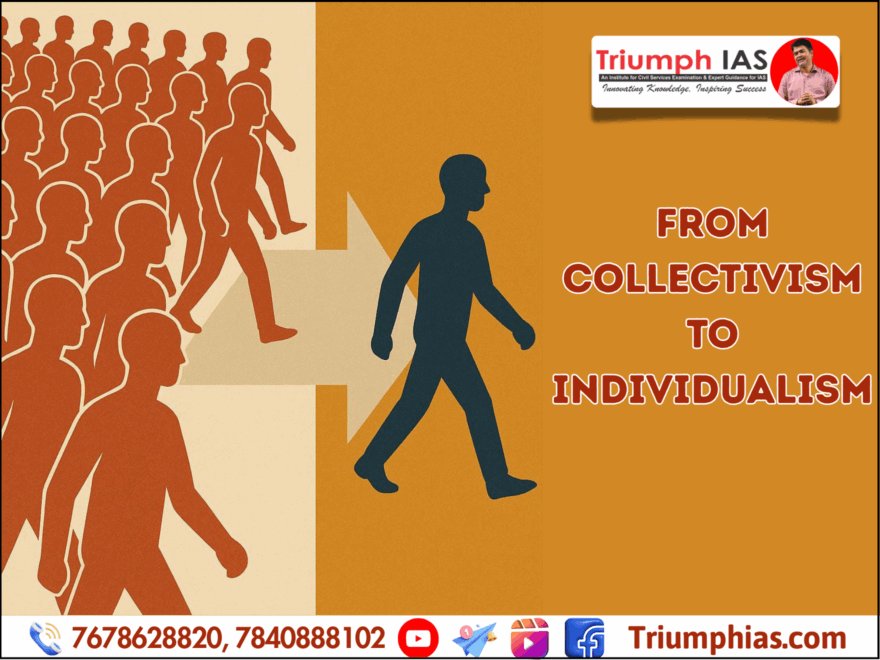
India’s social landscape is undergoing a profound transformation—from a traditionally collectivist ethos rooted in joint families, community living, and shared identity to a rising wave of individualism characterized by personal freedom, self-expression, and nuclear family preferences. This transition is not merely cultural—it is sociological, deeply intertwined with urbanization, globalization, digitalization, and economic liberalization. This shift raises crucial questions for students of Sociology: How is individualism altering social relations, and what are its implications for institutions like family, marriage, and community?
Current Scenario and Trends
Data & Indicators
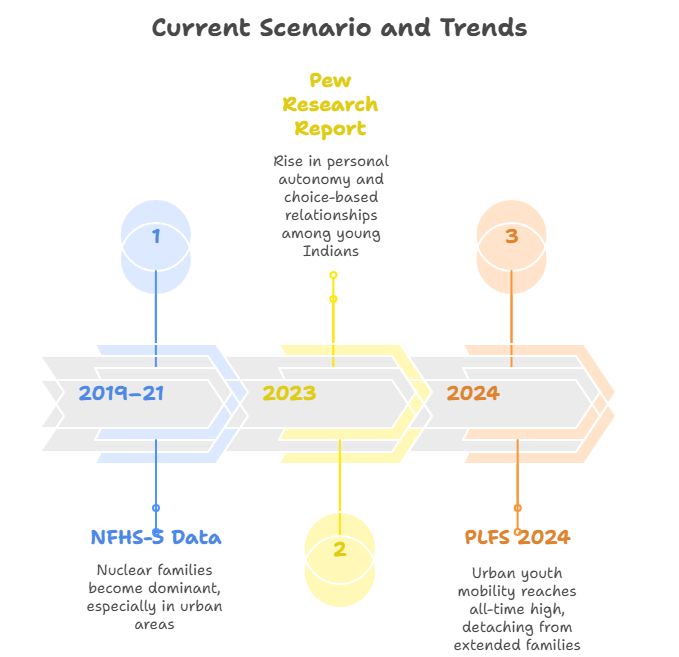
National Family Health Survey (NFHS-5) (2019–21) shows that nuclear families have become the dominant household type, especially in urban areas.
According to the Periodic Labour Force Survey (PLFS) 2024, urban youth mobility is at an all-time high, leading to detachment from extended family systems.
A 2023 Pew Research report on India noted a significant increase in personal autonomy and choice-based relationships among Gen Z and millennials.
Sociological Analysis:
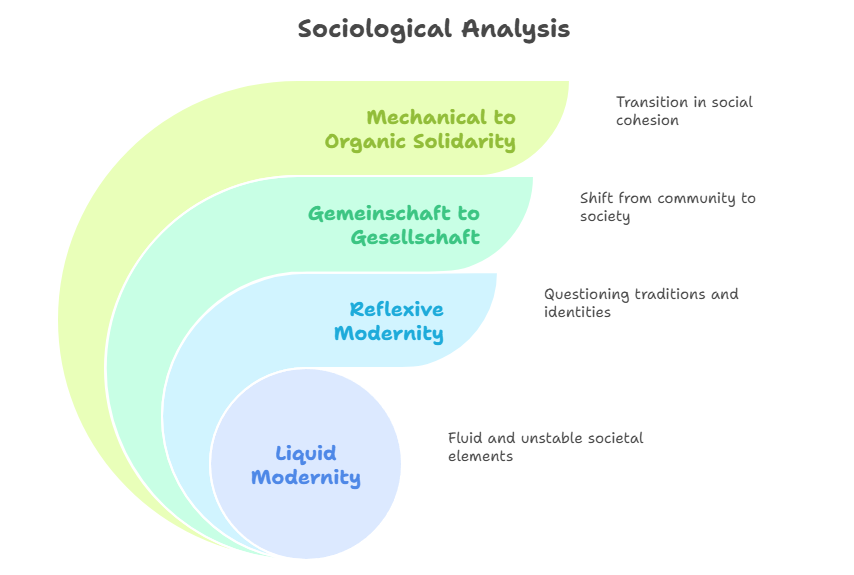
Mechanical vs Organic Solidarity: Durkheim observed that traditional societies (like pre-modern India) exhibited mechanical solidarity, where individuals were bound by shared values and collective conscience. Modern India, however, is drifting towards organic solidarity, with individuals performing specialized roles and social ties becoming more contractual and impersonal.
Gemeinschaft to Gesellschaft: Ferdinand Tönnies’ concepts reflect this shift well. Gemeinschaft (community) characterized by emotional bonds and loyalty is giving way to Gesellschaft (society)—a rational, individualistic association based on personal interests, typical of urban India.
Reflexive Modernity: In the age of reflexive modernity, individuals increasingly question traditions, negotiate identities, and make lifestyle choices based on self-reflection. Anthony Giddens’ theory explains why arranged marriages, caste affiliations, and family expectations are being challenged in favor of personal preferences.
Liquid Modernity: Zygmunt Bauman’s idea of liquid modernity highlights how relationships, work, and values have become fluid and unstable. This applies directly to India’s gig economy, dating culture, and urban migration trends, where short-term goals often trump long-term commitments.
Examples from Indian Society
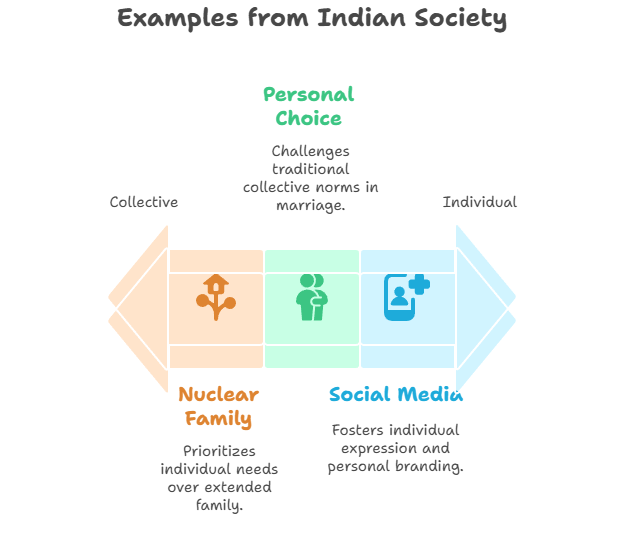
Rise of Nuclear Households: Migration to cities for education and employment has led to a rise in nuclear families. Over 70% of households in metro cities like Bengaluru and Delhi are now nuclear.
Digital Individualism: Social media platforms foster individual expression, redefining identity politics and community life. Platforms like Instagram and LinkedIn are now central to personal branding and social mobility, especially for the youth.
Personal Choice in Marriage: Inter-caste and inter-religious marriages are growing slowly but steadily. The 2021 India Human Development Survey (IHDS) found that 12% of marriages in urban areas are inter-caste, challenging collective norms.
Consequences of Individualism
Positives
Greater autonomy for women and youth
Rise in entrepreneurial spirit
Flexibility in career and personal growth
Erosion of regressive practices like forced marriage or rigid gender roles
Negatives
Elderly isolation and lack of intergenerational care
Mental health issues: loneliness, FOMO, and social anxiety
Erosion of community bonds, reduced civic participation
Consumerism and identity crisis
Way Forward:
Promote intergenerational living models with flexibility and privacy.
Encourage community participation via digital cooperatives or citizen forums.
Develop public mental health infrastructure to support urban youth.
Recognize and respect individual rights while nurturing collective well-being.
Conclusion
India is walking the tightrope between collectivist heritage and individualist aspirations. This sociological evolution reflects broader changes in economy, technology, and culture. The challenge lies in finding a balance—where individual freedom doesn’t erode social cohesion, and where personal growth is harmonized with community care.
Previous Year Questions
Paper 1 –
Discuss the impact of modernization on social institutions in India. (2015)
Explain how sociology has contributed to our understanding of the relationship between individual and society. (2017)
Describe how Emile Durkheim’s concept of division of labour helps us understand the shift from mechanical to organic solidarity. (2019)
Critically examine the relevance of the concept of alienation in the contemporary world. (2023)
Explain how individualization, as discussed by Ulrich Beck or Anthony Giddens, is shaping personal identities today. (2024)
Paper 2 –
Discuss the changing nature of the Indian family in the context of industrialization and urbanization. (2014)
Examine how the processes of globalization and liberalization have impacted social values and institutions in India. (2016)
Explain the factors responsible for the rise of nuclear families in contemporary India. (2017)
Discuss how the rise of individualism is affecting traditional marriage systems in Indian society. (2019)
Explain how urbanization has led to the decline of community living and emergence of individual-centric lifestyles in India. (2020)
How are youth in India negotiating tradition and modernity in the era of social media and digital culture? (2021)
Discuss the role of education and economic independence in shaping the aspirations and choices of Indian youth. (2023)
How does the rise of consumer culture reflect a shift from collective identities to individualized choices in Indian society? (2024)








One comment