In the last decade, the feminist movement has evolved beyond the struggle for equal wages or representation — it has become a deeper critique of patriarchal, capitalist, casteist, and heteronormative structures. From #MeToo to the rise of Dalit and queer feminist voices, the decade has witnessed both progress and backlash. Feminism continues to demand not “special treatment,” but equal dignity, autonomy, and justice.
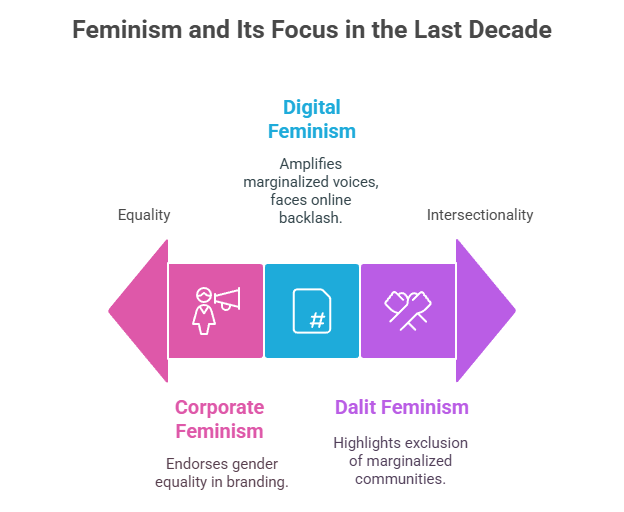
Feminism and Its Focus in the Last Decade
From Equality to Intersectionality: Modern feminist discourse recognizes that gender is not a standalone axis of oppression. Feminist scholars and activists have adopted an intersectional approach to examine how gender discrimination overlaps with caste, class, sexuality, and disability. Example: Dalit and Adivasi feminist voices like Thenmozhi Soundararajan and Sukumari Bhaskar have highlighted that mainstream feminism often excludes marginalized communities.
Digital Feminism and Online Backlash: Social media has become both a tool and a trap. Movements like #MeTooIndia allowed survivors to speak out, but also led to online harassment, doxxing, and threats, especially targeting outspoken feminists from marginalized communities.
Corporate Feminism vs Radical Feminist Demands: While companies endorse gender equality in branding (e.g., SheLeads, Pink-washing campaigns), they often sidestep structural change. Example: Companies publicly supported #MeToo, but many failed to take concrete action against powerful perpetrators or improve workplace grievance mechanisms.
State Policies for Women
Several schemes have been launched in India to improve women’s welfare:
Beti Bachao, Beti Padhao (2015)
Pradhan Mantri Ujjwala Yojana (2016)
Sukanya Samriddhi Yojana
While these programs address material needs, they rarely challenge underlying patriarchal norms, such as son preference, female seclusion, or unpaid domestic labor.
Critique: These are often developmentalist approaches rather than transformative feminist interventions.
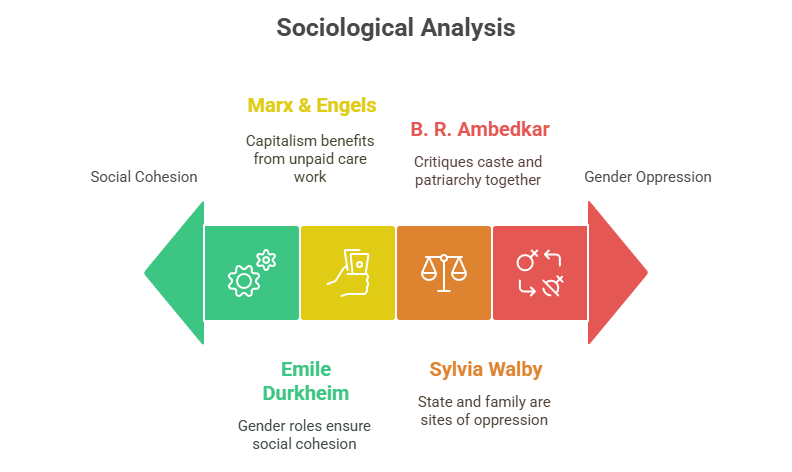
Sociological Analysis
Emile Durkheim: He would view gender roles as part of the social structure ensuring cohesion, but feminism critiques how this structure disadvantages women.
Karl Marx & Friedrich Engels: Feminist economists draw from Marxist analysis, showing how capitalism benefits from unpaid care work, especially done by women.
Sylvia Walby: Her theory of public and private patriarchy is relevant in analyzing how both the state (laws, policies) and family (norms, traditions) are sites of gender oppression.
B. R. Ambedkar: He warned that caste and patriarchy go hand in hand. His writings laid the foundation for Dalit feminism, which critiques both Savarna feminism and Brahminical patriarchy.
Voices of the Margins
In the last decade, new leadership in feminism has emerged:
Transgender activists like Grace Banu and Living Smile Vidya challenge the gender binary.
Young Dalit feminists are breaking silence around caste-based sexual violence.
Adivasi women are resisting displacement and ecological destruction through a feminist lens.
Their activism marks a decentralization of feminist discourse, emphasizing community-driven and inclusive strategies.
Backlash and the Rise of Men’s Rights Groups
Parallel to feminist progress, there has been a resurgence of patriarchal backlash:
Men’s rights groups claiming “reverse discrimination”
Troll armies targeting outspoken feminists
Normalization of misogynistic content on social platforms like YouTube and Instagram
This pushback reveals the threatened status quo — proving that feminism is, in fact, shaking up established power dynamics.
The Way Forward
Decolonize and Decaste Feminism – Include more Dalit, Bahujan, Adivasi, queer, and disabled voices.
Reform Institutional Mechanisms – Strengthen laws, workplace policies, and grievance redressal for women.
Expand Feminist Research – Support gender-based research in areas like labour economics, urban planning, and public health.
Educate for Gender Equality – Integrate gender studies in schools and universities beyond token workshops.
Conclusion
Feminism in the last decade has gone from demanding access to seats at the table to questioning who built the table and whom it serves. While strides have been made in visibility and awareness, real empowerment will only come when patriarchal structures are dismantled, not merely decorated. A feminist future is not a “women’s issue,” it is a justice issue — and it belongs to us all.
PYQs
Paper 1
Write a note on ‘patriarchy’. [2022]
How is gender equality addressed in the work of feminist sociologists? [2021]
Distinguish between sex and gender. How do gender roles get socialized? [2020]
Bring out the significance of the feminist methodology in sociological research. [2019]
How do intersectionality and standpoint theory enrich feminist understanding of society? [2018]
Write short note: Feminization of poverty. [2016]
Explain how gender relations are embedded in the structure of kinship. [2015]
Evaluate the contribution of Sylvia Walby to the understanding of patriarchy. [2014]
Paper 2
How successful have the government initiatives been in promoting gender equality and women’s empowerment in India? [2023]
Discuss the emergence and growth of Dalit feminism in India. [2022]
Examine the changing nature of women’s movements in India in the context of social media activism. [2021]
Critically examine how the intersection of caste and gender impacts access to education and employment for Dalit women. [2020]
Discuss the sociological factors behind the declining female labour force participation in India. [2019]
Evaluate the role of the state in addressing violence against women in India. [2018]
Examine the role of women in environmental movements in India. [2017]
Analyze the impact of globalization on women’s status in India with suitable examples. [2015]
Discuss the role of Indian legislation in addressing gender-based discrimination. [2014]












One comment